
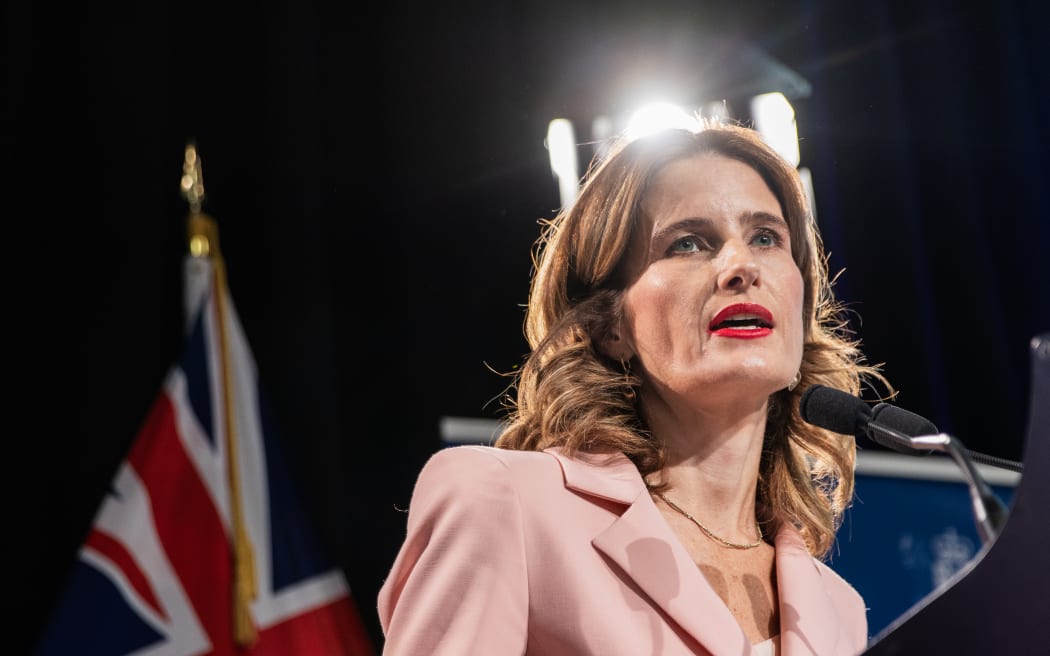
Finance Minister Nicola Willis
Photo: RNZ / Samuel Rillstone
In the absence of an eye-catching, big-spending policy in Nicola Willis’s third Budget, the headline was a surprise return to surplus in 2028/29. How did she do it?
Willis pointed to “tough decisions” and “careful management” of public finances. But the cutting – or reprioristing – of spending needed an assist from Treasury’s models to land the early surplus boast.
Those models are only as good as the numbers that go into them. And “numbers can always change,” Willis said.
Back in black
After the global financial crisis in 2008, a ‘decade of deficits’ was predicted. In successive Budgets, then Finance Minister Bill English trimmed back the date of a return to surplus and the books were ‘back in black’ by 2015.
There is no such luck for Willis. The projected return to surplus of 2028/29, if it transpires, will be the first since 2020. Late last year, it was looking more like 2029/30. Getting back to 2028/29 in the context of a fuel and cost of living crisis was unexpected.
Some commentators were quickly suggesting it was founded on “heroic” assumptions. It sure looks like a steep climb back to surplus.
The predictions that inform such a sharp turnaround span economic growth, inflation, the tax take and job creation.
Economic growth spurt
Almost as sharp as the turnaround of the government accounts is the predicted rise in Gross Domestic Product (GDP). Treasury thinks the economy will have grown by 1.2% in the year to June, improving to 2.3% in the year to June 2027, and 3.2% in the following year.
Even though there was no Middle East conflict or fuel crisis at the time of the last Budget, these predictions are only a little more restrained than 12 months ago.
This is where the ‘heroic assumptions’ allegation comes in. War in the Middle East will end, it’s assumed. Oil prices will fall and the recovery will get underway, it’s assumed. The booming export trade in primary products will continue, it’s assumed.
Or, as Willis says, the numbers could change.
Unemployment easing
The inverse of the economic growth prediction is a declining unemployment rate. The forecast here is notably changed from 12 months ago.
The unemployment rate will continue to rise to 5.5% this year, it’s predicted, before falling by half a percentage point per year in the following two years.
The return, and hasty retreat of inflation
The unwanted return of inflation – and the outsized impact it could have on everything – is a feature of the forecasts. It’s not really news that Treasury expects a jump as high as 4% this year. But the ‘heroic assumptions’ claxon sounds again when it suggests a quick decline back to 1.6% inflation in 2027.
Fuel prices will account for one of the four percentage points of inflation expected to show up in the June quarter this year, Treasury says. But falling oil prices and weaker economic growth will get inflation back down fast. Here’s the caveat, again: “The outlook remains subject to a high degree of uncertainty,” Treasury says.
The brighter economic days to come underpin a suite of better-looking predictions for the government’s revenue, spending, and borrowing.
A growth spurt equals a revenue spurt
Some commentators have expressed sympathy for Willis as luckless, because she’s never got to enjoy a surprise overshoot of revenue, above forecast. It’s a dangerous mirage to chase but Treasury is dangling the carrot a bit in this set of predictions.
Courtesy of its expectations of strong economic growth, revenue is expected to climb by $800m next year, then start leaping by $2b in 2028 and $3.2b in 2029. These would be very important contributions when a $2.6b surplus is booked for 2028/29.
“The Government has always said it would not over-react to changes in fiscal forecasts,” Willis said.
“So upside revenue surprises … will contribute to reducing the deficit. On the other hand, downside revenue surprises will not necessitate a sharp spending reduction.”
Debt will remain historically high
When governments don’t make “sharp spending reductions” in response to hits on the tax take, the gap is made up with borrowing.
The result, for Willis, is debt as a percentage of GDP continuing to climb for the next three years – from a predicted 42.2% this year, to 45.6% next year, to 46.1% in 2028. It is expected to decline after that, but by the end of the decade, it’ll still be notably higher than it is now – and more than double what it was prior to the pandemic.
And spending marches on
The spending curve reveals, in a zoomed out kind of way, very little changed from the last Budget. On a closer look, of course, there are big reallocations of cash from one place to another (there’s more on the detail of spending below).
Spending as a whole marches on, but again, those predictions of strong economic growth support a story more to the government’s liking. When its spending is viewed as a proportion of GDP, it more or less stands still at 32.6% this year and next. It bends down after that, to 31.5% in 2028, and 30.7% in 2029.
“Tight operating allowances in future Budgets are a key factor in this reduction,” says Willis.
The biggest contributor to that tightening, in this Budget, is the public service ‘transformation’ plan, which bring significant cuts to several agency baselines.
How the spending breaks down
So much for the agencies, the projections and the assumptions, what is the government planning to actually spend on? The chart below drills into the detail when you click or tap on a label.
Sign up for Ngā Pitopito Kōrero, a daily newsletter curated by our editors and delivered straight to your inbox every weekday.