
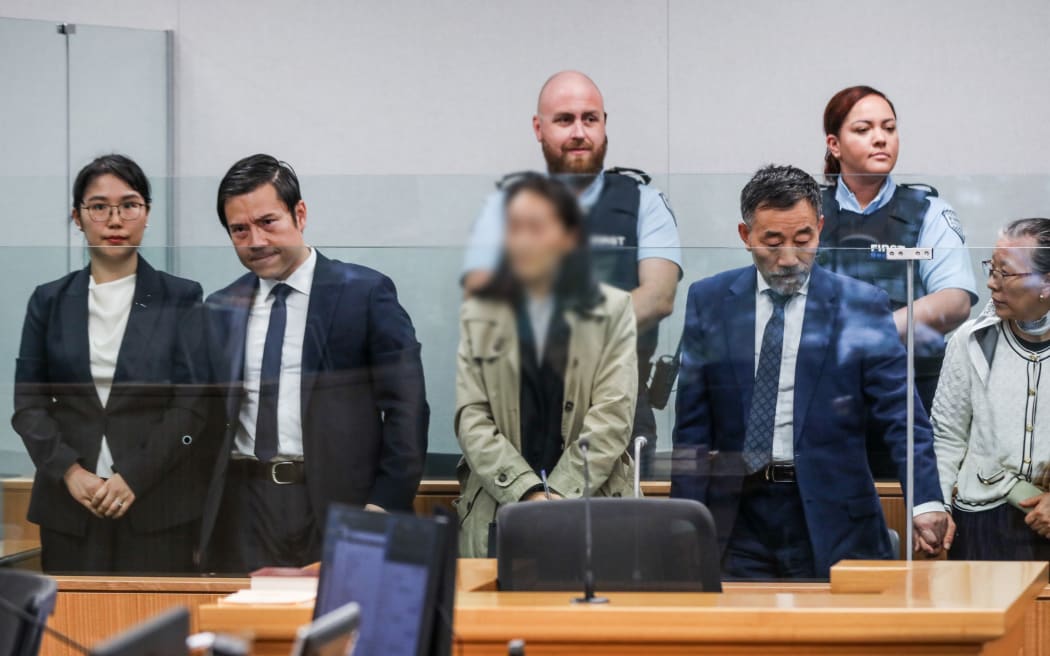
(From left) Lanyue Xiao, Kaixiao Liu, an interpreter, Jingui Liu, Xiuyun Li in the Auckland High Court.
Photo: RNZ / Marika Khabazi
Rice bags filled with stones and reports of “very thin” women at an Auckland Orewa house were evidence and scenes presented to a jury in the kidnapping and manslaughter trial of Shulai Wang.
A medical surgery kit and a Portacot wrapped in a black plastic bag were among other items found in the house.
The house is where the Crown believes 70-year-old Wang spent her last days before her body was found in Auckland’s Gulf Harbour.
The Crown said Wang travelled to New Zealand from Hainan Island in China to seek religious instructions from Kaixiao Liu in August 2023, and that she was one of six women who stayed with Liu’s family.
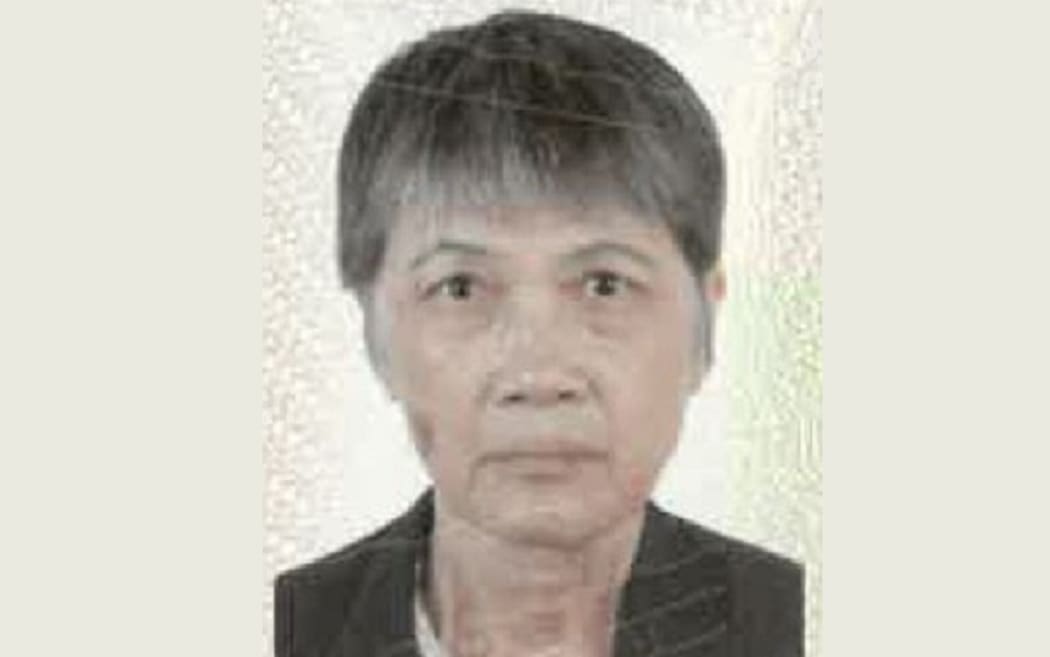
Shulai Wang.
Photo: Supplied / Police
Eight months later, her body was found wrapped in rubbish bags, with two SunRice rice bags tied to her which contained more than 15kg of garden stone.
Kaixiao Liu, his wife Lanyue Xiao and his parents Xiuyun Li and Jingui Liu have each denied the kidnapping and manslaughter of Wang.
The Crown says Wang was starved and punished for breaking the rules of the group, and was bound in tape after a failed escape attempt.
Today, the jury of 12 was also reduced to 11. One member of the jury has been discharged by Justice Mathew Downs for reasons that were suppressed by the judge.
Jury sees evidence exhibited
Wang’s body was unidentified for months, but “Operation Parade” eventually traced serial numbers on the rice bags on her to a purchase of more than 18 bags of rice by Kaixiao Liu and the house he paid rates for on Harvest Avenue, Orewa.
The jury at Auckland’s High Court was taken through images of the house which was first searched by police on 1 July 2024, a day after Kaixiao Liu and his wife Xiao were arrested at the airport.
On Wednesday, Justice Downs declined all media applications to publish images from the exhibits.
Evidence from Detective David Sanders, who was the first to oversee the search of the house, showed bags of SunRice rice bags filled with stones, similar to the rice bags and stones found on Wang.
‘Concern’ for women at house
Further evidence from Detective Beth Bates, who took over from Sanders, showed images of a rooftop garden, a walk-in closet with recording equipment, and sleeping arrangements in the five-bedroom house which police believed had housed 14 people – including the defendants’ four children.
Bates said upon arriving, she saw that three of the adult women in the house looked “very thin” and were wearing multiple layers of clothing.
She said they looked tired and a bit dirty.
Bates told the jury she was concerned for these women, and arranged for a Mandarin-speaking doctor to examine them, but the women declined.
She said one of the women she tried to talk to through an interpreter just “smiled and rocked back and forth”.
This woman, whose name is suppressed, later told another detective that she had come to New Zealand with someone “who is no longer here”.
Based on this woman’s arrival date in New Zealand, Bates said she had contacted Customs to find out who had accompanied that woman to New Zealand – and that was confirmed to be Shulai Wang.
Bates confirmed this was the first time police became aware of this name and that this may have been the identity of the person they had been seeking to identify since the discovery at Gulf Harbour.
A woman at the house: three meals a day, other occupants of the house were friends
Detective Sergeant Nian Zhou also gave evidence on Thursday, being the one who spoke to the women whose revelation led police to Wang.
Zhou said the woman initially didn’t engage, but subsequently answered when he asked about their daily lives at the house.
“They mentioned about they had three meals every day, mainly rice.
“Occasionally they had meat, eggs to eat. Her daily routine is walking around the garden and stayed inside the house, but sometimes, they come out as well,” he said.
During cross-examination, Kaixiao Liu asked Zhou if he’d heard from the woman that she had found a place she could live.
Zhou said the women told him she met people over the internet – a music website – and she referred to the occupants of the house as friends.
Liu also asked Zhou if the woman spoke of being persecuted by her own family, to which Zhou said no.
Quentin Duff, Xiao’s standby lawyer, asked Zhou if the woman ever spoke to him about her experiences with authority figures before coming to New Zealand.
Zhou said no.

Police at Gulf Harbour in March 2024.
Photo: RNZ / Nick Monro
She said the other women in the house, including Kaixiao Liu’s mother Xiuyun Li, all refused to engage with police.
Earlier, the jury heard that the five women in the house who followed Liu’s teachings had all overstayed their visas by more than 42 days, and were deported in August 2024.
Photos of the house showed a room where three of the five women slept, and Bates said two of the women slept in the lounge on camp beds.
Medical surgery kit, portacot in black plastic bag, handwritten notes found at house
A detective responsible for compiling exhibits of items found during the search the defendants’ home on Harvest Avenue, said a tent on the deck of the house had contained a portacot in a black plastic bag, mattresses and a pram.
The jury was also shown images of a black rubbish bag found in the garage of the house, which contained a hat, a water bottle and a singlet.
Detective Joshua Symes said the white singlet was similar to the one found on the deceased.
Syme’s evidence showed handwritten notes, diaries and notebooks were also found in various places in the house.
A medical surgery kit and two stethoscopes were found inside a walk in wardrobe.
Earlier the court heard evidence from detective Lauren Hecny that immigration records showed the defendant Xiuyun Li – Kaixiao Liu’s mother – practiced as a doctor in China for 37 years.
Crown lawyer Emma Kerr said in her opening on Monday that Wang’s punishment included being locked in a tent outside the house.
She said the tent had probable blood staining, and that the base of the cot was also stained with blood.
The trial continues.
Sign up for Ngā Pitopito Kōrero, a daily newsletter curated by our editors and delivered straight to your inbox every weekday.