
A mysterious new kind of celestial object discovered by the James Webb telescope just inched closer to reality, a new study reports.
Looking within a large stellar nursery in the southern sky, astronomers found two pairs of “rogue” Jupiter-like objects that are similar to mysteriously paired planets that the James Webb Space Telescope (JWST) previously discovered. The planet pairs — which tumble through space, seemingly untethered to any star — dwell in a different part of the Milky Way than JWST’s initial discoveries, suggesting that the enigmatic objects truly are a new kind of object. However, further observations are still necessary for confirmation.
You may like
A jumbo-size mystery
A new type of object?
What to read next
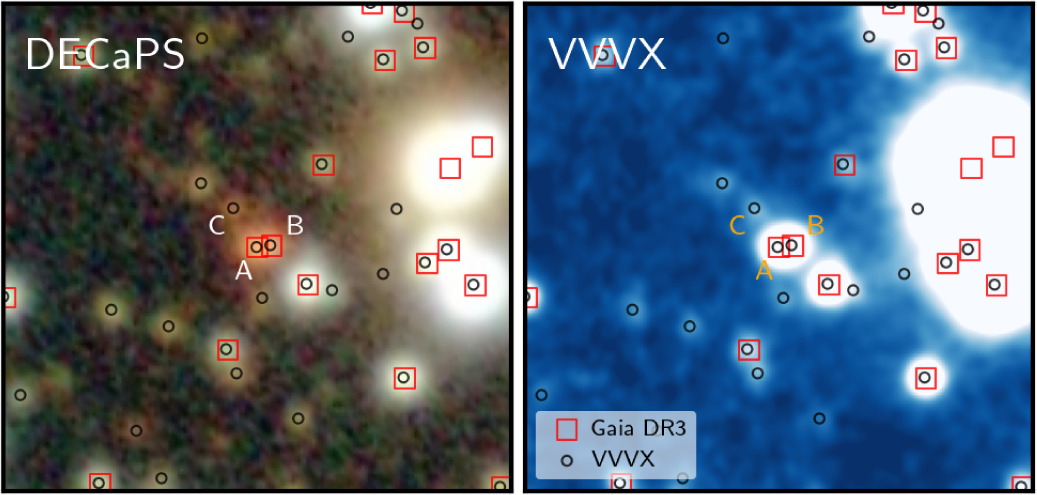
One of the newly discovered Jupiter-size planet-like object pairs, as marked by the letters A and B. (C refers to a possible third member of this group whose membership remains very tentative.) The left panel is from the archival infrared snapshots by the Visible and Infrared Survey Telescope for Astronomy, while the right is from visible-light images by the Gaia telescope.
(Image credit: Cáceres et al. (2026))
Cáceres, C., Minniti, D., Mejías, A., Gomez, M., Alonso-García, J., Ivanov, V., Pullen, J., Saito, R., Smith, L., Solano, E., Beamín, J., Rojas-Bozza, D., Soto, P. and Zelada, R. (2026). Discovery of Planetary-Mass Binaries in the Lower Centaurus-Crux association. Astronomy & Astrophysics, 708, A378. https://doi.org/10.1051/0004-6361/202347673
TOPICS