
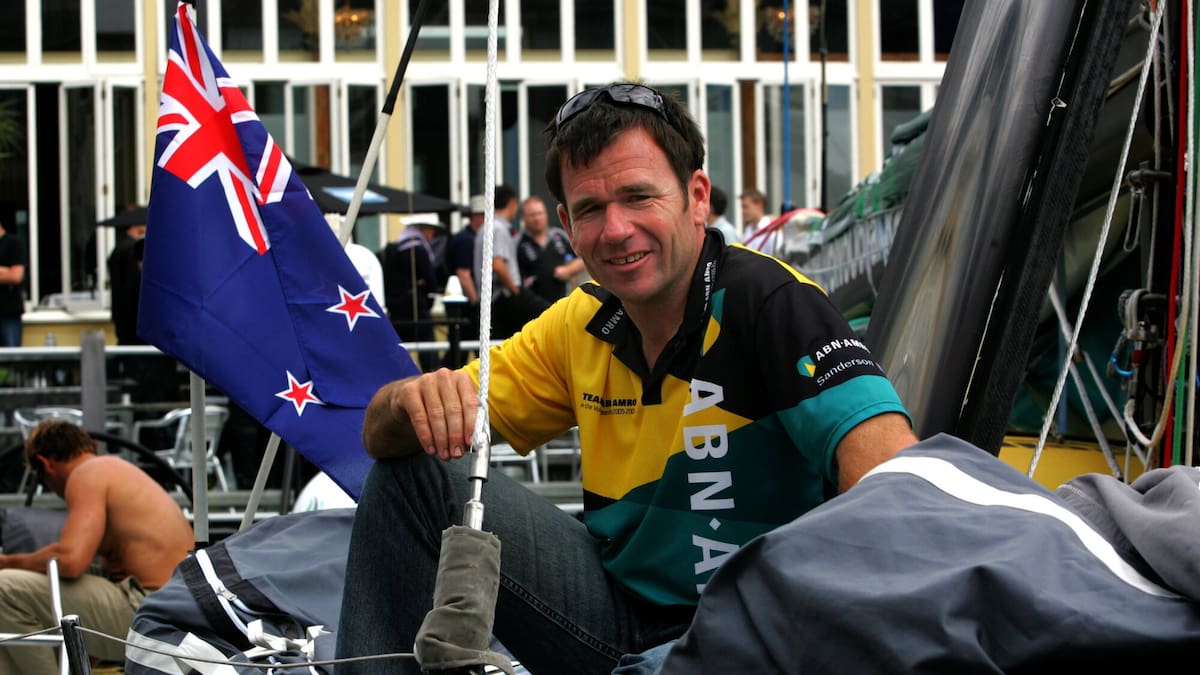
But it was in the 2005-06 edition, which had by then been renamed the Volvo Ocean Race, that Sanderson made a name for himself as he became the youngest skipper to win the famed race around the world at just 35 years old.
His ABN Amro I crew officially had the win wrapped up on arrival into Portsmouth, which was the third-to-last leg of the event.
“When we finished and won the race in England, which was the leg as to which we won the race when I was the skipper, I was famously quoted as saying it was my Mount Everest, it was my Olympic gold medal. It really was. It’s what I wanted to do, so the race has been a huge part of my life.” Sanderson tells the Herald.
It was an emotional leg of the race for Sanderson. Arriving in the UK first meant he had won the race and he was due to get married during the stopover, but the team were also dealing with the death of 32-year-old Dutch sailor Hans Horrevoets. Horrevoets was competing as part of the young ABN Amro II crew and was swept overboard. While he was recovered by the crewmates, he could not be resuscitated.
“When we came in to finish the leg into England, I mean it was just the most unbelievable rollercoaster of emotions,” Sanderson says.
Moviestar, skippered by Bouwe Bekking, narrowly leads ABM Amro I, Mike Sanderson, into Wellington Harbour in a close race for the finish of leg three. Photo / Mark Mitchell
Reflecting on his career competing in the race, Sanderson says there were plenty of lessons he took from his time on the ocean, but one thing always held true.
“I’m a huge believer [in] if you line up all the people that are in your team and you line them up against all the other teams, I think the best team has always won this race,” he says.
“The lesson which I worked out in my youth with it and then took into success and then have since taken into business and things is it’s 100% just a people game. And if you’ve got better people and you can give them the resource and the support, then that breeds success.
“In business, you talk about meeting budgets and bits and pieces and you talk about risk management and all these sort of things, but you know, 2 in the morning in the Southern Ocean, you want to be risk management, you want to be the guy driving while you’re looking after the guy up the mast. For me, an event like this is like everything exaggerated a thousand times.”
The Ocean Race will return to New Zealand in early 2027 for the first time in almost a decade.
When the fleet depart Spain in mid-January, they will be immediately faced with the challenge of completing the longest opening leg in the 53-year history of the race – a 14,000 nautical mile (25,928km) run that will see them travel on the Atlantic Ocean to the west of Africa before sailing on the Southern Ocean below Australia and arriving in New Zealand.
The fleet looks a little different now to the vessels that Sanderson raced on, with the Ocean Race being contested on foiling IMOCA boats – 18m (60ft) high-performance ocean racing monohulls capable of speeds exceeding 30 knots.
While entries into the race are yet to be confirmed, there are hopes for a boat sailing under the New Zealand flag, with Conrad Colman looking to lead a Kiwi team around the world.
Sanderson says it will be great to see another boat competing under the New Zealand flag, but there are challenges that come with getting that off the ground.
“It’s really hard to answer because the problem is New Zealanders expect results. So whilst I really love the fact he’s having a go to get it off the ground, New Zealanders are used to winning in this event,” he says.
“So, it’s tough because, right now, he hasn’t got the ingredients to win the race. It’s a real chicken-and-egg situation, isn’t it? Is he capable of winning it? I have no doubt. But … you’ve got to have the people, you’ve got to have the money, you’ve got to have the time and he’d be probably the first to admit he doesn’t have the ingredients in place. So it’s super tough.”
The Ocean Race is returning to New Zealand with support of up to $4 million in funding from the Government’s Major Events Fund. The fleet are expected to arrive in Auckland on February 20-21 and depart on March 20.
“There’ll be a range of things that those costs cover, but we want to stage an amazing event to again demonstrate that it’s a perfect decision to stop over here and to do the longest stopover here,” Tourism and Hospitality Minister Louise Upston said.
“If I think about seeing just literally 10 people deep on some of these piers when the Ocean Race has come in in years gone by, and one of the things that the teams have commented on time and time again is the amazing welcome they get into Auckland and New Zealand. That is incredibly memorable. Auckland, New Zealand turns on an incredible welcome for these teams and that’s what we do so well and I know we’ll do incredibly well again next year.”
Christopher Reive joined the Herald sports team in 2017, bringing the same versatility to his coverage as he does to his sports viewing habits.