
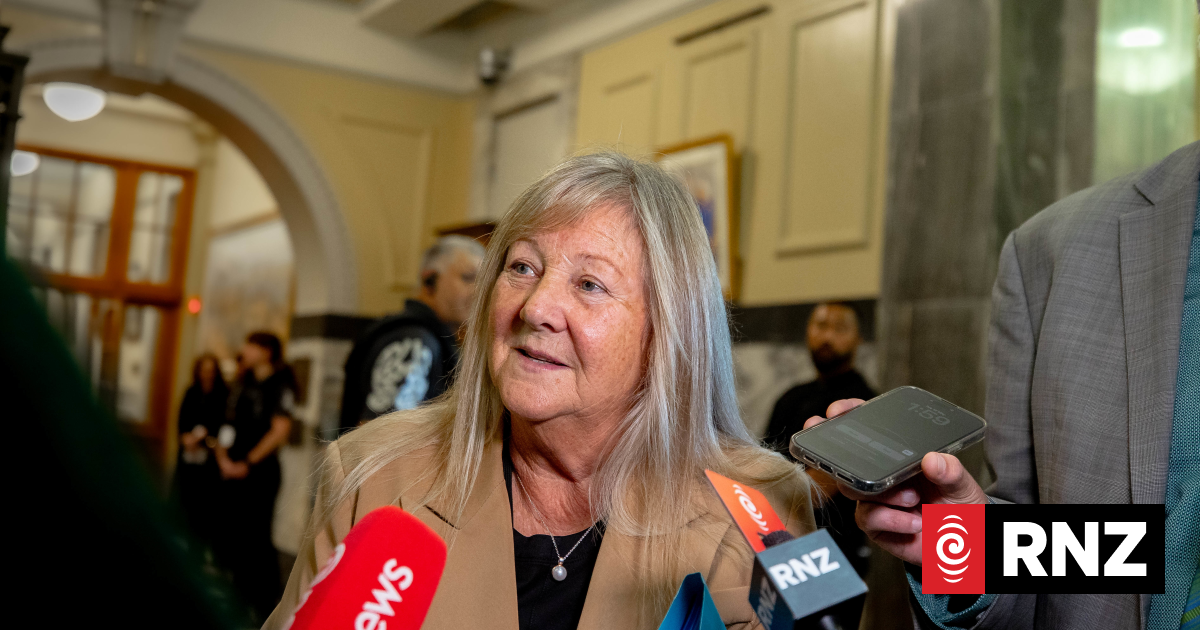
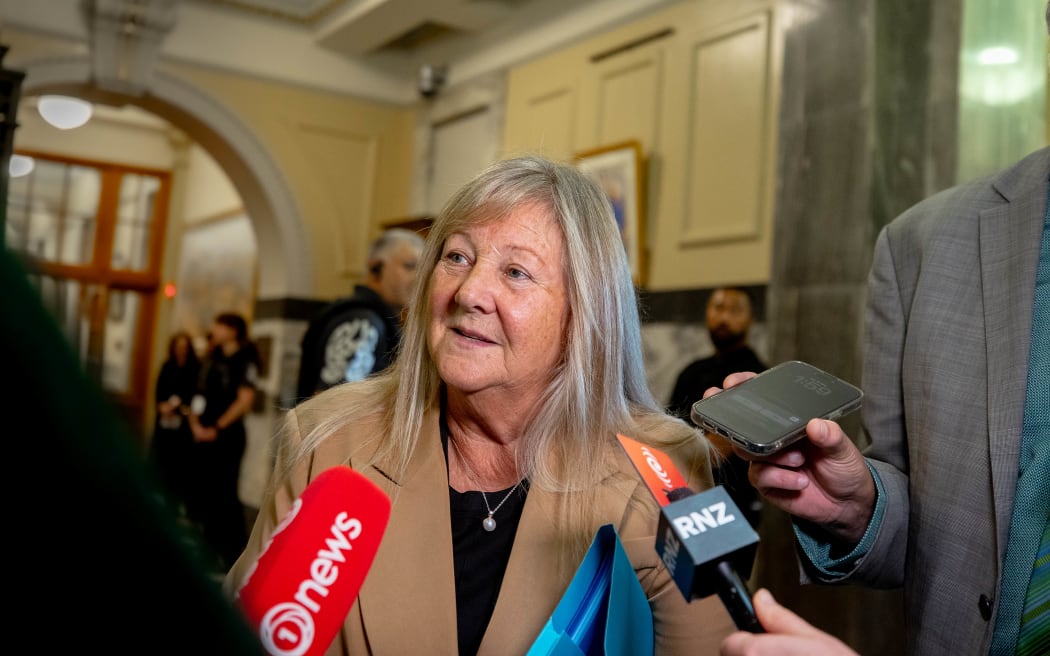
Minister of Science, Innovation and Technology Penny Simmonds.
Photo: RNZ / Mark Papalii
Scientists are adamant investing in the sector now will pay dividends later – but are not holding out much hope for a big Budget funding boost after a year of redundancies and funding cuts amid a major overhaul of the sector.
Last year saw the biggest shake-up to the science system in 30 years.
It saw Crown Research Institutes merge into Public Research Organisations, the scrapping of Callaghan Innovation, and a raft of new intiatives including: the establishment of the Gene Technology Regulator, an office to attract foreign investment, and an advisory council to the prime minister.
Budget 2025 cannibalised research and innovation funds to help fund the changes.
Minister of Science, Innovation and Technology Penny Simmonds would not comment on Thursday’s Budget, but said researchers make an “extraordinary contribution” and the sector’s significant reforms would create a more stable, strategic, and sustainable system.
Innovate or ‘death spiral’ – researcher
Lincoln Agritech chief executive Travis Glare said the sector’s recent upheaval needed to be followed by stability and long-term vision.
“There’s been real cuts to the science system over the last few years, which means the system struggles as you’re basically losing people. You’ve got amalgamated science organisations – that takes a lot of money to merge organisations – and that’s all money that’s not going into actually doing the science.”

Lincoln Agritech chief executive Travis Glare.
Photo: Supplied / Lincoln Agritech
He hoped Budget 2026 would redirect money into research and development [R&D] – his company’s core purpose – and ‘blue-skies’ or curiosity-driven research to enable a “discovery pipeline”.
Glare said investing in science over more tangible public services could be a difficult argument for taxpayers, but he said long-term economic success hinged on innovation – and that required years of work.
“We’re not actually building an economy that will pay for better healthcare and better education. The government is having to divide a much smaller pie every year and innovation is the only way we’re getting out of this death spiral.”
Glare said after years of what felt like “ad hoc” funding – a strategy for the sector was a brightspot.
“Not everyone is going to agree with it, but at least reseachers understand what the government is looking for.”
In its report to the prime minister earlier this year, the Science and Technology Advisory Council outlined a framework for the government to signal investment priorities. It was based on four ‘pillars’ covering primary industries, environmental sustainability, technology, and health.
It said the country’s poor economic performance reflected “deep-seated structural and external challenges” and targeted public investment in science, innovation, and technology [SI&T] offered “one of the most direct and high-impact pathways to restore momentum”.
“This is reinforced by overwhelming international evidence that SI&T are core to lifting productivity, export competitiveness and economic growth.
“The country’s scientists, researchers and entrepreneurs deliver strong results within the system’s constraints, but barriers continue to limit their impact.”
It urged the government to scale up investment once the framework proved its capability.

Co-president of the New Zealand Association of Scientists Troy Baisden.
Photo: Waikato University
Co-president of the New Zealand Association of Scientists Troy Baisden said business R&D had flatlined recently, indicating the public system was not adequately supporting private investment and believed New Zealand did not appreciate the link between science R&D and productivity.
“There’s a lack of a sense that much of our agricultural productivity came from investments 20-30 years ago in science.”
He said small gains in the sector over the past year had been overshadowed by bigger losses and hoped the overhaul in the sector created a system that politicians could confidently invest in.
But optimism for this Budget was tempered.
“What we’re really looking for at this point are no more cuts.”
‘Everything you touch came through … research’
MacDiarmid Institute director Nicola Gaston said she was not expecting much in the Budget, but after a year characterised by disruption a commitment to boost funding – down the line – would be welcome.

MacDiarmid Institute director Nicola Gaston.
Photo: Victoria University
“In the absense of new money this year, a plan to grow investment over time and … more information about the process of funding so that it has a level of visibility to researchers [would be good].
“That level of uncertainty I think has created some level of distrust of the process, so I’d like to see more detail and something that looks like an actual plan.”
Gaston said research funding, or “baseline funding for universities” was essential if the country wanted a workforce capable of navigating a “rapidly changing world”.
“You need to have a functional research-informed education system, that means you need to fund research.”
Auckland University associate professor of sociology Sereana Naepi agreed, maintaining there would be no Rocket Lab without a healthy education and undergraduate research pipeline.

Dr Sereana Naepi
Photo: Supplied
But she acknowledged investing in such a system could be a hard sell for the public given a lot of the work was unseen.
“But everything you touch came through the research space at some point and so while we’re not an immediate day-to-day thing in a lot of people’s minds, if you like your phone, if you like your computer, if you like immunisations or if you like that ability to put a stent in your heart – it usually came out of the research sector before it got privatised.”
Long-term direction promised
Science Minister Penny Simmonds – the third to hold the portfolio this government term – said the science reforms were focussed on getting the settings right so public investment “delivers stronger impact, with clearer priorities and better connections to industry”.
She said R&D continued to be supported through public investment and tools like the R&D Tax Incentive.
“Which is helping lift business investment in innovation, which is extremely important as two-thirds of the R&D that happens in New Zealand takes place in private businesses.
“The upcoming Science Investment Plan will set out the government’s long-term direction for science, innovation and technology and will provide greater certainty for the sector.”
She said she was unable to comment on what may or may not be included in the Budget ahead of Budget Day.
“However, what I can say is, New Zealand’s researchers make an extraordinary contribution and deserve a system that supports excellence and stability.”
Sign up for Ngā Pitopito Kōrero, a daily newsletter curated by our editors and delivered straight to your inbox every weekday.