
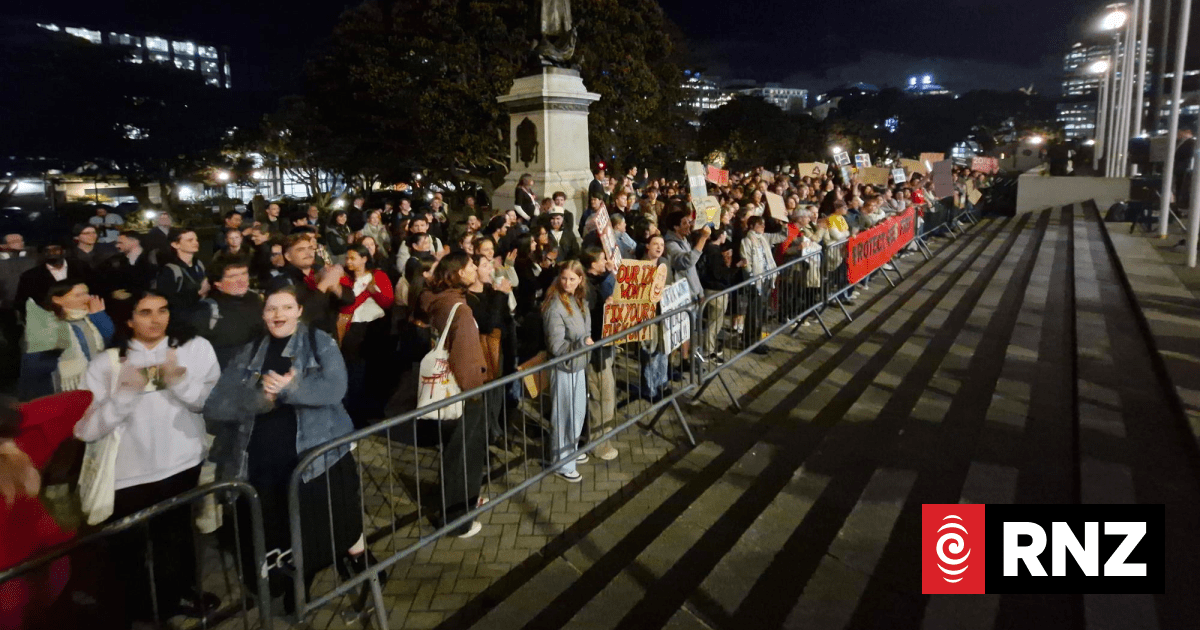
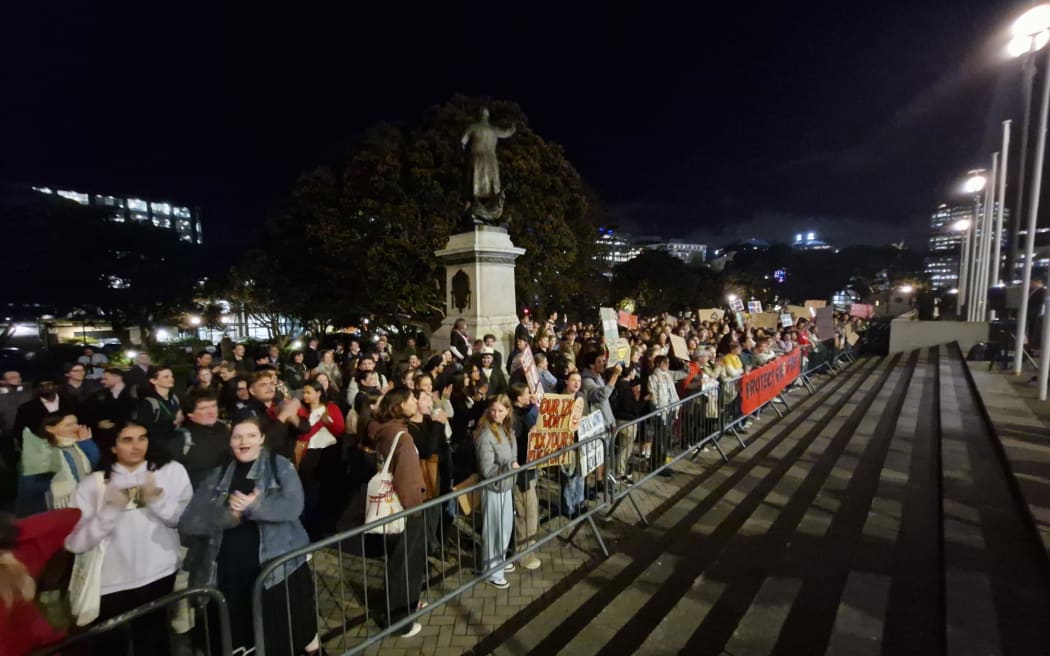
Students marched on Parliament on Thursday to protest the government’s decision to end the fees-free policy at the end of this year.
Photo: RNZ / Russell Palmer
The government’s Budget sparked angry scenes in Wellington overnight when students marched on Parliament.
They were protesting the government’s decision to end the fees-free policy at the end of this year and let tertiary institutions raise their fees by up to six percent for the third year running.
Victoria University students’ association president Aidan Donoghue said the changes were a double-blow for students.
“For many of our first and second year students, they’ve had $12,000 ripped from them as they made an informed choice to start their studies with a guarantee that at least one year of debt will be forgiven,” he said.
“That alongside another six percent increase … It’s just untenable. It’s a one-two punch to the gut for us.”
Donoghue said universities were likely to opt for the full six percent fee rise because the Budget froze subsidy rates for everything except basic foundation education courses.
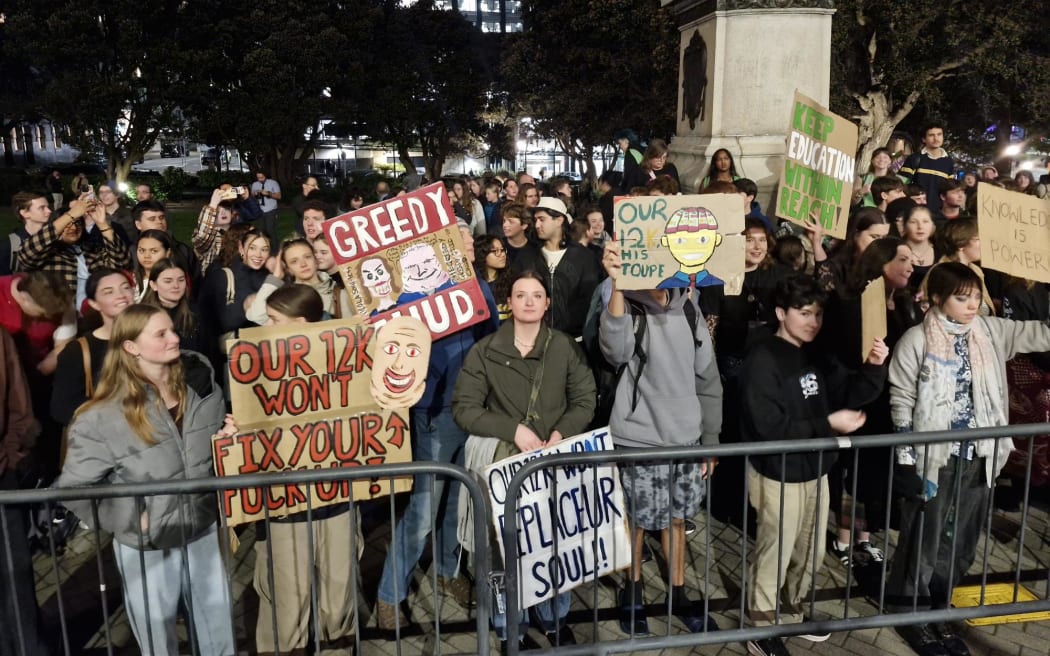
The government is also allowing tertiary institutions to raise their fees by up to six percent for the third year running.
Photo: RNZ / Russell Palmer
One of the protesting students, Rose Schneehagen said she was upset about the government’s decisions.
“I’m studying early childhood education, so teachers, something that New Zealand definitely needs. People like me are getting messed up and having to be in more debt and take out more student loans just to help out this country,” she said.
Another protestor, Ciara, said she hoped they would persuade the government to make a change.
“I hope that we are able to make a change. There’s a lot of us, a lot of voices. There’s strength in numbers and I do believe that this could be a wake-up call for the government.”
The fees-free cut would save the government $1 billion over four years.
Some of that money was going to schools including $69 million to double the 10,000 secondary students doing courses at trades academies.
There was also $80m over four years for secondary school curriculum resources, teacher training, and a new secondary school qualification.
Post Primary Teachers’ Association president Chris Abercrombie said it was not enough.
“This is once in a generation educational change. It’s probably some of the biggest change we’ve seen since, to be frank, Tomorrow’s Schools. All at once. We’ve had assessment change, we’ve had curriculum change but not all together,” he said.
“Erica Stanford talks about having the world’s best education system, well they seem to want to have the world’s best cheapest education system.”
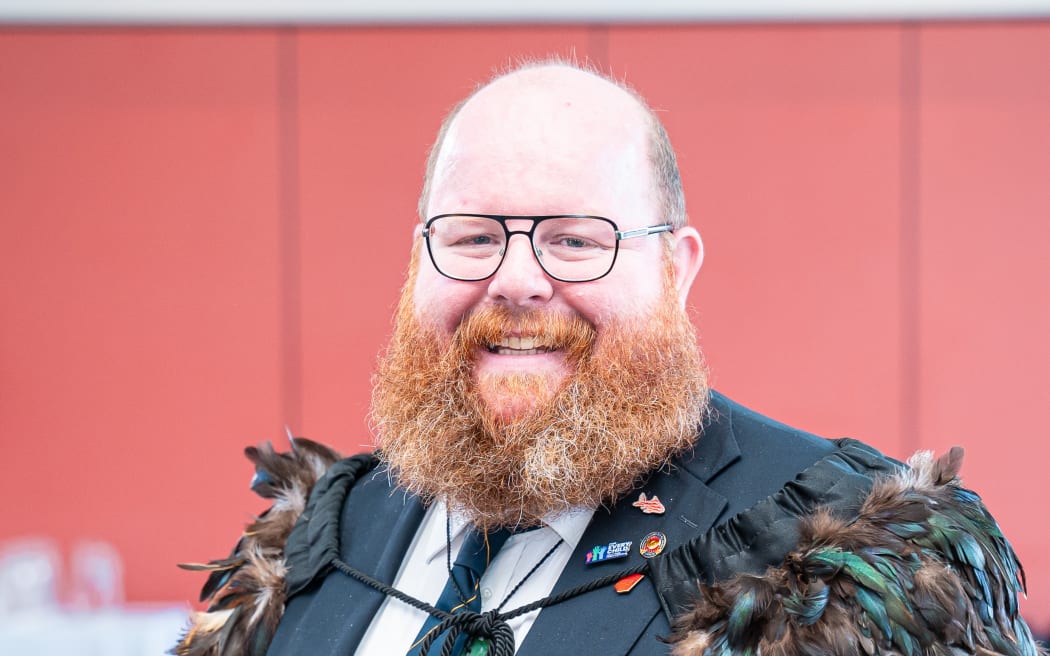
Post Primary Teachers’ Association president Chris Abercrombie.
Photo: Supplied
Abercrombie said $20m to provide professional training for every secondary teacher amounted to a bit more than $600 per teacher and would cover only a day of training for each of them.
Stanford denied that estimate. She said the government would provide five days training for every secondary teacher.
At the other end of the education spectrum – early childhood, the Budget provided most services with a 1.5 percent subsidy increase from July.
Te Rito Maioha chief executive Kathy Wolfe said that was six months earlier than normal but it was not enough.
“We normally have to wait to the following January so that is a positive step. However the 1.5 percent isn’t going to even scratch the surface for us. It’s just so well short of addressing any ongoing and growing financial pressures for us,” she said.
Sign up for Ngā Pitopito Kōrero, a daily newsletter curated by our editors and delivered straight to your inbox every weekday.