
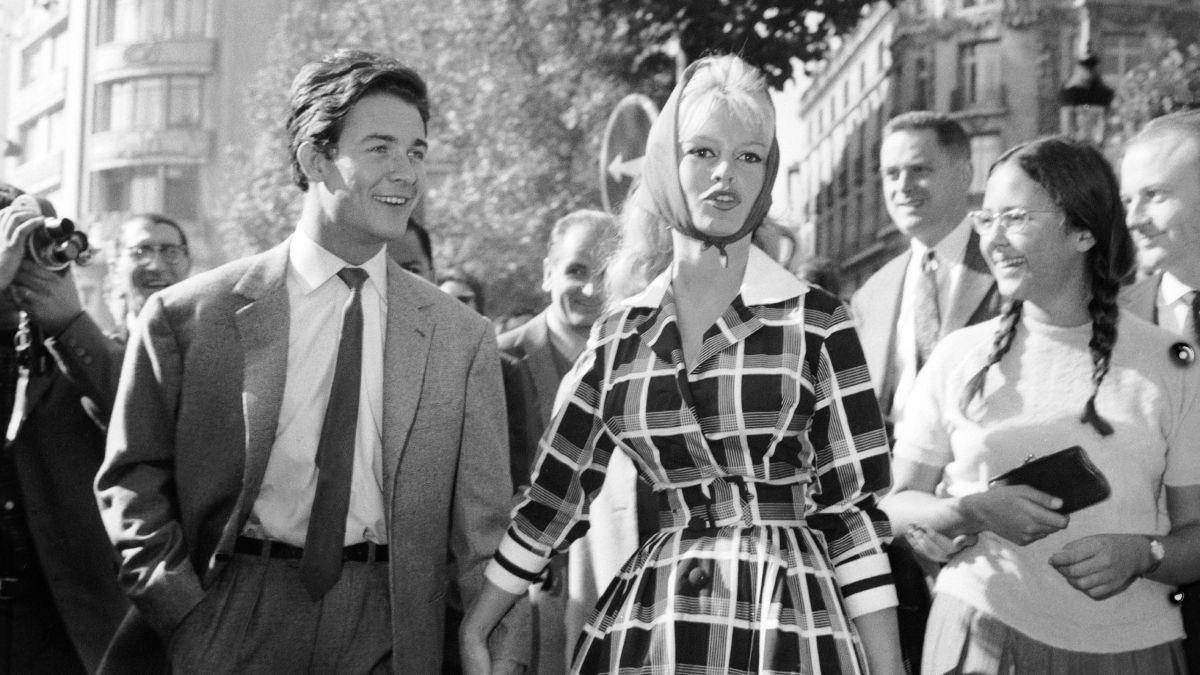
Jacques Charrier was already a rising star when he met Brigitte Bardot in 1959, so it is perhaps unfair to claim that she brought him recognition, though she certainly brought him fame. Falling in love with her would change his life, mostly for the worse.
Bardot had spotted Charrier in Les Tricheurs (The Cheaters), a comedy about the decadence and existential angst of a generation of rebellious Parisian youth, directed by Marcel Carné. Charrier played Bob Letellier, a handsome young aristocrat who is led astray by an unscrupulous Parisian named Alain. Though harshly judged by French critics on its release in 1958, the film was a box office hit and with ten million tickets sold across Europe, it turned Charrier into a heartthrob overnight.
Bardot wanted in on the fun and insisted he be cast as her leading man in the comedy Babette Goes to War, about a naive girl from the French countryside who is parachuted into German-occupied France to kidnap a German general. It was a new kind of role for Bardot — “Until now,” she said, “all my films have been restricted to audiences over 16” — and Charrier was to play the French lieutenant and intelligence officer, Gérard De Crécy-Lozère, tasked with helping Babette in her wartime mission.
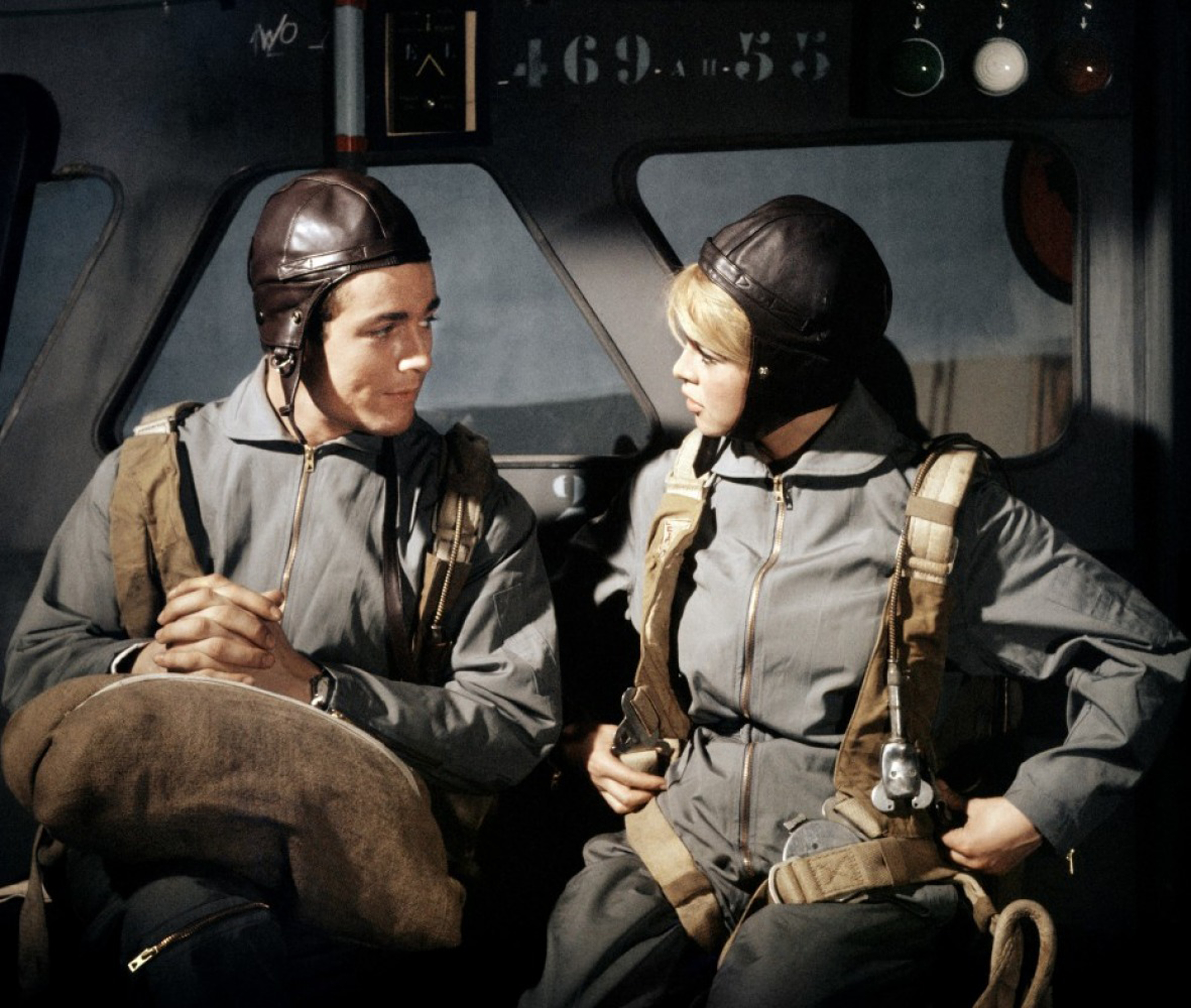
The couple in Babette Goes to War
SUNSET BOULEVARD/CORBIS/GETTY IMAGES
That the glamorous pair fell in love on set, as well as in the film, was irresistible for the tabloids who went mad over the romance and the couple’s beguiling good looks — Charrier with his square jaw, dimpled cheeks and boyish James Dean smoulder. Even more thrilling was the wedding in June 1959 in Louveciennes and the honeymoon in St Tropez, where the couple would live for the next three years not so much in peace as in relentless scrutiny.
Photographers constantly swarmed around Bardot’s villa, La Madrague, which became a symbol of 1960s libertine glamour, its residents the epitome of the jet-set romance era. They mingled with artists, writers and musicians at lazy Provençal lunches; bohemians trailed in their wake, curious onlookers ogled and journalists disguised themselves as fishermen just to catch a glimpse of the star and her new man.
The experience would have been novel and somewhat unsettling for Charrier, a reserved 22-year-old who grew up in a family of military men, and trouble began almost immediately. In 1959 he was publicly ridiculed for shirking military duty on health grounds in the midst of the Algerian War. It became a state affair and Roland Boudet, a Gaullist deputy, denounced him on the floor of parliament to laughter and applause. “I would like to know what measures the government intends to undertake so that all of our recruits are treated exactly the same,” Boudet said, “even when they emerge from the world of high fashion or on the arms of a big star.”
In 1960 Bardot gave birth to their son, Nicolas. She later claimed that Charrier had stopped her from having an abortion and in a bitter 1996 memoir, Initiales BB, described him as “a violent, alcoholic macho”. In the book she compared her pregnancy to a tumour and said that she would have preferred “giving birth to a dog”.

With their son, Nicolas, whom Brigitte rejected
AFP/GETTY IMAGES
The year Nicolas was born, Charrier was hospitalised for nervous depression at a private clinic in Meudon, a southwest suburb of Paris. Local reporters attributed it to a disagreement with the director Henri-Georges Clouzot, who forbade anyone, including Charrier, from accessing the set of La Vérité, in which Bardot was starring.
After the couple’s divorce in 1962 — caused in part by Bardot’s affair with the actor Glenn Ford — she granted Charrier full custody over Nicolas. Bardot continued making films during their tumultuous marriage, but Charrier’s career never recovered. Critically, he turned down a role in Purple Noon in 1960, when Bardot was pregnant, and the part was given to Alain Delon.
Jacques Joseph Henri Charrier was born in 1936 in Metz, northeast France, where his father Joseph was stationed as a career military officer; his mother was Marie (née Vuillaume). He broke with family tradition when aged 17 he entered the École des Beaux-Arts in Strasbourg and trained to become a potter. By 1956 he had pivoted to acting when a teacher from the Conservatoire de Montpellier offered him a role in a local film, L’Arlésienne, based on a short story by Alphonse Daudet.
After studying at the National School for the Dramatic Arts in Paris he was an extra with Comédie Française and in 1957 landed the lead male role in The Diary of Anne Frank with Pascale Audret at the Théâtre Montparnasse. There he was spotted by Carné, who cast him in Les Tricheurs.
A year later he appeared in a similar role in Les Dragueuers (The Chasers), a sardonic romantic drama about two chance companions — one rich and handsome (Charrier), one poor and less photogenic (Charles Aznavour) — who “chase” girls. “The drageuer is never a Prince Charming,” said the director Jean-Pierre Mocky in an interview with Jean-Luc Godard. “He is free of any sentimental or physical prejudice … But the character interpreted by Jacques Charrier is a false dragueur, or more exactly, he’s a boy who has all the required qualities to become a perfect dragueur, but realises along the way that by becoming an automaton of seduction he is condemning himself at the same time to a frightening moral solitude.”

Charrier and Bardot on the set of Babette Goes to War
SUNSET BOULEVARD/CORBIS/GETTY IMAGES
The description had eerie resonances with Charrier’s own life, which suffered in association with Bardot. None of the 20-odd films he made after their divorce were notable successes, and a film production company he founded in 1969 closed after a few years. He finally quit the film business in 1975 after a film he produced with Columbia, Il Pleut sur Santiago, about the 1973 coup in Chile, flopped.
He found fulfilment when he returned to the École des Beaux-Arts in the 1980s to study painting, exhibiting in Paris, Geneva and San Francisco. In 1996 his series of 282 paintings, inspired by the Code of Hammurabi, an ancient Babylonian legal text, was displayed at the Unesco headquarters in Paris.
He married three more times: in 1964 to France Louis-Dreyfus, with whom he had two daughters, Sophie and Marie; in 1982 to Linda, with whom he had another daughter, Rosalie; and in 2009 to a Japanese photographer called Makiko Kumano, who survives him with his daughters and son Nicolas.
Charrier lived in relative obscurity until the publication of Bardot’s memoir. He and Nicolas sued successfully for violation of privacy and a year later he published a damning riposte, Ma réponse à Brigitte Bardot (My Reply to Brigitte Bardot) in which he revealed that the star, known for her far-right political sympathies, had given him her father’s library, including a signed copy of Mein Kampf. Bardot countersued and lost.
“I had no other choice,” explained Charrier when defending himself against accusations that he was cashing in on the controversy. “I did it for my children, to restore the truth. If I could simply concentrate on my painting, I assure you I would gladly do without this kind of publicity.”
Jacques Charrier, actor and artist, was born on November 6, 1936. He died on September 3, 2025, aged 88