
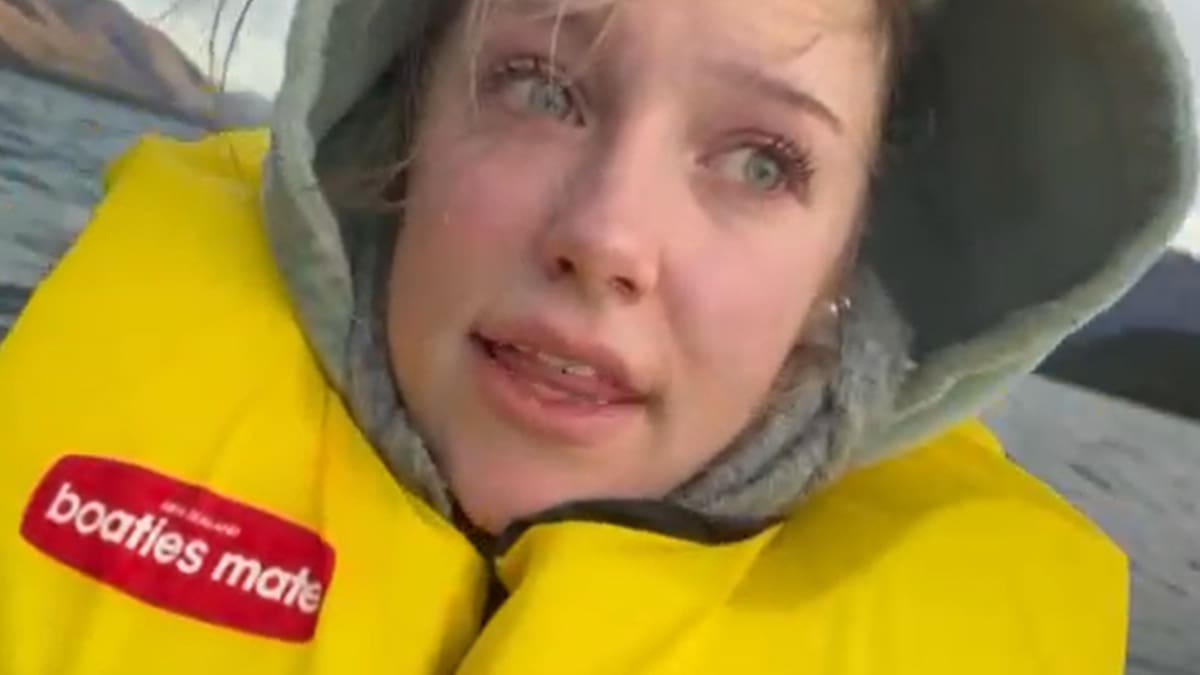
After factoring in the distance, winds and currents, she launched her inflatable boat around 4pm.
Marie Zessin had planned an overnight solo adventure to Pigeon Island. Photo / Supplied
“I was listening to my podcast about halfway between the mainland and the island, then all of a sudden I just didn’t feel the resistance anymore,” she said.
“My right paddle actually broke, like, I just saw the yellow part of the paddle drifting away and immediately I thought, ‘Oh my God, what do I do?’”
Zessin first tried paddling with the remaining oar, kneeling in the inflatable boat and switching sides.
But metre-high waves and strong currents spun the boat in circles and began flooding the vessel, soaking her clothes, sleeping bag and food.
“After about 10 minutes I was completely soaked,” she said.
“I was wearing four layers of clothing and I was scared of getting hypothermia.”
Marie Zessin said she purchased her inflatable boat on Facebook Marketplace and had taken it out on the lake multiple times. Photo / Supplied
Believing she was closer to Pigeon Island than the mainland, Zessin spent another 20 minutes trying to reach shore before realising the current was dragging her further away.
“At that point I was like, ‘Okay, I’ll just try to get to any shore at all’.”
A confident swimmer, long-distance runner and a volunteer firefighter back in Germany, Zissen said she refused to let herself dwell on the possibility that she could die.
Instead, she started recording videos on her phone to keep herself calm.
“It helped me organise my mind because I could be like, okay, this is the situation, these are my options.
“It helped me not catastrophise too much and get into panic mode.”
After an hour battling the lake, Zessin managed to drag herself and the boat ashore before passing out from exhaustion and shock.
Marie Zessin became stranded on Lake Wakatipu after her paddle broke. Photo / Supplied
When she regained consciousness, she said she was still freezing, soaked and stranded far from the road.
She abandoned her belongings and staggered through dense bush and a freezing river before reaching a main road about 15 minutes later.
“I was there fully wet, crying in my life vest with branches in my hair trying to wave cars down,” she said.
“Eventually, one guy turned around and I just ran to him still panicky.”
Zissen described the stranger, Ricardo, as a “hero”.
“He didn’t think twice about coming down to the river with me to get my stuff and he didn’t expect anything in return,” she said.
“It was so pure-hearted.”
Zessin said Ricardo returned with her through bush to retrieve her belongings before driving her back to her car, which she had left parked in the bush.
She said she hopes he will reach out so she can buy him a restaurant voucher.
She also said she has a warning for others planning solo adventures: “Always double-check your equipment”.
A spokesperson for Coastguard told the Herald people heading out on the water should take forms of communication with them, ideally an Epirb, VHF radio and a phone in a waterproof case.
Boaties are also advised to always wear a lifejacket, check the marine forecast and tell someone where they are heading and what time they plan to return.