
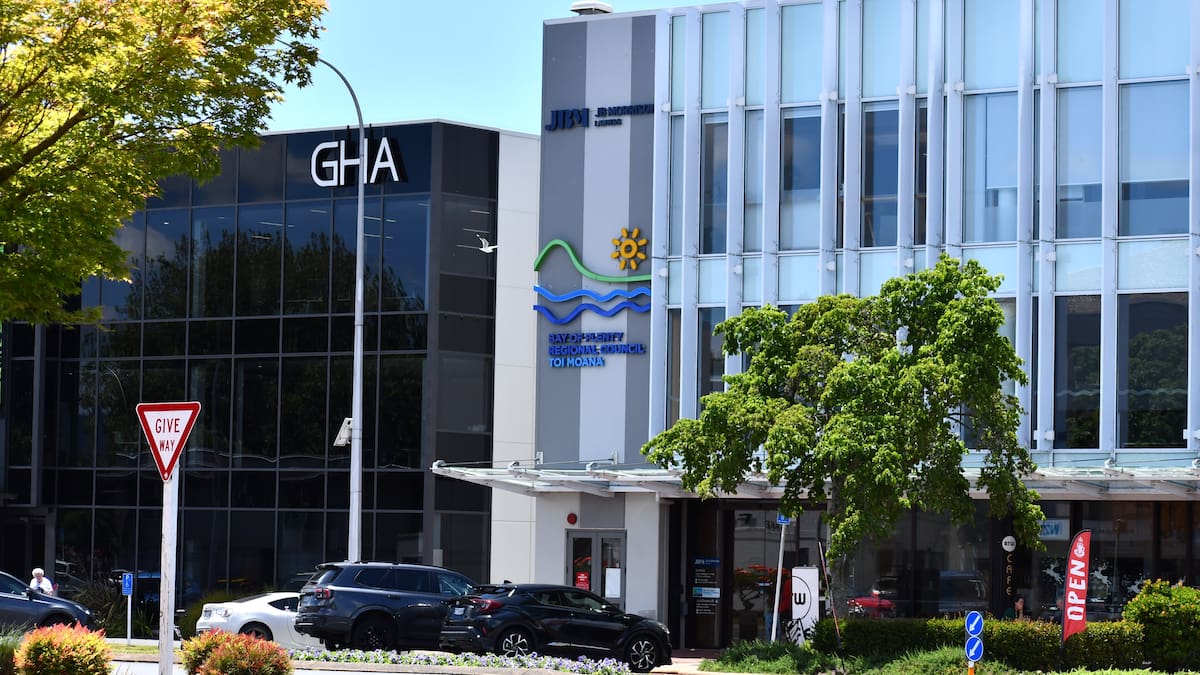
The council approved $1 million for regional reorganisation planning and $170,000 towards the recently signed Western Bay of Plenty city and regional deal.
The funding comes as Bay of Plenty councils consider amalgamation options in response to wider local government reforms.
In Rotorua, $620,000 in ongoing costs linked to the purchase of Kererū Farms will be funded from the council’s reserves.
The 266-hectare dairy farm is being transitioned to lower-nitrogen land use as part of efforts to improve Rotorua lake water quality, the media release said.
Bay of Plenty Regional Council chairwoman Matemoana McDonald and chief executive Fiona McTavish with the consultation document for the Annual Plan 2026/27 and Long Term Plan Amendment.
Councillors also approved $250,000 to develop a Rotorua Lakes biosecurity “proof of concept” system aimed at reducing the risk of invasive freshwater pests, including freshwater gold clam.
Public transport changes included ending the Baybus OnDemand trial service in Tauranga South in December. The trial started in March 2024.
The council said it had strong patronage and customer satisfaction compared to previous fixed route services, but needed a significant ongoing subsidy.
Further work was planned on future public transport options for Tauranga South.
Urban public transport fares across the region will increase by 3.1% from July, with fares rounded to the nearest 10 cents. The council said the increase reflected rising operating costs and reduced external funding.
That would add 10c to standard adult fares, with a Bee card.
The Baybus OnDemand trial in Tauranga South will end. Photo / Bay of Plenty Regional Council
Councillors approved $150,000 for an iwi-led Tauranga Moana Strategy and agreed to investigate options for a technical hub intended to provide specialist support to iwi and hapū.
No additional biodiversity funding was approved for 2026/27, with existing investment levels to remain in place while the council develops a regional indigenous biodiversity strategy ahead of the next long-term plan.
A new Regional Benefit Fund of up to $20m was approved. The fund is intended to support large-scale projects delivering environmental, economic, social and cultural benefits across the region.
The council said the fund would be financed through reserves and investment returns rather than rates.
Regional council chairwoman Matemoana McDonald said in the media release councillors had sought to balance affordability with maintaining core regional services.
“We know many people across our region are doing it tough, and that has been front of mind throughout this process,” McDonald said.
She said councillors had made “difficult trade-offs” by deferring or reducing some non-essential spending, while continuing work on environmental protection, regional resilience and long-term planning.
On the Baybus OnDemand decision, McDonald said councillors recognised the service had been well used but needed to consider the cost to ratepayers and the wider public transport network.
The annual plan will be formally adopted on June 25 and will take effect from July 1.