
The $23m grant is for a three-year project called Hydrothermal Oxidation – Futureproofing Bioresource Management in the UK and was announced last week.
UK water regulator Ofwat is funding the grant. The project will be led by private water company Anglian Water Services.
Other project partners include Severn Trent Water, Northumbrian Water, Cranfield University and AtkinsRéalis.
Speaking from the UK, Cetogenix chief executive and co-founder Dr Trevor Stuthridge told the Rotorua Daily Post he was meeting the partnership team after the announcement, “and preparing for the next phase of the project”.
About two and a half years ago, Anglian Water Services and other UK water companies were “under pressure to find a solution to putting their organic waste on to farmland”, Stuthridge said.
A study with consultancy firm AtkinsRéalis identified Cetogenix as a potential technology.
“They reached out to us saying they’d like to work with us on understanding the technology …”
Two years ago, Cetogenix received £1.3m of funding with its commercial partners for proof-of-concept work. The results “exceeded the expectations of our water partners”, he said.
“They submitted another proposal for £10.2m to allow the partnership to take the technology to basically full-scale deployment at one of their sites.”
Stuthridge said the funding meant the technology, which was “pre-commercial” in New Zealand, now had a commercial pathway.
“This is a game-changer for us.”
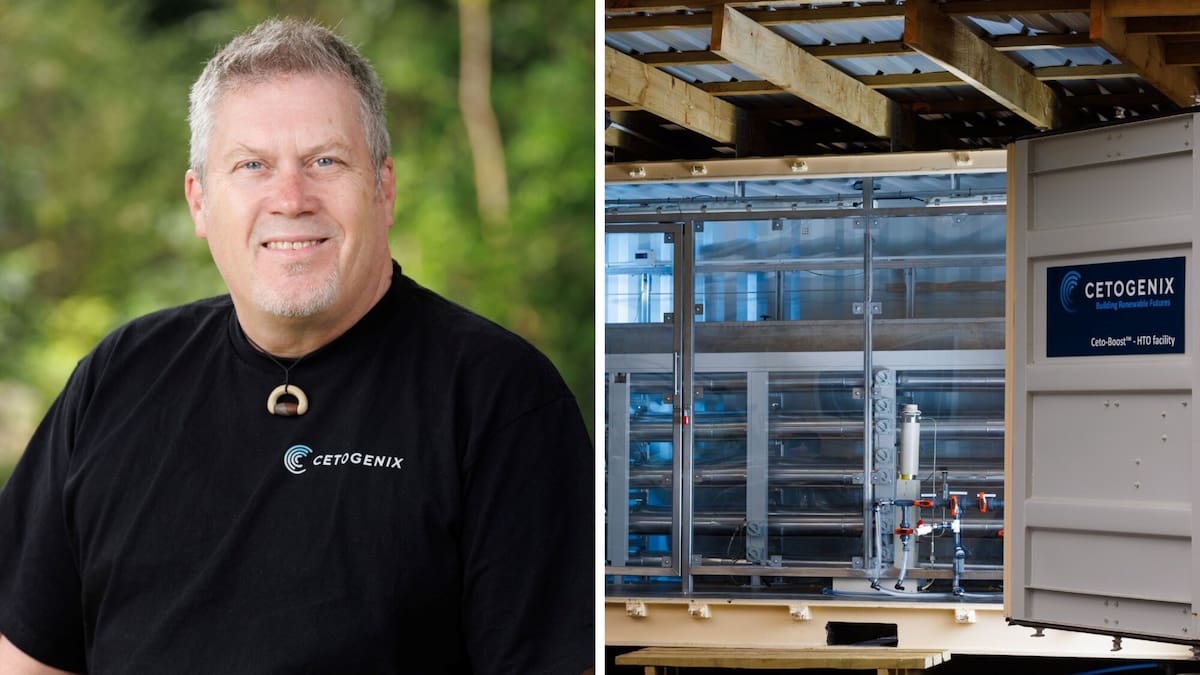
Cetogenix chief executive and co-founder Dr Trevor Stuthridge.
The biomethane gas produced could replace natural gas.
“That’s a big driver in Europe … to avoid their dependency on fossil natural gas from Russia and from the USA.”
Secondly, the technology recovered nitrogen, phosphorus, green ammonia and phosphate, which replaced synthetic fertilisers.
“This is very timely at the moment because large amounts of the world’s natural gas and fertilisers are coming through the Strait of Hormuz and, with the Iranian-US conflict, those supplies are being cut off.”
The world generated about 100 billion tonnes of organic waste a year, of which 2% was treated or reused, he said.
Waste material was a “vast resource”, and the technology supported a circular economy.
“Circularity means that we can find another purpose for that waste, turn it into high-value products and … close the cycle so that waste is literally not wasted.”
Rotorua cleantech company Cetogenix has secured a $23 million grant in the United Kingdom that could help commercialise and globalise its technology.
Stuthridge said the company’s major market was Europe and it would “likely” establish a permanent presence in the UK.
Cetogenix was established in 2022. Its four co-founders had worked together for more than 15 years at Scion.
It was working on a large agricultural project in South Waikato and was also looking to do trials with Ecogas in Reporoa and Watercare.
As a New Zealand start-up, “we’ll probably have to go out to come back in”, Stuthridge said.
“It is our intention to help drive this technology in the New Zealand market, but it’s a very small market, so we will de-risk the technology over here in the UK and Europe … and we’re excited that we can then push forward to redeploy it back into New Zealand when we’re ready.”
Megan Wilson is a health and general news reporter for the Bay of Plenty Times and the Rotorua Daily Post. She has been a journalist since 2021.