
 China is sitting pretty. But a tipping point is coming for oil competition. · Yahoo Finance
As the US war in Iran – and the blockade of a vital shipping the lane – drags on, it still appears to be, more or less, business as usual in Australia. Overall petrol stocks are actually higher than prior to the war and petrol prices currently sit under $2 a litre.
Part of this somewhat eerie calm is driven by the Albanese government’s fuel excise tax reduction, which has removed 26.3 cents a litre at the bowser, plus the impact of the reduction of GST payable on the excise tax.
The expectation of a relatively swift end to the conflict in the Middle East has kept oil prices lower than many anticipated so far, there are a multitude of other factors that have come together to support the ‘Lucky Country’s’ fortunes.
RELATED
From the dramatic reduction in oil imports into China to Australia’s fuel suppliers continuing to provide exports, even at the expense of their own domestic supplies, a combination of lady luck and quid pro quo on energy flows have so far insulated Australia from the worst of the ongoing crisis.
An unexpected boost from China
China has been building an even greater supply of oil reserves in recent decades and now possesses an estimated 1.3 billion barrels of oil, the largest reserves in the world by far.
This trend of building sizeable reserves is not isolated to oil. From metals to fertiliser, Beijing has prepared for the worst by building big reserves.
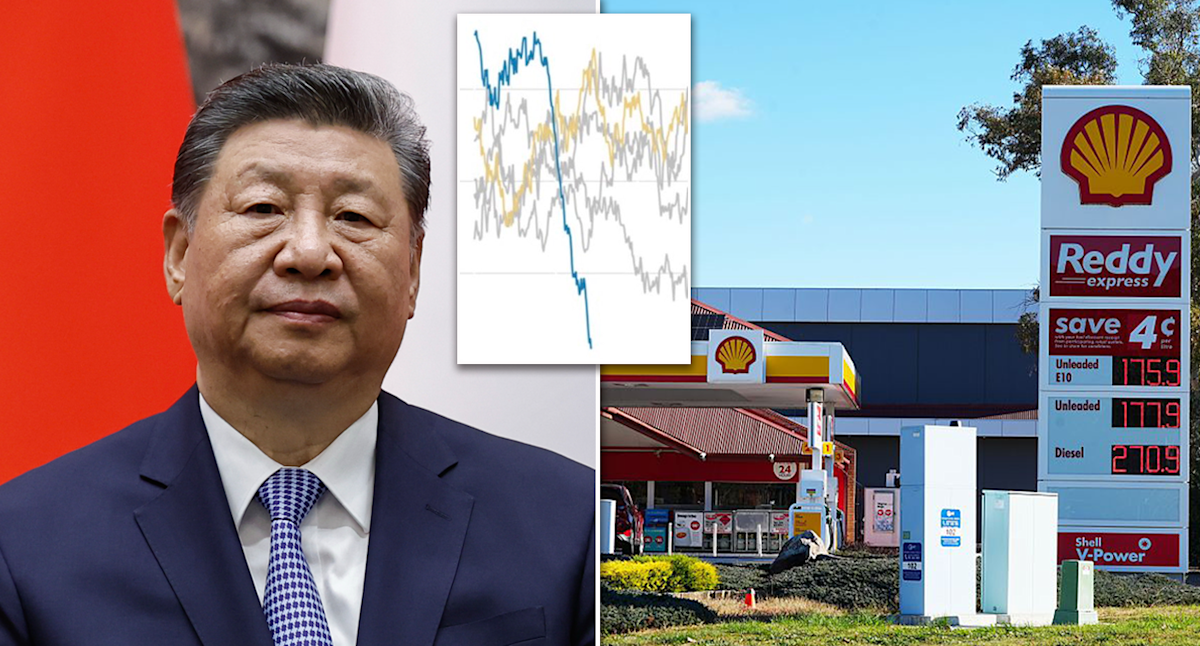
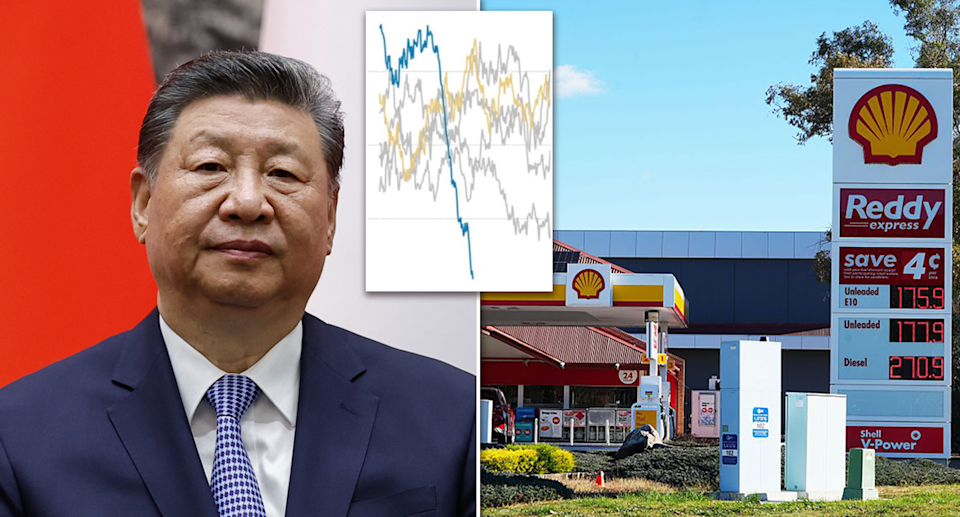
A good illustration of the growth in China’s oil reserves comes from energy analyst John Kemp, who has charted the growth in the country’s oil reserves for the past 25 years.
 Xi Jinping had been building oil reserves prior to the conflict. · Yahoo Finance
With these reserves Chinese imports of fuel and oil have fallen dramatically in year on year basis since the start of April.
According to an analysis from JP Morgan, China’s net imports of oil, fuel and other products have fallen by 5.5 million barrels per day in year-on-year terms in the last 30 days of data.
While up to one fifth of that decline could be attributed to China dramatically reducing exports of refined fuels and perhaps another fifth from reducing the growth of reserves compared with 2025, it’s clear that China is choosing to burn through its oil reserves.
For what reason and for how long this will continue is a multi-trillion dollar question, but at this stage the only people who really know the answer are the Chinese leadership.
This situation has helped cushion things so far. · Yahoo Finance Fuel conservation efforts continue in Australia’s Suppliers
On the 10th of May, Indian Prime Minister Narendra Modi made an address to the public urging a major reduction in fuel usage, using the pandemic as an example of the need to work from home and have online meetings.
He went on to encourage the following:
Usage of public transportation
Carpooling
Reducing non-essential travel
Avoiding foreign travel for one year
Modi’s push was summed up under the slogan which translates into English as: “Nation First, Duty Above Comfort”.
Yet even as the Modi government pushes for its citizens to reduce their fuel usage, Indian exports of fuel to nation’s like Australia continue.
In recent years, Australia has become increasingly reliant on India for fuel imports, rising from 3.7 per cent of the overall total during the 2023 calendar year to 8 per cent in 2025.
Some of Australia’s other major sources of fuel are also running major fuel and energy conservation campaigns.
In South Korea, President Lee Jae Myung urged citizens to “save every drop of fuel” and to “actively participate in energy-saving movements in daily lives, such as taking public transportation and conserving electricity,”.
President Myung did not sugar coat the seriousness of the crisis for South Korea warning that it: “is not a passing shower that quickly subsides, but rather a massive storm whose duration is uncertain, making it all the more severe.”
In 2023, South Korea was the number one nation for Australian fuel imports, accounting for over a quartet – 26.2 per cent – of all fuel imported for Aussie motorists.
Our suppliers have been tightening their own belt. · Yahoo Finance A tipping point is fast approaching
Australia’s atmosphere is a stark contrast to many of our neighbours in the region, most of whom are facing far more significant challenges.
Which begs the question, where is the tipping when nations are forced to secure fuel supplies for domestic consumption and export customers begin to miss out?
Or does Australia’s leverage over other energy related commodities such as coal and liquefied natural gas (LNG) sufficiently insulate us?
With no end currently in sight for the conflict in the Middle East, the push to keep fuel supplies flowing at pre-war volumes will only get harder.
So far the United States has burned through great swathes of its at call fuel inventories, seeing record high fuel and oil exports on a combined basis. But now that scope is beginning to gradually dwindle, with stocks of distillate oil (diesel, heating oil etc) hitting a multi-decade low.
Tanks of everything from diesel to jet fuel continue to dwindle throughout countries reliant on imports.
In the early months of the crisis, Australia was competing with developing Asian countries for fuel cargoes, due to the fact that these nation’s rely most heavily on fuel stemming directly or indirectly from the Strait of Hormuz.
But as the challenges surrounding fuel availability go global, Australia will no longer be competing solely with developing nations for fuel cargoes, instead some of our main rivals for jet fuel cargoes for instance, become Britain, Germany and France.
The longer the crisis in the Middle East persists, the greater the level of difficulty becomes, as wealthier and wealthier nations compete for a dwindling supply of available fuel cargoes.
Competition will heat up. · Yahoo Finance Commonwealth Bank warning of ‘severe market reaction’
Donald Trump’s insistent claims in recent days that a deal between the US and Iran is imminent appear, again and again, to be little more than hot air.
If that cycle continues, Australia is facing a rapidly deteriorating situation Commonwealth Bank chief economist Luke
“Rapid inventory drawdowns of oil and other refined products have acted as a shock‑absorber, shielding businesses and consumers from higher prices and preventing wide‑spread demand destruction across advanced economies. However, these emergency inventories are being quickly depleted,” he wrote in a note to investors last week.
If the current situation persists, the bank expects oil to surge to US$150 a barrel “by mid‑June to mid‑July”, well higher than its peak during this conflict.
“This will drive inflation sharply higher, growth sharply lower, and again raise the prospect of fuel shortages and restrictions in Australia. If the ceasefire does collapse entirely, we expect Iran to widen its retaliation to a greater range of economic targets, driving a severe market reaction,” he warned.
That outcome is getting closer by the day.
Get the latest Yahoo Finance news – follow us on Facebook, LinkedIn and Instagram.