
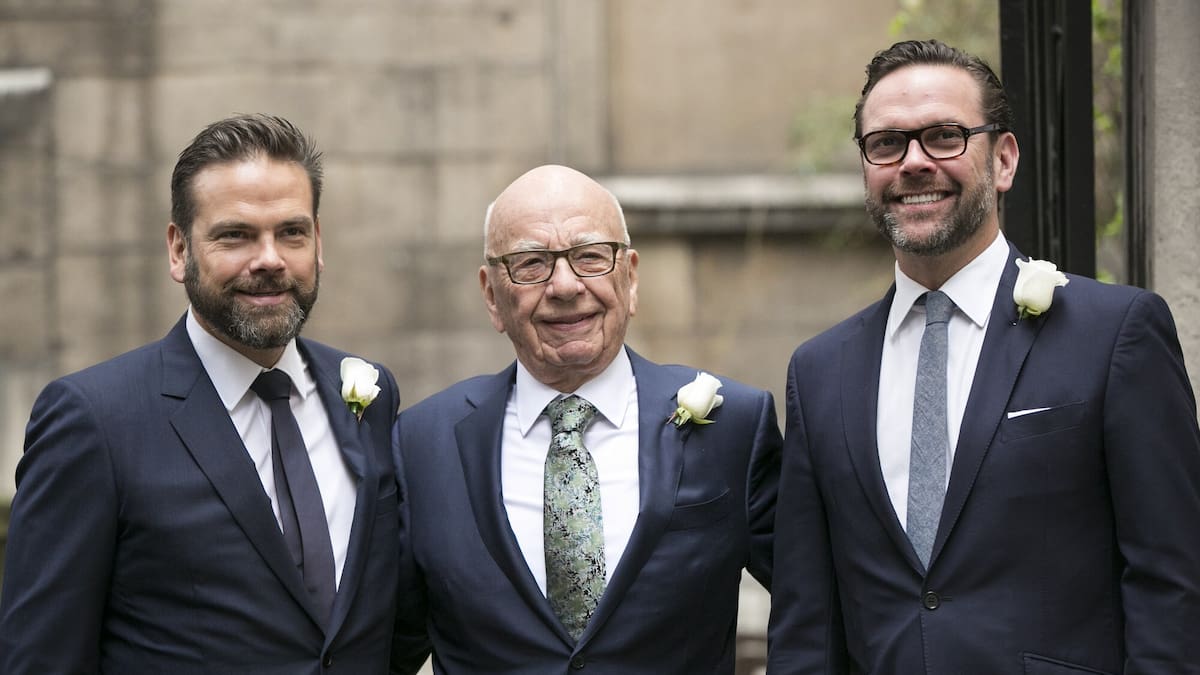
Rupert Murdoch owned New York for more than a decade: he bought the magazine in a hostile takeover in 1976 and, at a time when News Corp had significant debt, sold it with Seventeen magazine, Soap Opera Digest and other publications to investment firm KKR for US$600 million ($1 billion) in 1991.
Staffers at New York magazine have welcomed their new owner.
“Murdoch is publicly saying what people want to hear – that he values the long-form journalism and cultural criticism we do,” said one of the magazine’s employees, who like others spoke on the condition for anonymity because they weren’t authorised to comment. “That’s all we can go on for now even if we’re well aware of billionaires who come in saying the right things and then lose interest or change their minds.” (Jeff Bezos, a billionaire and the founder of Amazon, owns the Washington Post.)
The deal, reportedly worth more than US$300m, is expected to close in the coming weeks. At that time, Vox Media will be bifurcated.
New York, which Vox Media bought in 2019, will go to Lupa Systems, with news site Vox.com and the Vox podcast network, which distributes Today, Explained and other popular shows. The rest of Vox Media’s portfolio – the Verge, Eater, SB Nation, Popsugar and the Dodo – will form a new company that, at present, is unnamed.
In interviews with more than a dozen Vox Media staffers in the days since the deal was announced, almost all said that the corporate split would lead to a better outcome for their respective workplaces.
One New York staffer said that in contrast to some other billionaires who have purchased media properties in recent years, James Murdoch has “actually been in the media business for a long time. It’s not like he’s just coming in new to it as like a fun trophy or novelty”.
“As far as possible new owners go, this guy is saying all the right things,” another said.
New York magazine editor David Haskell speaks at the National Magazine Awards on May 19 in New York City. Photo / Getty Images
Hours after the sale was announced, James Murdoch made a cameo at New York magazine’s offices in Lower Manhattan. He spoke briefly to staffers – for no more than three minutes, by one account – telling them he had been a longtime reader of the magazine, that he was excited about the high quality of their work and that he planned to invest. He also took an impromptu tour of the magazine’s archives.
Murdoch and Lupa Systems declined to comment for this story.
Spirits were already high.
Last Tuesday night, New York had taken home the general excellence award from the American Society of Magazine Editors – one of the magazine world’s highest honours.
A happy hour was already planned for Wednesday at New York City’s Patsy’s Pizzeria, where staff celebrated the ASME win as well as the sale news.
Vox Media CEO Jim Bankoff, who will run the properties bought by James Murdoch, said in an interview that he and James Murdoch had crossed paths over the years, both having come up in roughly the same era of digital media, but didn’t know each other well. He said that as negotiations with James and Kathryn Murdoch progressed, he appreciated their approach to journalism, including through their philanthropy. The couple’s Quadrivium Foundation supports local news through the nonprofit American Journalism Project and connects journalists and scientists via the website SciLine.
“I was just impressed by not only their professional experience, but their commitment to other things that they found to be important to them and to the world,” Bankoff said.
The deal started to take shape in the fall when Vox received unsolicited offers for its podcast business, and Bankoff and his colleagues started thinking about what buyer would be best. Lupa emerged as the right partner, he said, in part because James Murdoch wanted not just the podcast business, but New York magazine and Vox as well.
He said the purchase is “an investment story” since the new owner is committed to growing the properties, not cutting them.
Staffers at New York and Vox.com also expressed relief that their leaders were staying on, including Bankoff, Pam Wasserstein, David Haskell and Swati Sharma.
Employees at both publications said despite their cautious optimism, they’re still processing what this means for their day-to-day work.
“Obviously a sale is always disconcerting, but it’s good that it’s someone who seems to want to build a real media business – someone who has resources and cares about print, audio and video,” said one Vox.com staffer.
Another Vox.com employee said there’s eternal worry in the news industry, adding that they’re more concerned about the new owner laying staff off than him interfering with the site’s editorial content. “Media is bleak right now regardless,” this person said. “I do hope that Murdoch actually wants to make good journalism and intends to be more than just a financial lifeboat.”
More questions surround the publications not bought by James Murdoch, which will be run by Vox Media President Ryan Pauley. The Verge’s management, for one, told staffers that they feel like they’re better off as part of a smaller, more focused company, according to four Vox Media staffers familiar with those conversations.
Media observers say the deal reveals as much about James Murdoch’s ambitions as it does about the state of the media industry.
“As contrasted to his dad, who has long had a penchant for huge bets, James Murdoch seems to be assembling a menagerie of relatively narrow-interest news and analysis sites – all of which seem to share solid standards for journalism, but none of which are in a league with a Fox or a Wall Street Journal,” said Bill Grueskin, a professor at Columbia Journalism School and a former deputy managing editor of the Wall Street Journal.
Paddy Manning, an Australian journalist who wrote a 2022 biography of James Murdoch’s brother Lachlan, said that three of Rupert Murdoch’s six children, “Liz, Lachlan and James – were all brought up as junior media moguls. They are chips off the old block. It’s what they know”.
Rodney Benson, a professor of media, culture, and communication at New York University, said the purchase shows that James Murdoch is a “serious and substantial supporter of quality, independent journalism at a moment when it is under attack, both politically and financially as never before”.
Benson said Vox “has remained a crucial bastion of fact-based yet engaging public affairs information, so I hope he can help it to survive and even thrive. If he can, it would be hard to imagine a more fitting and effective counterforce to the values of the media empire he left behind”.
Mark Feldstein, the Richard Eaton Chair of Broadcast Journalism at the University of Maryland and a former CNN investigative correspondent, saw a psychological dimension to the purchase – and a family irony.
“The money that came from giving conservatives red meat on Fox News is now being used to counter-programme the young progressives,” he said. “James is offering vegetarian options.”