
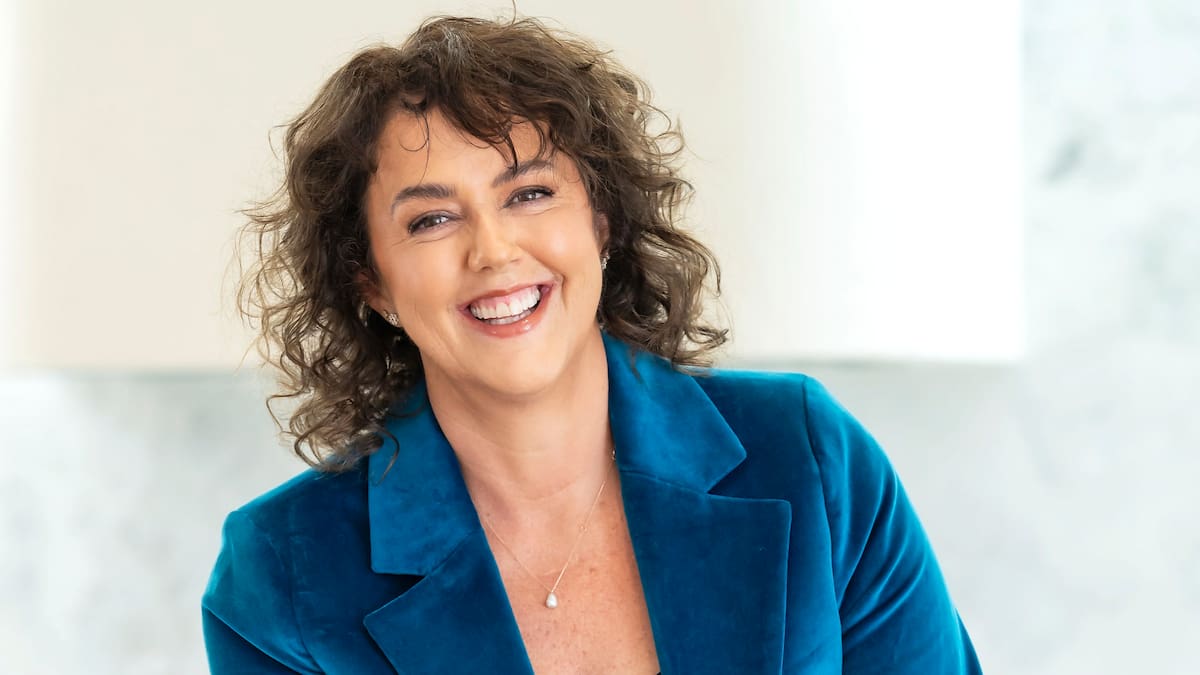
By her mid-30s, she’d built an impressive career in advertising and moved to Singapore with her husband Pete and their children, Isabella and Luca, to lead a major global brand and live the supposedly glamorous expat life.
Yet behind the polished exterior, Fleur was exhausted by the corporate demands and trying to still be present for her children.
Isabella, Pete, Fleur and Luca. Photo / NZ Woman’s Weekly
“I was in multiple countries every week, 24/7 on a plane travelling between New York, London and Asia,” she explains. “There was massive responsibility and pressure.”
Still, the formidable wahine (Ngāti Kauwhata and Ngāti Kuia) kept pushing forward, until a quiet comment from her then-5-year-old daughter stopped her in her tracks.
“She looked up at me with total innocence and said, ‘When can I have my mummy back?’” shares Fleur. “That was a bit of a gut punch.”
In an attempt to make family life more sustainable, Fleur relocated to Australia for a less demanding role. Even so, the toll of chronic stress was catching up with her. Near-constant headaches and fatigue became her normal, and after the marathon in France in 2009, her health collapsed completely.
“It got to the point where I couldn’t get through a sentence without coughing up blood,” she recalls.
Fleur was diagnosed with multi-organ stage-four sarcoidosis. The disease causes clumps of inflammatory cells to grow in various organs. For Fleur, it was in her lymph nodes, meaning it could appear anywhere in her body.
“This was my 39th year and the doctors weren’t sure I would make my 40th,” shares Fleur.
Most sarcoidosis patients respond well to treatment, but nothing seemed to work for Fleur. In total, she has had 23 rounds of chemotherapy – four to eight rounds are the standard – multiple surgeries, steroids and immunotherapy treatment.
Unable to work for 18 months and with Pete at home looking after the kids, the couple could no longer afford the fancy cars or house repayments.
“Everything we worked so hard for – my identity and role, our houses – was gone when I couldn’t work,” admits Fleur.
Fleur has had 23 rounds of chemotherapy, multiple surgeries, steroids and immunotherapy treatment. Photo / NZ Woman’s Weekly
Determined to rebuild their life, Fleur returned to work while still undergoing treatment.
She says, “I was kind of in denial for a few years, thinking I could overachieve my way out of this.”
Then in 2015, Fleur learned the sarcoidosis had spread to her brain.
“It was then I really realised, if you don’t have your health, you have nothing,” she reflects. “We had lost everything and all I truly wanted was 24 hours in a well body.”
The only option left was acceptance. Fleur realised, “I cannot control whether I live or die… What I can choose is how I respond to my reality and how I want to show up for life despite it being out of my control.”
This was a profound shift that proved invaluable when, in 2017, Fleur was given another devastating diagnosis – breast cancer, that was picked up during a routine mammogram.
Fleur, then 47, recalls standing alone on the beach, pleading with a higher power.
Fleur with her newly released book, The Overachiever’s Reset. Photo / Emma Winza
“The deal I made with the universe and God was, ‘Please let me stay here long enough to see my children grow up and in doing so, I’m going to help others not end up like me.’”
That promise led to becoming a leadership coach and an author. Fleur’s newly released book, The Overachiever’s Reset, shares the deeply personal lessons she has learned about burnout, perfectionism and self-worth, and how to approach success more sustainably.
“My book matters so much to me,” says Fleur. “I am still in the waiting room of death, but it is an opportunity for me while I am here to make sure I help as many people as possible.”
Fleur knows her future is still uncertain. In December 2025, a second primary breast cancer was picked up in her other breast and she has just finished radiation treatment. But by prioritising purpose-driven work and her family, she’s also the happiest she has ever been.
“We often live our lives as if we’re invincible, but we’re very aware that every day is precious,” she says.