
This time, the outlaw motorcycle gang engaged the services of an accountant to manage their financial affairs.
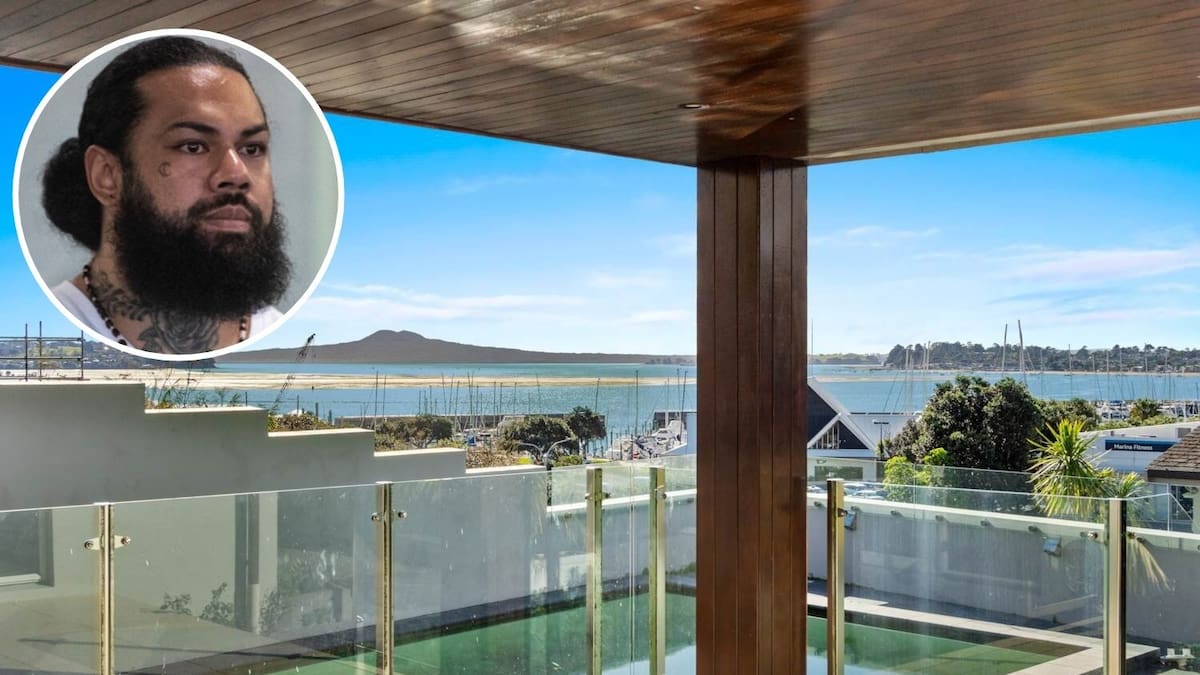
The most significant investment was a three-storey home in Half Moon Bay purchased for $3.8m in August 2023.
The five-bedroom, three-bathroom dwelling has a pool and panoramic views of the Hauraki Gulf stretching from the marina to Rangitoto Island.
The property was registered in the name of Viliami Havea but he never lived at the address.
Instead, Naufahu’s wife moved into the palatial home with their family.
Court documents show that the accountant, who has interim name suppression, had earlier incorporated a company in the name of Havea, who was an associate of the Comancheros, in March 2023.
Over the next six months, more than $3m was deposited into the bank account of Havea’s new business, which was purported to be a construction firm, in 76 transactions.
The funds had been paid by shell companies based overseas.
As well as paying the deposit of $250,000, Havea later completed the house purchase with payments of nearly $1.8 million into his lawyer’s trust account and a mortgage.
However, the mortgage was secured with forged tax returns which claimed that Havea had an annual income of more than $700,000.
That same year, Havea bought two businesses, a bar and neighbouring cafe in a small town north of Auckland, for just over $1.8 million.
The hospitality businesses were later sold by Havea to new owners shortly before Operation Scuba ended in March 2024.
The Half Moon Bay mansion was restrained under the Criminal Proceeds Recovery Act.
Under the law, police do not need to secure a conviction for frozen assets to be eventually forfeited.
They only have to show that someone profited from criminal offending to the lower standard of proof applied in civil cases – “on the balance of probabilities” – rather than surpassing the more difficult “beyond reasonable doubt” threshold for criminal cases.
Frozen assets are managed by the Official Assignee until a High Court judge rules on whether the assets should be permanently forfeited.
In this case, the property was sold at a mortgagee sale for $2,505,000 in July 2024.
The Comancheros motorcycle gang paid $3.8 million for a mansion in the upmarket Auckland suburb of Half Moon Bay with panoramic views of the Hauraki Gulf. Photo / Supplied
While Havea’s name was listed on the paperwork for the Half Moon Bay address and the hospitality businesses, Operation Scuba alleged that Pasilika Naufahu was the true owner.
For more than two years, the Comancheros president – who has been described by detectives as a charismatic figure in court – maintained his innocence.
But on the eve of the trial in the Auckland District Court this month, Naufahu changed his mind.
He pleaded guilty to participating in an organised criminal group and three counts of money laundering: nearly $1.8m for the Half Moon Bay house, about $99,000 in mortgage repayments, and more than $1m for the two businesses.
The 38-year-old will be sentenced in July.
Viliami Havea also admitted multiple counts of money laundering, as well as using an altered document and obtaining by deception in relation to the false mortgage documents.
The accountant denied all the criminal charges against him.
However, he was found guilty of money laundering, false accounting, using an altered document, obtaining by deception and participating in an organised criminal group following a trial at the Auckland District Court this month.
The accountant will also be sentenced in July.
Comancheros president Pasilika Naufahu is currently serving a nine-year prison sentence for drug and money laundering offences. His time in prison is expected to be longer after he recently admitted new money laundering charges. Photo / NZME
With Naufahu now admitting to the money laundering offences in Operation Scuba, the Herald can now reveal the Comancheros boss was also accused of smuggling 199kg of drugs while behind bars.
Two other Comancheros, Ulakai Fakaosilea and Jalal Safi, had already admitted using cellphones smuggled into prison to orchestrate the massive meth shipment which was hidden inside wheat thresher machines from Dubai.
They did not implicate their leader and there was no direct evidence tying Naufahu to the drug bust.
However, the Operation Brewer case relied on Naufahu’s own words to prosecute him in a trial last August.
In an encrypted message sent to all Comanchero members, Naufahu laid down a new set of rules that became known as “The Commission”.
The long and rambling decree said: “The purpose for implementing these measures is to maintain number one [ranking] in the underworld and, most of all, to protect the club and our members.
“War is inevitable in the underworld. It’s about preparation, determination, perseverance, dedication, commitment and staying Comanchero till da end.”
Funds paid to the Commission would be used to support the families of “members doing time for the club”, pay legal bills for those in court, polytech fees for anyone wanting to study, patching ceremonies and the annual Christmas party.
The commission would also pay for an “intel team” to build dossiers on the rival gangs “so if we ever go to war with anyone, da intel team will bring out their folder and we take them out”, while a separate “ghost team” would carry out any hits.
The new rules meant members would pay a 10% cut of their criminal earnings to the club, or $5000 for every kilogram of drugs sold by the “big movers and shakers” among the Comancheros.
Anyone found not paying the fees would lose their patch and be fined $200,000.
“Trust is earned, respect is given and loyalty is demonstrated,” Naufahu said.
“You betray any of these and you will lose all three.”
One of the gold-plated Harley-Davidsons seized from the Comancheros in 2019 following Operation Nova, which led to a nine-year prison sentence for the gang’s leader Pasilika Naufahu. Photo / NZ Police
In a novel move, Operation Brewer also relied on security camera footage from inside Rimutaka Prison where Naufahu was imprisoned with his underlings.
Played repeatedly during the trial last year, the footage showed Fakaosilea and Safi, who spent most of their days by Naufahu’s side, ducking into a cell on the day the 199kg drug shipment was delivered to a safe house.
Naufahu, meanwhile, continued to play chess on a picnic bench in the prison courtyard.
Timestamps on the CCTV and encrypted messages matched up to show that during the time Fakaosilea and Safi were in the cell together, the pair used smuggled cellphones to send orders to the group who had collected the drug shipment on their behalf.
Twenty-three minutes after the final message, Fakaosilea walked up to Naufahu and appeared to briefly interrupt his chess game.
Naufahu shuffled his feet and playfully shadow-boxed in his seat as Fakaosilea, doing an exuberant jig of his own, walked away.
There’s no audio to the footage. But prosecutors at the trial told Judge Belinda Sellars that Naufahu must have been told something along the lines of: “it’s done”.
So was the “happy dance” to celebrate the successful 199kg drug shipment and a looming financial windfall for the Comancheros?
Defence lawyer Ron Mansfield KC said that was an unsafe assumption, rather than incriminating evidence.
It could have just as easily been to celebrate an impressive chess move or a response to ribbing from his underling, he said, describing his client as always outgoing and animated.
“None of these inferences are available,” Mansfield told the judge during his closing address. “It just requires speculation that is untenable.
“We’re stretching the work of inferences here to the worst extreme, in my submission, and it shouldn’t be permitted. There needs to be real and reliable evidence, and there’s simply not.”
In the end, Judge Belinda Sellars agreed.
While the judge acknowledged that the facts and circumstances of Operation Brewer raised a “high degree of suspicion”, she said there was not enough evidence to prove Naufahu’s knowledge of the 199kg shipment.
Naufahu was acquitted on the charges of importing and possessing methamphetamine for supply, and participating in an organised criminal group.
Jared Savage covers crime and justice issues, with a particular interest in organised crime. He joined the Herald in 2006 and has won a dozen journalism awards in that time, including twice being named Reporter of the Year. He is also the author of Gangland, Gangster’s Paradise and Underworld.