

Key events
Show key events only
Please turn on JavaScript to use this feature
European stock markets have made a muted start to trading at the start of June.
London’s FTSE 100 share inde has dropped by 30 points at the start of trading, with precious metals miners Fresnillo (-2.8%) and Endeavour Mining (-2.6%) leading the fallers, followed by defence firms BAE Systems (-2%) and Babcock (-2.3%).
Elsewhere, Germany’s DAX is up just 0.06% while France’s CAC 40 has dipped by 0.1% and Italy’s FTSE Mib is completely flat.
Wall Street is on track to open a little higher, though.
Matt Britzman, senior equity analyst at Hargreaves Lansdown, says there is a ‘split tone’ in global markets:
double quotation markThe tug of war for investors remains much the same: strong corporate earnings and AI-led optimism are still doing plenty of heavy lifting, but elevated bond yields, firm oil prices, and uncertainty over the path for interest rates are keeping a lid on the enthusiasm.
ShareeasyJet shares surge 11% after attracting takeover interest
UK airline easyJet has hit out at private credit firm Castlelake for considering a ‘highly opportunistic’ takeover bid.
On Friday, Castlelake said it was in the “early stages of considering a possible offer” for easyJet, but had not approached to the company’s board.
This morning, easyJet told the City that it would consider a proposal, and be “especially mindful of its valuation and deliverability”.
The airline added:
double quotation markValuation: the Board notes the highly opportunistic timing when easyJet’s share price is temporarily depressed due to the current situation in the Middle East and its impact on customer confidence and jet fuel prices.
Deliverability: the Board notes the considerable regulatory, financial and other execution challenges associated with a potential takeover of easyJet.
Shares in easyJet have jumped by 11% at the start of trading to 442p, their highest level in three months.
The 0.6% drop in UK house prices last month is the biggest decline since June 2025, Nationwide’s data shows.
Economists polled by Reuters had expected a smaller drop, of 0.2%. [corrected].
Updated at 03.13 EDT
UK house prices fall: What the experts say
Here’s some snap reaction to the news that UK house prices dropped last month for the first time this year:
Tom Bill, head of UK residential research at Knight Frank:
double quotation mark“This is further evidence that the housing market slowed down at precisely the time of year when you would expect momentum to be building. There won’t be a cliff-edge moment, but the impact of higher borrowing costs will erode spending power and squeeze house prices this year as mortgage rates agreed before the Middle East conflict gradually disappear.
With the Bank of England likely to sit on its hands for the foreseeable future, we expect minimal house price growth in 2026, with uncertainty around the Budget and ideological direction of the government likely to keep a lid on activity.”
Nathan Emerson, CEO of Propertymark, comments:
double quotation mark“Stable house prices will be welcomed by many buyers and sellers looking for greater certainty in the market after a prolonged period of economic volatility. Buyers who need to move are continuing to act decisively, particularly where mortgage rates have stabilised, and supply levels remain constrained.
“Many households are continuing to carefully assess affordability before making decisions, particularly as mortgage costs remain higher than many borrowers have become accustomed to over recent years. However, steady pricing can help support confidence and encourage more balanced negotiations between buyers and sellers.”
Amy Reynolds, head of sales at Richmond estate agency Antony Roberts:
double quotation mark“Despite concerns about the conflict in the Middle East, demand continues to hold up for well-priced, high-quality homes and the closer the asking price is to true market value, the greater the likelihood of securing a successful sale. Buyers are not stretching to make offers they don’t believe will be accepted – they are simply choosing alternative properties.
In certain price brackets, buyers have the luxury of choice and vendors need to be mindful of this. While the wider economic backdrop may temper the pace of growth, we are seeing a more price-sensitive market where realism and accurate positioning are key.”
Nationwide’s Robert Gardner also predicts that the UK housing market could pick up strrength if the Middle East crisis eases:
double quotation markHousing affordability had been improving steadily in recent years due to a combination of income growth outpacing house price growth by a wide margin and a modest decline in borrowing costs.
“While market interest rates have risen in recent months, the impact on affordability has so far been modest. Indeed, swap rates, which underpin fixed‑rate mortgage pricing, remain well below the highs reached in 2023 and are broadly in line with levels prevailing in 2024, implying only a partial reversal of earlier gains.
“This provides some confidence that, if the latest shock passes relatively quickly, and energy prices normalise in the quarters ahead, any near-term softening in the housing market will also prove short lived.”
Photograph: NationwideShare
This chart shows how UK house prices have now dipped back from their record high:
Photograph: NationwideShareIntroduction: House prices fell in May
Good morning, and welcome to our rolling coverage of business, the financial markets and the world economy.
UK house price fell last month for the first time this year, as the Iran war drove up borrowing costs and weakened demand.
Lender Nationwide has reported that prices fell by 0.6% in May, the first monthly drop since last December, as the recent rise in mortgage rates weakened demand from buyers.
That pulled the annual rate of house price inflation down to 1.7% in May, down from 3% in April, with the average price of a property now slipping to £278,024.
A chart showing annual UK house price Photograph: Nationwide
Robert Gardner, Nationwide’s chief economist, says:
double quotation mark“Given the uncertainty caused by developments in the Middle East and the subsequent rise in energy prices and market interest rates, some loss of momentum was to be expected. Indeed, consumer confidence has weakened noticeably since the start of the conflict, with GfK’s headline index falling to its lowest level since late‑2023 in April, with only a marginal increase in May.
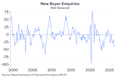
“Measures of housing market sentiment have also deteriorated. The Royal Institution of Chartered Surveyors reported a sharp fall in new buyer enquiries in March, taking the index to its weakest reading since 2023 and remained deep in negative territory in April
 Photograph: Nationwide
Martin Beck, chief economist at WPI Strategy, says this suggests the UK housing market’s recent resilience is “being tested” by the rise in borrowing costs after the Middle East crisis began.
Beck added:
double quotation mark“May’s fall should not be overinterpreted, but it does underline the pressure facing buyers. Weak consumer confidence, sluggish income growth and mortgage rates that remain far above the ultra-low levels seen for much of the last decade-and-a-half are continuing to weigh on affordability.
“While those headwinds make it hard to see house prices returning to consistent growth in the near-future, the US-Iran ceasefire and recent diplomatic developments have reduced the risk of a more severe shock to inflation, borrowing costs and the housing market.
UK average mortgage rates did drop at the end of last week, amid hopes of a breakthrough in the US-Iran peace talks.
But generally, the market is tough, especially for first-time buyers. They face the most challenging conditions since the financial crisis, the boss of Britain’s largest housebuilder warned last week.
The agenda
7am BST: Nationwide house price index for May
9am BST: Eurozone manufacturing PMI for May
9.30am BST: UK manufacturing PMI for May
3.30pm BST: Sir Alan Bates to give evidence to MPs on government compensation schemes
Updated at 02.17 EDT