
Editors’ Note: This essay is a part of a short series on AI and Pope Leo XVI’s May 26, 2026 encyclical Magnifica Humanitas. A round-up with links to all essays will be available later this month.
It seems that whenever a new technology is introduced, the generation who came of age without it bemoans its use among the young. When I was a child, this was certainly the case with calculators. Our parents and teachers warned us that by mindlessly plugging numbers into a keypad we were allowing important cognitive abilities to atrophy—abilities that have all sorts of utility even outside of math class. Even though we knew our elders had a point, most of us simply rolled our eyes and carried on. Who wants to memorize all those multiplication tables, anyway?
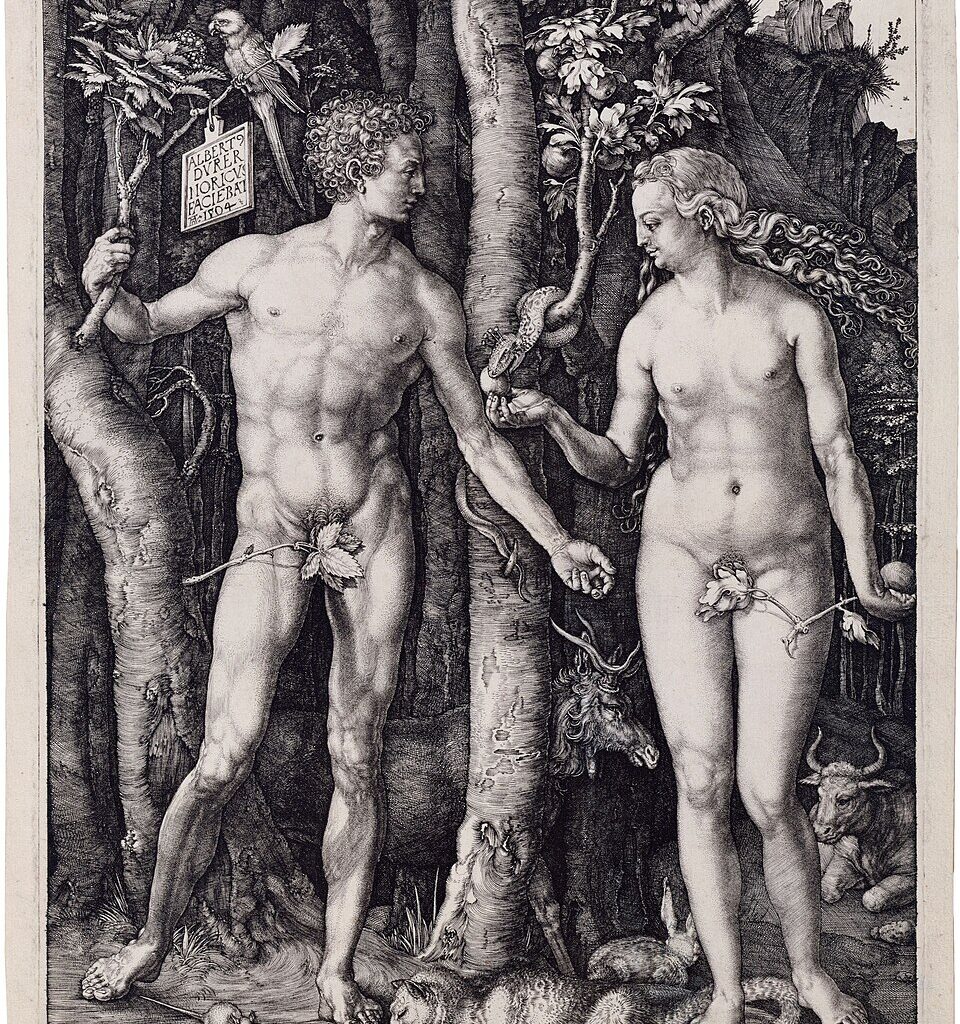
While some would consider current misgivings about Artificial Intelligence to be equally worthy of dismissal, others (including me) would beg to differ. In fact, I intend to make the case that, as a technological innovation, AI is unique (and, indeed, uniquely dangerous), especially when understood in light of Christian anthropology. Its uniqueness and danger lie in its ability to perform tasks that—according to the creation narrative of Genesis—define our purpose and identity as humans. Among them: (1) Our ability to use language to make sense of things, (2) our ability to provide companionship to one another, and (3) our ability to bring beauty into the world through the arts. Without discounting the gains that come from the use of AI, it’s clear that, by outsourcing our thinking, loving, and creating to machines we’re outsourcing not just our labor but perhaps the very things that, according to the first two chapters of Genesis, make us human.
Outsourcing our Words
For much of the creation story, God is the sole speaker, using the power of his Word to summon the world into being. Eventually, however, we learn that the Lord has bestowed this same faculty upon one of his creatures—the human. Forming the animals from the very soil from which the human was taken, God then presents them to him “to see what he would call them” (Gen. 2:19b). And so, with the permission of his Maker, the human gives each animal a unique syllabic label—a verbal coding system that allows him to efficiently differentiate the huge animal with the prodigious nose and big floppy ears from the green scaly creature with great snapping jaws that lives in the river.
With the ability to verbalize the difference between these creatures, the human can then classify them into a hierarchy of categories—species, genus, family, order, and so on. In short, he can use the power of words—his logic— to make logical sense of the logical world that he inhabits (a world that owes its very existence to the Word or Logos).
This, it seems, is a uniquely human trait. Only we can use the power of speech to comprehend both our physical and metaphysical reality. But not only that: Only we can use that same power of speech to communicate our understanding of reality to other humans so that they too can know what we know.
Until just a few years ago, this was believed to be a peculiarly human trait. But now, with machine-based learning, we can outsource to an algorithm our ability to make sense of things. I have been told (and I don’t doubt) that enormous blessing can flow from this—from researching, detecting and treating cancer to finding solutions to climate change. But, as so many have already noted, the dangers to the average user are significant. Ethical concerns aside, a student who uses an LLM like Chat GPT to formulate the thesis and outline of her anthropology term paper (instead of grappling with these complex ideas on her own) is forfeiting something precious about her God-given humanity.
Outsourcing Companionship
Although the Lord creates many animals, presenting each in turn for the man to name, we learn that, among them “there was not found a helper as his partner” (Gen. 2:20). When it comes to his vocation of tilling and keeping the garden, the man needs the partnership of one who is like him and yet, at the same time, different. And so the Lord creates woman, fashioning her—not from the soil—but from the man’s side. Thus, the problem of human loneliness has been resolved and, based on the man’s jubilant response (“at last, bone of my bone and flesh of my flesh!”) he is very pleased indeed.
Here, we learn that humans were meant to live in companionship with one another—in marital partnerships, yes, but also in friendships defined by mutual, self-giving love. Karl Barth understood this as the very way in which human beings reflect the image of their creator—a God who exists in an I-thou relationship, not only with creation, but within himself as Father, Son, and Holy Spirit.
Companionship, however, is difficult. For aside from being a comfort and delight, our fellow humans can also be something of a nuisance. Longing for affirmation from others, we find ourselves, instead, subject to criticism. Offering a word of correction in love, we’re met, not with appreciation, but scorn and hostility. Again and again, we’re disappointed by the flaws and failings of our neighbors. Again and again, we let them down through our own. It’s understandable, then, why tech entrepreneurs have identified a lucrative market for virtual companions—perfect partners available every hour of the day to meet every emotional need; partners who are capable of measureless empathy (or, at least, the simulacrum of it), never too tired to listen, never making demands of their own.
The dangers of relying upon such AI “companions” has been covered at length elsewhere. Suffice it to say that no algorithm could ever serve as substitute for genuine human fellowship. When God observed that it is not good for the man to be alone, he did not send an angel as a companion (much less a large language learning model). He sent another human being. When we rely upon AI for companionship; when we abdicate our calling to be our brother’s keeper, allowing a robot to do the job instead, our humanity is dangerously compromised.
Outsourcing Fruitfulness
After creating humanity in his own image, the Lord immediately pronounces blessing upon them: “Be fruitful and multiply, and fill the earth and subdue it” (Gen. 1:28). True, this blessing of fruitfulness—the call to bear, beget, and propagate the species—is not unique to humans (see Gen. 1:22). However, it could be argued that in humans alone, this fruitfulness extends beyond sexual reproduction and into the realm of creativity—the weaving of myths and stories, the composition of music and poetry, the making of paintings, drawings and sculptures.
J.R.R. Tolkien coined the term “sub-creation” to describe this unique human ability. Although unable to summon things into being ex nihilo, we can nonetheless use what the Creator has already made, combining them in a potentially infinite number of configurations to fashion unique creations of our own. In this way, we bring beauty into the world—beauty that reflects the greater beauty of God’s vast and intricate design.
Up until the last decade, creativity was seen as a power peculiar to humans—a power that no machine would ever be able to replicate. But now, by plugging a few prompts into an AI image generator, it is possible for me (a person with little or no artistic talent or training) to “create” an utterly unique, Renaissance-styled painting of the Greek myth of Pygmalion and Galatea. With a few strokes on a keyboard, my 8-year-old daughter can “compose” a funny song about a kangaroo and a hippopotamus in a high-speed car chase—even uploading it to a streaming platform for sale. Leaving aside the question of whether such “creations” truly constitute art, it’s safe to say that such a use of Artificial Intelligence is yet another capitulation of our God-given humanity; namely, our God-given capacity to produce and create.
Even though Artificial Intelligence poses unique dangers, it would be both inaccurate and irresponsible for us, as Christians, to dismiss it as wholly evil. And even if we were to label it as such, it would remain a technology we’re forced to grapple with. So it’s worth asking: Aside from what has been stated above, are there other ways in which AI dehumanizes us? Is it possible to use AI sparingly and wisely to augment instead of encroach upon our God-given identity and vocation as humans? What guidance can we offer a younger generation of Christians being raised in a world where such technology is ubiquitous? In the coming years, it will be crucial for us to wrestle with such questions. Our humanity is at stake.

The Rev. Terence Chandra is an Anglican priest serving at Stone Church in Saint John, New Brunswick, Canada. He and his wife (the Rev. Jasmine Chandra) also run Pennies and Sparrows, a non-profit organization that ministers to marginalized people in their community.