
Australian capital cities that appear most “overvalued”, and potentially more vulnerable to the nation’s housing reckoning, have been identified in new analysis.
Controversial tax reforms and economic pressures have been credited with pushing prices down across the country, with early signs investors are turning away from the market.
Prices fell 0.9 per cent in Sydney and 0.8 per cent in Melbourne last month alone, as some economists predict downturns of up to 10 per cent in major markets this year.

New analysis of Real Estate Institute of Australia data by AMP chief economist Shane Oliver suggested Brisbane was the most overvalued capital city when comparing long-term prices to rental yields.
Mr Oliver shared the results on Monday saying recent trends in the property market “may mean the 30-year super cycle upswing in prices may be close to over”.
When adjusted for inflation, Brisbane houses were 57 per cent overvalued, with Sydney second at 42 per cent and Adelaide third at 40 per cent.
Brisbane (33 per cent) and Adelaide (30 per cent) were also in the top three for overvalued units, along with the nation’s capital Canberra (30 per cent).
“It’s basically another indicator showing that home prices are overvalued … particularly for houses and notably in Brisbane, Adelaide and Sydney,” Mr Oliver told news.com.au.
“It doesn’t mean though that prices are going to fall really sharply as most valuation measures for housing have suggested excessive valuations for years and a sharp fall would require something like much higher mortgage rates or unemployment, both of which seem unlikely.
“Rather, I think the relativities between homes and units and cities may be a guide to which parts of the market are most vulnerable in the current property slowdown.”
Mr Oliver is not the first to state the federal government’s new capital gains tax and negative gearing settings could end the housing super cycle, which is characterised as a prolonged period of expansion.
Prices began skyrocketing in the late 1990s, and accelrated over the past decade fuelled by a growing population, tightening supply and previous tax settings that encouraged people to speculate on property.
It comes on the back of three interest rate hikes in 2026, with more potentially on the horizon, inflation hitting household budgets and tax reforms reducing incentives for property investors.
Centre for Independent Studies chief economist Peter Tulip, however, did not agree with the methodology of using long term prices and rental yields to judge what was overvalued.
The ex-Reserve Bank of Australia (RBA) and US Federal Reserve expert said homes that tended to be higher on that scale were located in inner city areas where capital growth was also greatest.
“The price to rent ratio in Australia is an upward trending series,” he said. “Every decade it’s higher than it has been before.”
Mr Tulip said yields had declined as interest rates also fell, and believed a better indication of value would be if someone was better off financially renting or paying a mortgage.
He was also not convinced the changes to CGT and negative gearing as applied to property would have the significant impact on prices proponents – and critics – predicted.
“As Treasury says in the budget papers, the tax changes will reduce house price growth by about two per cent,” he said. “So it’s just tiny.”
The Brisbane and Adelaide markets have been among the fastest growing in Australia, with house prices in the Queensland capital growing $173,500 in the past year.
Brisbane hit a high of $1.08 million for all dwellings in May, with PropTrack data recording its median house price rising 15 per cent over the past 12 months to $1.236 million.
In Adelaide the median house price rose to $1.025 million last month having grown $118,900 in the last year and a staggering 85.3 per cent in the past five years.
REA Group senior economist Angus Moore said this week that Adelaide’s prices had more than doubled since 2020, partly driven by interstate migration.
But he said low stock and quickly rising prices meant “affordability in South Australia now is really quite strained”.
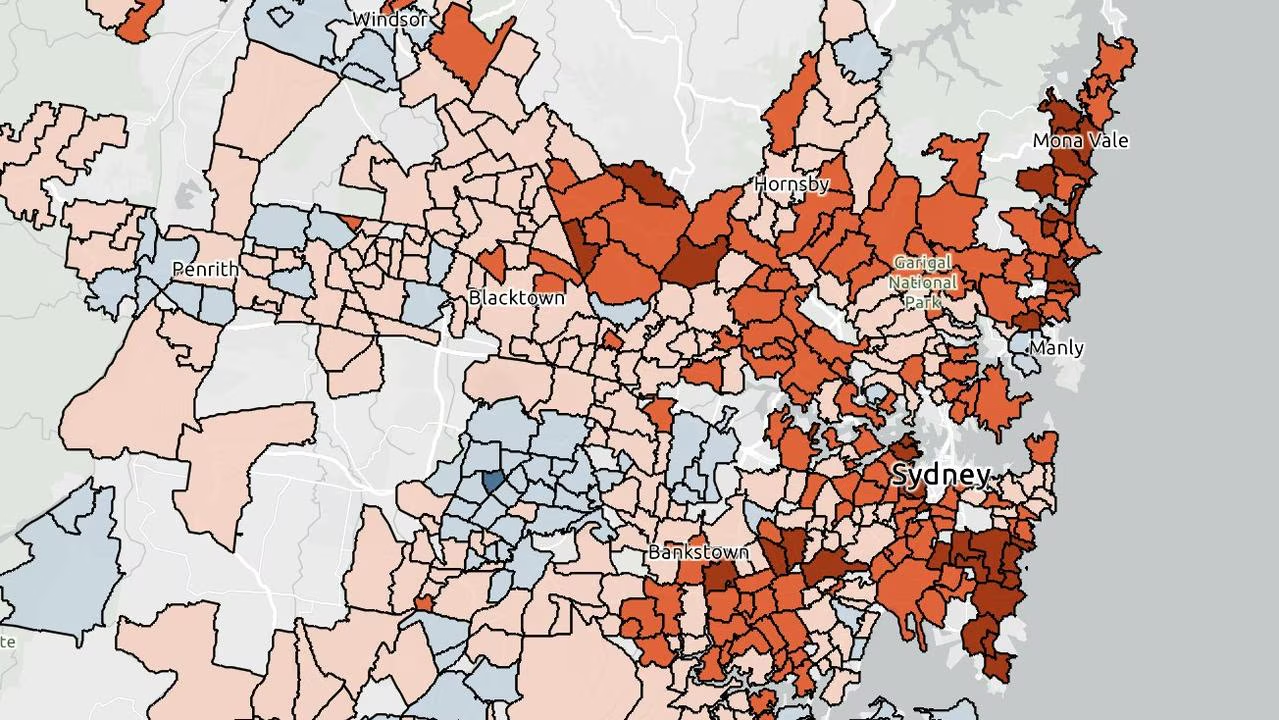
Meanwhile, data from Cotality shows house values in several suburbs inner Sydney have fallen by five to eight per cent over the past three months.
They include sought-after suburbs such as Randwick, Coogee, Clovelly, Glebe, Balmain, Dee Why, Mona Vale and Narrabeen.
Melbourne also saw similar falls over the past three months, particularly in the up-market inner east and southeast suburbs.
News.com.au reported on Monday tens of thousands of Australians could be “devastated” by house price corrections in Sydney and Melbourne after entering the market using the federal government’s five per cent deposit scheme.
SQM Research managing director Louis Christopher said homebuyers who borrowed huge mortgages could now be facing negative equity and find it difficult to sell.
Treasurer Jim Chalmers on Tuesday faced questions over the five per cent deposit scheme after internal RBA notes, published in the Nine Newspapers, stated it had pushed up house prices last year.
Speaking on Today, Mr Chalmers focused on the reforms announced in the May budget to argue the government had “done a lot since the first term” to make housing more affordable.
“What they mean is when first-home buyers go to an auction they’re less likely to be competing with someone whose already bought five, or 10 or 15 established homes, that’s one of our objectives here,” he said of the tax reforms.
Mr Oliver noted in a blog post this week a resumption in interest rare cuts and resolution to the oil shock being felt in Australia’s economy could lead to stronger property prices next year.
“In terms of the 30-year super cycle upswing – many of its key drivers are now fading but the supply shortfall is key,” he wrote.
“If it closes quickly thanks to stronger supply or a faster fall in immigration, then the super cycle upswing may well be over.”