

This article first appeared in The Edge Malaysia Weekly on May 25, 2026 – May 31, 2026
MALAYSIA’S fund management industry appears to be entering a phase of consolidation, as high operating costs, mounting fee pressures and the growing importance of scale nudge firms towards mergers and acquisitions.
A string of recent deals between major players suggests the trend is accelerating.
Among the transactions was Affin Bank Bhd’s (KL:AFFIN) acquisition of Pheim Asset Management Sdn Bhd for RM50 million, which was completed in April. The deal was intended to strengthen the bank’s asset management and wealth management capabilities. As at March 31, Pheim AM had RM832.8 million in assets under management (AUM) and advisory, serving institutional, corporate and retail clients.
Separately, Japan-linked Amova Asset Management proposed last December to acquire a controlling stake in AHAM Asset Management Bhd (AHAM Capital), formerly known as Affin Hwang Asset Management. If the deal goes through, Amova Asset Management’s stake in AHAM Capital will jump from 20% to 97.7%. Upon further negotiation, Amova, formerly Nikko Asset Management Co Ltd, intends to acquire all of AHAM Capital.
AHAM Capital, which has stakes in private equity firm Bintang Capital Partners Bhd and digital wealth platform Versa Asia Sdn Bhd, said AUM had surpassed RM100 billion as at Nov 30, 2025, “placing it among Malaysia’s three largest asset managers”.
A fortnight ago, The Edge, quoting sources, reported on the management buyout of MIDF Amanah Asset Management Bhd by its CEO Shan Kamahl. A disclosure in parent company MBSB Bhd’s (KL:MBSB) 2025 annual report stated that its unit Malaysian Industrial Development Finance Bhd (MIDF) had on March 11 entered into a share sale agreement with an undisclosed third party for the proposed disposal of its entire stake in MIDF Amanah.
Unlike pure retail-focused unit trust managers, MIDF Amanah’s business also includes institutional mandates for pension funds, takaful operators and statutory bodies, giving it a more diversified AUM profile anchored partly by long-term institutional relationships.
“We are seeing a more diverse ecosystem comprising traditional active managers, boutique firms, Islamic asset managers, digital wealth solutions and increasingly specialised investment capabilities.
“Overall, the industry remains well positioned, but firms are increasingly required to adapt their business models to remain relevant and competitive,” the Federation of Investment Managers Malaysia (FIMM) tells The Edge.
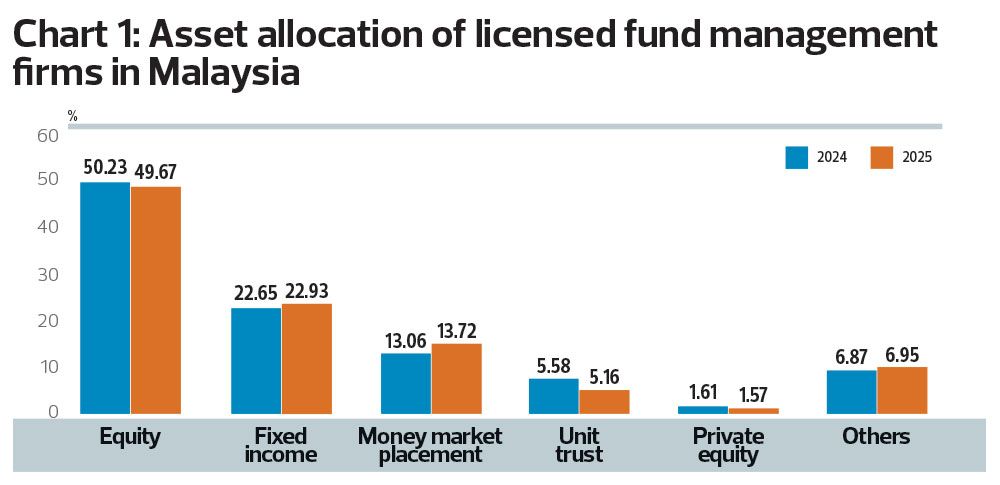
Malaysia’s fund management industry had grown into a RM1.14 trillion sector in 2025, according to the Securities Commission Malaysia (SC), with unit trust funds accounting for nearly half of total AUM, followed by the Employees Provident Fund, corporate bodies and wholesale funds. The increasing concentration of assets among larger players, with almost 54% of industry AUM controlled by just five firms, is telling of scale becoming an important competitive advantage within the sector (see Chart 1).
According to SC, there were 58 fund managers in the country as at March 31, 2026.
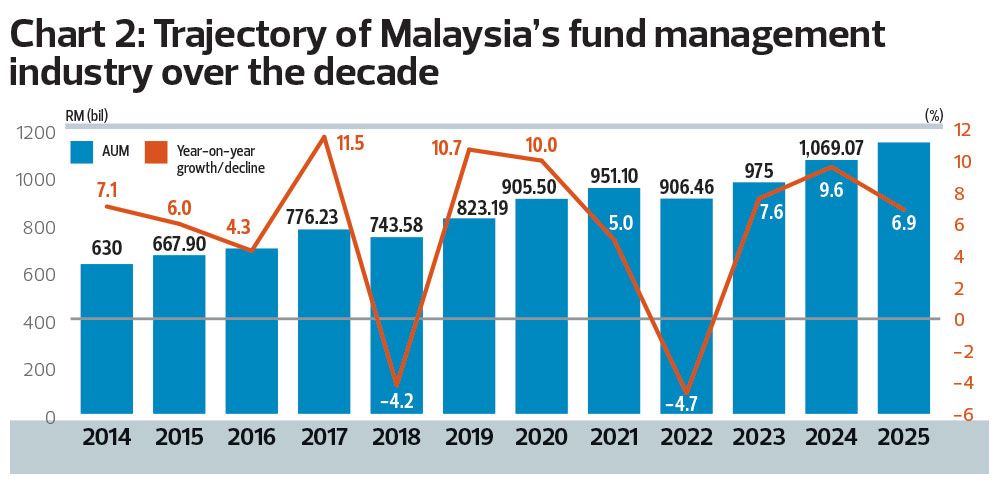
Malaysia’s AUM year-on-year growth of its fund management industry appears to have tapered over the years since 2019. Fund managers have pointed out, however, that the high single-digit percentage averages were considered “healthy” (see Chart 2).
“After all, over the long term, they are tied to savings and income growth,” Tradeview Capital CEO Ng Zhu Hann tells The Edge.
“Slower growth is usually tied to macroeconomic conditions and stock market performance. I believe the growth slowdown in 2024 and 2025 stems from global tariff announcements and broader uncertainty, which triggered sharp declines in capital markets and dampened investors’ risk appetite.”
Fee and margin compression, distribution capabilities, high costs
“Fund management is a challenging industry to be in. A manager can’t just collect management fees without performing. Failing to perform for consecutive quarters puts a fund management firm at risk of having its quota reduced by [high-performance] clients like the Employees Provident Fund (EPF). There’s fierce competition with fund and asset management giants like Public Mutual Bhd, AHAM Capital and Principal Asset Management, which have the banking network, large distribution sales force and established pool of high-net-worth clients,” says Tradeview’s Ng.
“Pheim has the trust of EPF as one of their largest clients in terms of AUM size, but being an independent fund management firm, it does not have a strong distribution network unlike bank- or insurance-backed fund management companies. Once the fund management firm’s AUM declines, margin compression hits.”
Ng deems Affin’s acquisition of Pheim a good deal for both parties and a strategic move for the bank to complement its offerings. FIMM concurs, pointing to the pressures placed on margins by rising operating costs, including compliance and technology-related investments, and competitive fee structures.
According to a veteran at a large Malaysian fund management company who requested anonymity, consolidation is being driven largely by economies of scale.
He points out that while the Malaysian fund management industry surpassed the RM1.1 trillion mark in AUM in 2025, after RM1.069 trillion in 2024, the market remains relatively concentrated, with the top five FMCs controlling 53.83% of total AUM in 2024.
“In this environment, it is harder for smaller firms to absorb the fixed costs of research, compliance, technology, product development and distribution while also competing on fees,” the veteran explains.
“In addition, fee pressure is a real structural issue. Malaysia’s traditional agency model has historically relied on relatively high commissions, while lower-cost digital channels have put pressure on that model and overall pricing in the industry. The short answer is: Smaller independent firms can still compete, but they need a clear niche, strong investment performance, and a distribution model that works. Without that, the economics become difficult to sustain.”
While the terms “fund management” and “asset management” are often used interchangeably, the former is the regulatory term used in Malaysia for licensed investment managers, whereas the latter refers to the broader business of managing investments and wealth across multiple asset classes and client segments.
“Fee compression remains one of the biggest pressures,” says the veteran, noting that investors are becoming more price-sensitive and lower-cost digital alternatives are resetting expectations.
He says distribution is another major challenge, as investments in Malaysia are still largely sold rather than bought, making it harder for firms without strong distribution networks to scale. Firms must also continue investing in technology, data, client servicing, product innovation and regulatory capabilities despite tightening margins.
“The industry is also being asked to do more for clients,” he adds, pointing to growing demand for broader product offerings, advisory services, alternative investments, retirement solutions and digital access.
FIMM emphasises the importance of investment attractiveness and policy environment in today’s economic climate.
It notes that policy measures and tax incentives can help shape investor behaviour and encourage participation in regulated investment products, citing the RM3,000 tax relief for the Private Retirement Scheme, which has supported retirement savings and contributed to gradual growth in PRS assets under management — a reflection of rising adoption of long-term retirement planning solutions.
FIMM also points to tax exemption on foreign-sourced income for qualifying investment income until 2032, saying it has provided greater clarity to market participants and supported portfolio diversification across global markets. It adds that such measures help sustain Malaysia’s investment appeal, support the development of the fund management ecosystem, and broaden investment choices for investors.
FIMM points out that talent and capacity development remain a key challenge, particularly in specialised areas such as alternatives, environmental, social and governance investing, quantitative strategies and digital capabilities.
“[The industry also needs] continuous investment in digital infrastructure, cybersecurity, data analytics and investor engagement platforms to meet evolving investor needs. These investments also contribute to higher operational complexity and cost considerations for industry players,” it says.
Better resources to benefit investors
In recent years, SC has focused on strengthening Malaysia’s investment management industry through digitalisation, sustainable and Islamic investing, private market development and greater retail participation under its Capital Market Masterplan 3.
While the regulator has not directly called for consolidation, industry players say rising compliance standards, technology investments and governance requirements are increasingly favouring larger and better-capitalised firms.
From FIMM’s perspective, further consolidation may benefit investors if it results in stronger, more efficient market participants with enhanced capabilities such as research, risk management, technology and product offerings.
“It is important, however, that such developments do not undermine market competition, innovation or investor choice,” it cautions. “Ultimately, the key consideration is whether consolidation leads to improved service quality, governance standards and long-term value creation for investors.”
“Consolidation can benefit investors if it leads to better resources, broader product ranges, stronger risk management and more consistent client servicing,” says the fund management veteran.
“Larger platforms may be better able to invest in technology, digital distribution, research and product innovation.”
He cautions, however, that while consolidation can improve scale and capabilities, it may also reduce market diversity if too many boutique managers disappear, arguing that the best outcome is a balance between scaled platforms and specialist players.
He envisions that in the next five years, the fund management industry is likely to be more polarised, with a smaller number of larger multi-asset platforms, along with a handful of specialist boutiques that survive by being highly differentiated.
“The winners are likely to be firms that combine scale, strong distribution, digital capability and clear investment specialisation,” he says.
He also expects greater emphasis on wealth solutions, shariah capabilities and alternatives as clients increasingly look for more than plain-vanilla exposure.
“In short, the industry will probably be more competitive, more concentrated and more outcome-focused than it is today,” he concludes.
Save by subscribing to us for
your print and/or
digital copy.
P/S: The Edge is also available on
Apple’s App Store and
Android’s Google Play.