
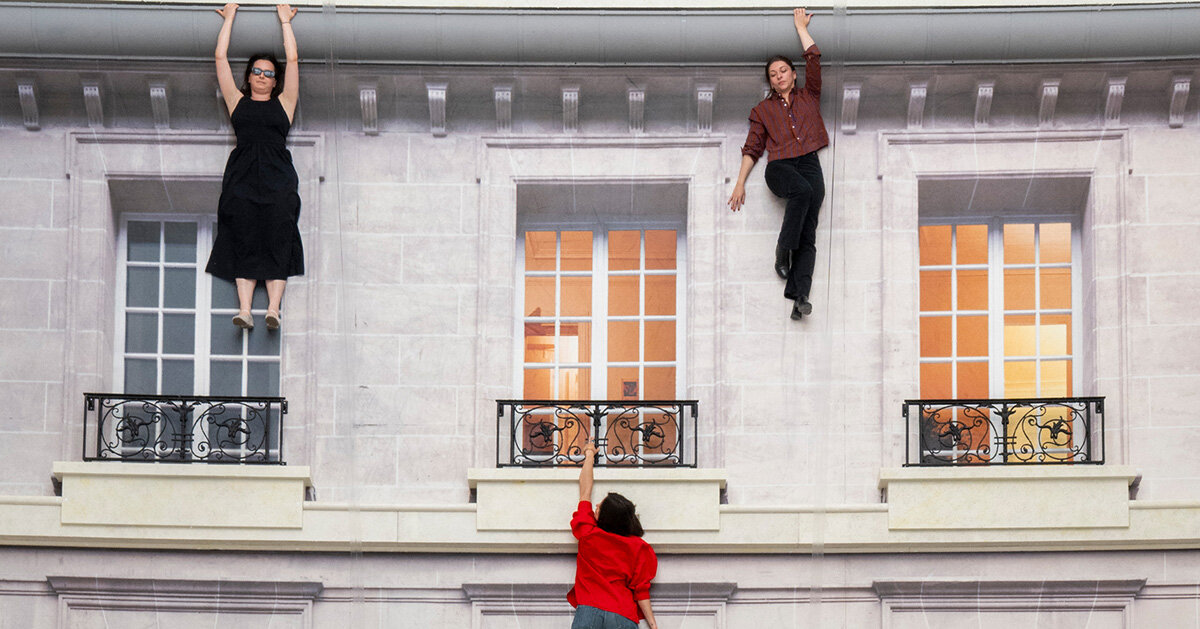
eandro erlich questions reality through architecture
Leandro Erlich takes over Paris’ Grand Palais with his first major monographic exhibition in the French capital, bringing together landmark installations, new works, archival material, and an extensive presentation of models and studies. The retrospective traces more than three decades of a practice devoted to questioning reality through participation and spatial experience.
For more than thirty years, the Argentinian artist has transformed the ordinary into something strangely unstable. A staircase becomes an infinite void, a building facade turns into a stage for impossible acts of gravity, clouds drift indoors, and a domestic interior suddenly begins to undermine everything we thought we knew about space and perception.
all images © Didier Plowy for GrandPalaisRmn, unless stated otherwise
exploring perception inside the grand palais retrospective
The exhibition immerses visitors in a succession of environments where familiar architectural forms are continuously transformed. Houses, windows, elevators, staircases, corridors, and urban facades appear throughout the exhibition as instruments through which perception is tested and reality destabilized. The effect is playful and often humorous, yet beneath the spectacle lies a sustained investigation into how we construct our understanding of the world.
Architecture has always occupied a central place in Erlich’s work, a fascination that can be traced back to his upbringing in Buenos Aires, where he was born in 1973 to an architect father. Yet his interest lies less in buildings themselves than in the experiences they generate. As he notes in the exhibition, ‘I am less interested in architecture for its function than for the experiences it creates. Art emerges precisely where that functionality begins to dissolve.’ Throughout the show, architecture becomes a medium for storytelling, uncertainty, and transformation.
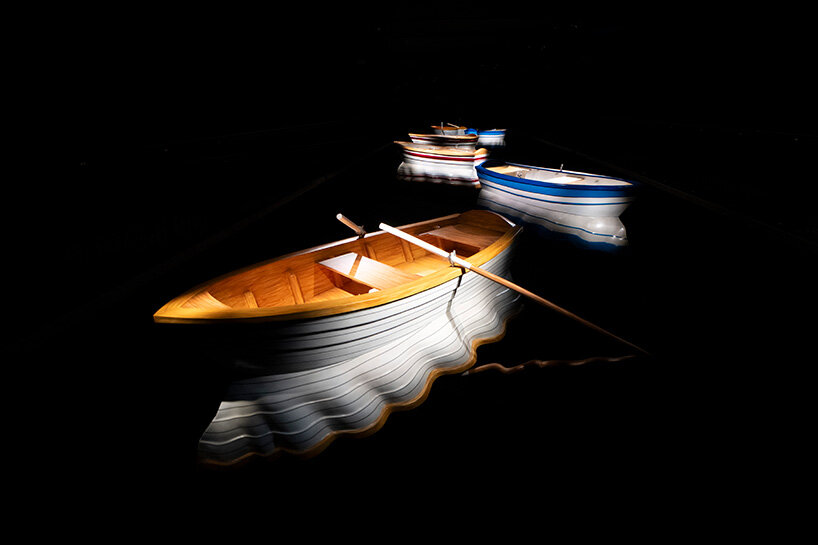
This approach is perhaps most evident in works that manipulate scale, gravity, and reflection. In Port of Reflection, a fleet of rowing boats appears to float upon a dark, still body of water. A closer look reveals something altogether stranger. Each vessel is paired with an inverted twin, producing the illusion of a perfect reflection without a drop of water in sight. Elsewhere, clouds materialize indoors in The Cloud, a series of ethereal forms composed from layered sheets of printed glass, evoking the poetry of natural phenomena and the fragile mechanisms through which perception operates. ‘I like to think that clouds are the very first form of human art. Before we even sculpted clay or drew figures on the walls of caves, we looked at the sky and found shapes in clouds,’ Erlich remarks.
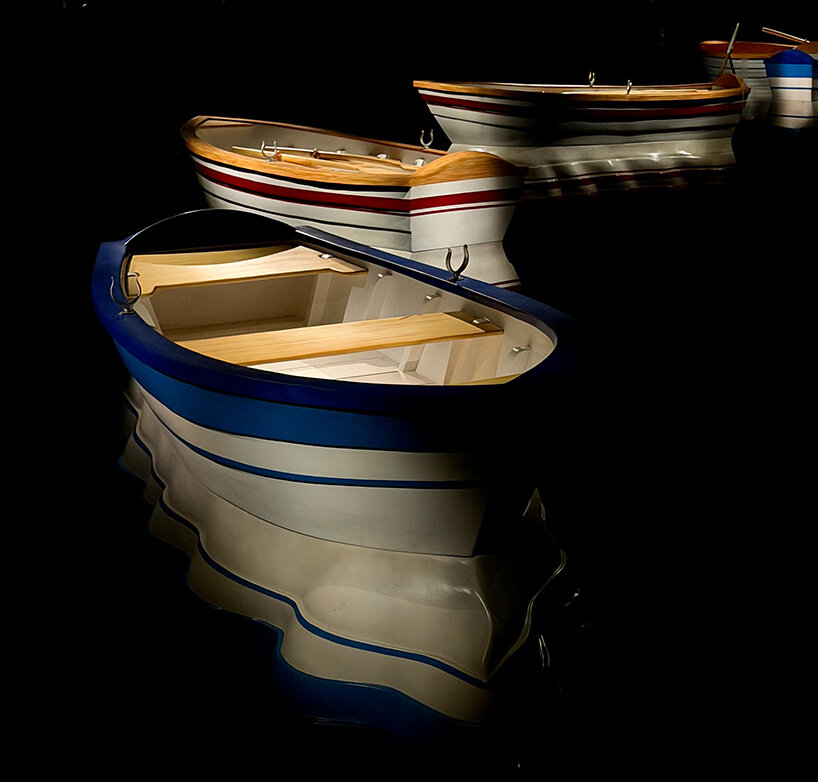
Port of Reflections, 2014 | image ©designboom
models and preparatory studies reveal the creative process
One of the most compelling aspects of the exhibition is its decision to expose the machinery behind these experiences. For the first time, Erlich presents an extensive collection of models, prototypes, and preparatory studies that reveal how he conceives his installations. Displayed throughout the galleries, miniature labyrinths, distorted facades, floating houses, environmental interventions, and impossible architectural scenarios offer an unprecedented glimpse into the artist’s process.
The models also demonstrate that spectacle is never the final destination. While Erlich’s works are often celebrated for their visual surprises, he consistently insists that illusion serves merely as a point of departure. ‘My work is close to kinetic art, but the surprise generated by my optical illusions is a starting point rather than a conclusion,’ he explains. ‘That is the moment the experience begins, and becomes interactive.’
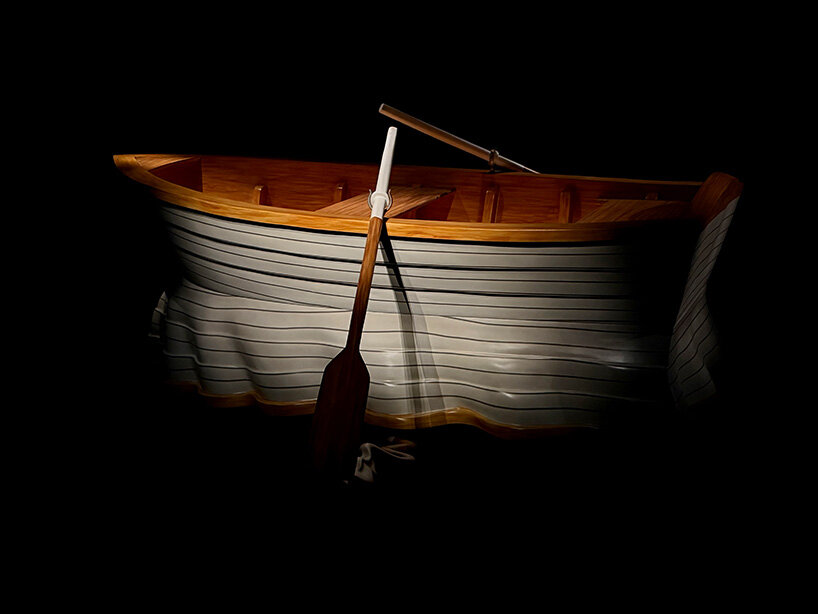
a fleet of rowing boats appears to float upon a dark, still body of water | image ©designboom
bâtiment and the role of participation in erlich’s work
Erlich frequently describes his audiences as collaborators, and many of his installations feel complete through human interaction. This relationship reaches its culmination in Bâtiment (2004), which occupies the final gallery of the exhibition. Here, a full-scale Parisian apartment facade lies horizontally beneath a vast mirror suspended at a forty-five-degree angle. The reflected image transforms the horizontal surface into a vertical building, allowing participants to appear as though they are scaling walls, hanging from windows, or defying gravity altogether.
The work has become one of Erlich’s most recognizable installations; yet, within the context of the retrospective, it takes on renewed significance, encapsulating many of the questions that have animated his practice for decades: questions about how perception constructs reality, how architecture shapes behavior, and how participation generates meaning.
‘I believe participation and perception are closely intertwined,’ says Erlich. ‘They come together at the moment an experience acquires meaning.’ This idea resonates throughout the exhibition, where reality is never presented as fixed or self-evident but as something continuously negotiated between object, space, and viewer.
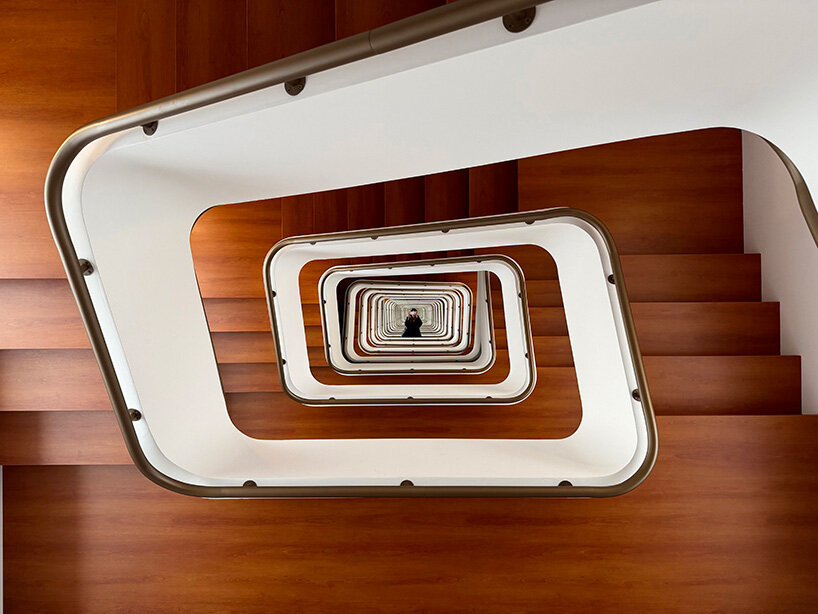
Infinite Staircase, 2020 | image ©designboom
from perceptual illusion to environmental uncertainty
While wonder remains a defining characteristic of Erlich’s work, the exhibition also reveals a growing engagement with environmental and social concerns. Several projects explore themes of instability, displacement, and ecological transformation through images of architecture in states of collapse, suspension, or mutation. Buildings appear uprooted from their foundations, urban structures bend under invisible pressures, and human constructions seem vulnerable to forces beyond their control.
The exhibition positions Erlich as an architect of experience. Across immersive installations, sculptural interventions, and rarely seen models, he demonstrates how certainty can be unsettled and how profoundly our understanding of reality depends upon perception. As one of the artist’s statements in the exhibition suggests, ‘Often, what interests me most is not the things themselves, but what they reflect, for it is in this gap between reality and its reflection that the world begins to feel uncertain.’