
As we walk its streets, Alba points out an unusual street art – spray-painted bananas, an iconic motif from local artist Thomas Baumgartel used to mark the most interesting art locations across the world.
She also explains that the city’s eclectic mix of architecture is largely a result of 90% of the city centre being destroyed during World War II.
The rebuild involved both preserving the city’s history and embracing modern design, and blends Gothic, Romanesque and Brutalism with more contemporary styles, such as the “Crane Houses”, three glass and steel high-rises in the shape of an upside-down L.
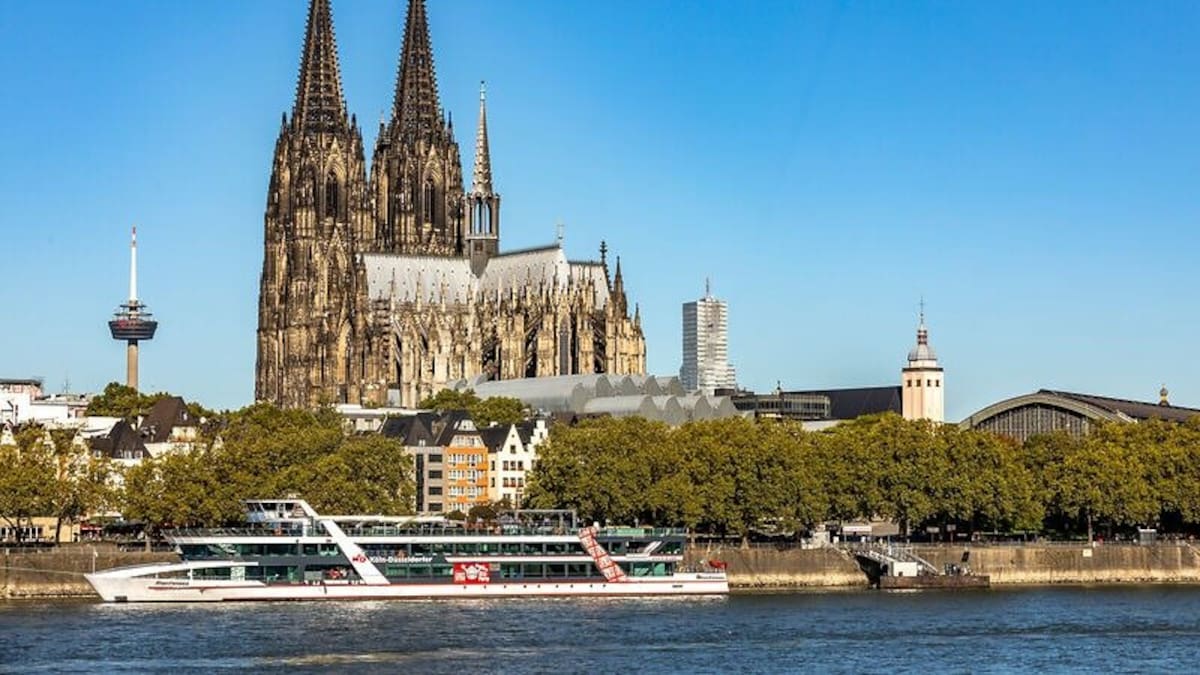
The city’s most famous piece of architecture, however, is the Cologne Cathedral. Known locally as simply “the Dom”, you see it as soon as you emerge from the main train station. At 157m-tall, it is the world’s third largest Gothic-style cathedral and took more than 600 years to complete.
A kiosk in Cologne. Photo / Bilderblitz, KolnTourismus
The cathedral is open daily, and usually the first thing to tick off your Cologne itinerary.
Highlights include climbing the tower’s 533 steps for a 360-degree view and admiring the gold-plated Shrine of the Magi, a Middle-Aged casket containing bones said to be those of the three kings who visited Jesus.
As our group approaches the cathedral, we stop at a kiosk nearby, one of the 1000 or so scattered throughout the city. They’re more than just small convenience stores; they’re places to socialise.
“Kiosk-hopping” is a popular pastime, Alba explains.
The equivalent of a bar crawl, you pick up a beer at one kiosk, and finish it by the time you walk to the next kiosk (if you’re wondering, yes it’s legal to drink in the streets here).
Cologne’s famous beer is Kolsch, a pale, top-fermented beer. Photo / Johann Schafer
Cologne’s famous beer is Kolsch, a pale, top-fermented beer. Our guide has brought us to a kiosk that sells one of her favourites, Schreckenskammer.
After some of us buy a bottle, she shares the proper way to cheer: hold the bottle by the neck, look each other in the eyes – or it’s seven years of bad sex – and tap with the bottle’s bottom (the neck is thinner and more likely to break; holding it here also helps keep the beer cool).
The other way to try Kolsch is at a brauhaus, an authentic German brewery, such as Peters Brauhaus in the city’s Old Town.
When the server brings your beer, you’ll notice they mark its coaster with a line. Once your glass is almost empty, they’ll refill it and add another mark to the coaster, to keep track of how many glasses you’ve had.
Take note – the only way to stop the refills is to cover the glass with your coaster when you’ve had enough.
Pair it with typical local cuisine such as fried sausage or pork knuckle with savoy cabbage and fried bacon-potatoes.
Head to Schee for quirky gifts and homewares, check out the latest exhibition at Art of Buna, or shop eco-fashion at Fairfitters. Photo / Dieter Jacobi, KolnTourismus
After the walking tour, I head to the city’s Belgian Quarter for some shopping (tomorrow is Sunday when shops will be closed, so this is my only chance to squeeze in some retail therapy for the weekend).
This trendy, creative neighbourhood is packed with boutiques, galleries, cafes, and bars. Sometimes they’re a mix of both, like manulit, a cosy bookstore that also serves coffee. Head to Schee for quirky gifts and homewares, check out the latest exhibition at Art of Buna, or shop eco-fashion at Fairfitters.
That night, I attend a classical music concert at Cologne’s Philharmonic Hall and I’m impressed by the underground, amphitheatre-style venue, which hosts almost daily concerts spanning classical, jazz and pop.
If you happen to pass the square above the roof while a concert is playing (as I did the next day), you’ll find it closed off with officials stationed around the perimeter, warning unsuspecting passers-by not to cross the square and disturb the famed acoustics.
Cologne’s Philharmonic Hall is an underground, amphitheatre-style venue, which hosts almost daily concerts spanning classical, jazz and pop. Photo / Koln Musik, Guido Erbring
On Sunday, my immersion in the city’s culture continues with a visit to Museum Ludwig, home to collections of Pop Art (the biggest outside the United States), Expressionism, and the third biggest collection of Picassos in the world.
After admiring works by Andy Warhol, Pablo Picasso and Salvador Dali, I spend the afternoon meandering through the city’s Old Town. Here, you’ll find cobblestoned streets, traditional breweries, the Romanesque-style Great St Martin Church, and street food like Reibekuchen, a German potato pancake.
Keep walking south along the river and you’ll end up in front of the Lindt Chocolate Museum, where you can take a tour or simply lose yourself in chocolate heaven at its retail store and cafe overlooking the Rhine.
Lindt Chocolate Museum. Photo / Jade Raykovski
After a visit here, you’ll need to walk it off. Cross the bridge outside the museum to the Rhine’s east bank, and take the riverside path north.
As you walk, enjoy the views of the Old Town across the river, including the cathedral and the colourful, reconstructed merchants’ homes in the area known as the Fish Market.
Before crossing back to the other side of the river along the iconic Hohenzollern Bridge, famous for its thousands of padlocks, stop in at the Cologne Triangle.
The office building doesn’t look like much from outside, but for just €5 you can visit its observation deck for panoramic views over the city.
St Martin Church and the Fish Market. Photo / KolnTourismus, Udo Haake
As I return via the bridge to the city centre, my attention is split between the sight of the cathedral’s majestic towers rising before me, which brauhaus I’m going to try next, and when I’m going to return.
The writer travelled at their own expense.