
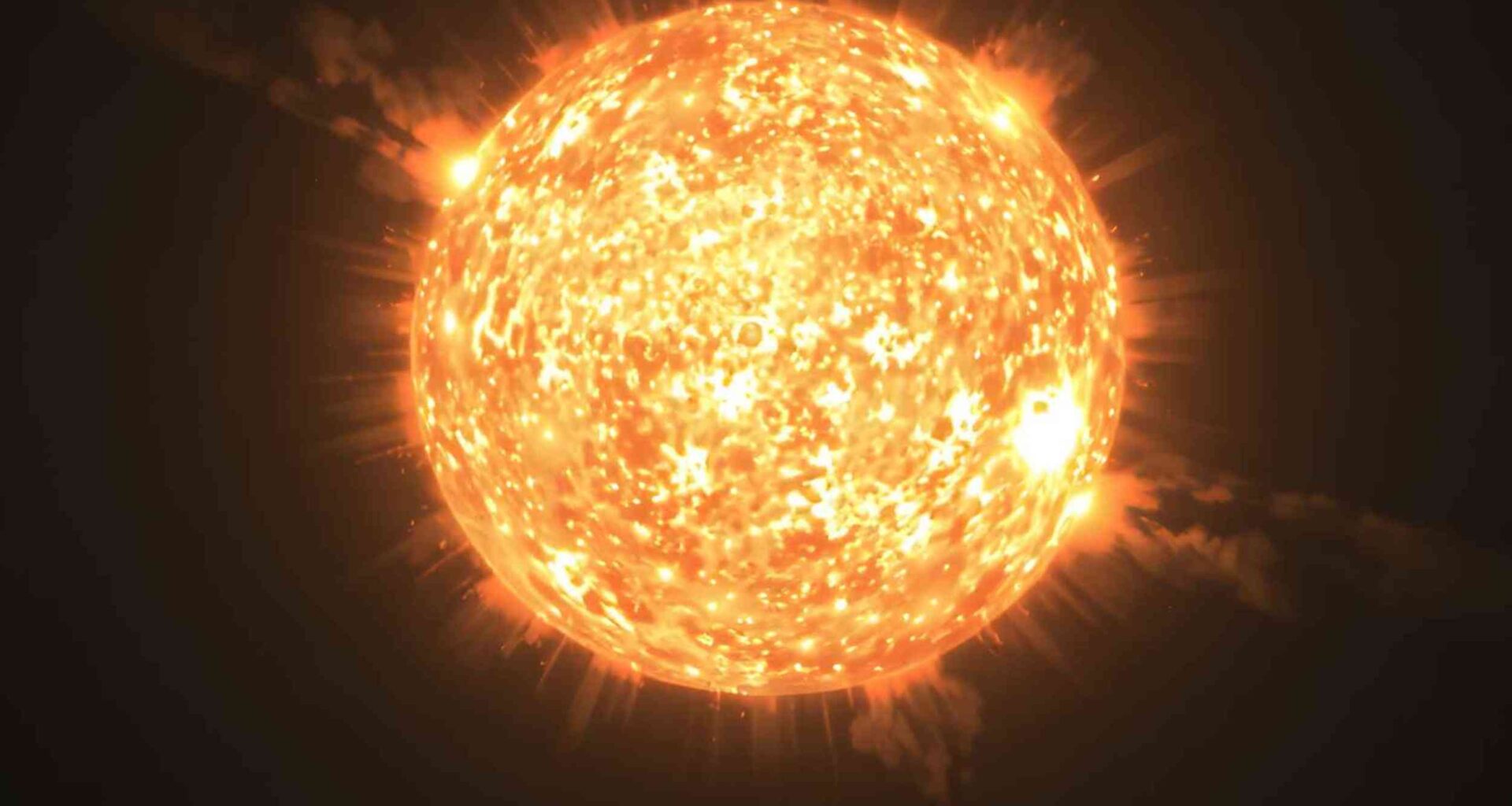
The Sun puts out radio noise all the time. Every so often, a solar radio burst flares up when charged particles get tangled in its magnetic field – but these signals usually fade within hours, days at most.
In August 2025, that assumption changed. A signal appeared, and when it did not stop, researchers started asking what in the Sun’s atmosphere could possibly keep it lit.
Longest solar radio burst

The signal ran for 19 straight days, smashing the old record for this kind of solar radio burst. The previous longest, recorded back in 2002, lasted only about five to six days.
A team led by Vratislav Krupar – a heliophysicist at NASA’s Goddard Space Flight Center (Goddard) in Greenbelt, Maryland – set out to figure out what could keep a solar radio burst alive for almost three weeks.
The duration sat so far outside the normal range that the usual explanations did not fit.
The kind of signal involved is called a Type IV burst. These come from clouds of electrons caught inside large magnetic structures wrapped around the Sun.
The radio waves themselves are harmless to anyone on Earth. But the magnetic conditions behind them often go hand in hand with violent eruptions that can knock out satellites.
Tracking a moving signal
A single signal lasting that long posed a tracking problem. The Sun rotates, so the source kept drifting in and out of view.
No single spacecraft could watch the whole thing from start to finish. The team stitched together observations from a fleet of missions scattered across the inner solar system – NASA’s Parker Solar Probe, the Wind and STEREO spacecraft, and the Solar Orbiter mission run jointly with the European Space Agency (ESA).
As the Sun turned, the burst passed from one spacecraft to the next, each catching a few days of it. That handoff turned out to be a clue in itself.
The signal moved exactly in step with the Sun’s rotation. It was not a series of separate flare-ups happening to land in the same spot – it was one structure, turning with the Sun, staying lit the entire time.
Pinning down the source
Finding where a radio signal comes from inside the Sun’s atmosphere is hard. The corona bends and smears radio waves as they travel, so the source looks far bigger and more spread out than it really is.
The distortion is severe enough to throw off any straight reading of the data. To cut through it, the team built a correction technique that adjusts the recorded signal direction to account for how much the solar wind had nudged it off course.
That let them trace the burst back to its actual point of origin. What they found was a helmet streamer – a towering loop of magnetic field that arches up from the corona and stretches far into the Sun’s outer atmosphere.
These are the elegant, pointed structures visible fanning out from the Sun during a total eclipse. They sit above the dividing line between regions of opposite magnetic polarity, and their closed loops are strong enough to trap solar plasma and hold it in place.
Three eruptions feeding it
A magnetic trap explains how the electrons stayed put. It does not explain how they kept radiating for 19 days.
Trapped particles lose energy over time. Left alone, they would fade.
Three coronal mass ejections – enormous eruptions that hurl plasma and magnetic energy into space – blasted out from roughly the same patch of the Sun during those weeks.
Each one appears to have dumped a fresh batch of energized electrons into the streamer’s field lines, one refill after another.
The researchers describe the whole setup as a corotating electron reservoir – a long-lived magnetic trap, turning with the Sun, that only became visible to spacecraft when the viewing angle lined up. When a new eruption rolled through, the supply got topped up.
Whether that refilling is the full story stays open. The team was careful to flag the gaps rather than paper over them.
What stayed unsolved
The biggest unanswered question is the simplest one to state: no one knows exactly what confined those electrons for 19 days.
The refill idea fits the timeline, but the precise mechanism keeping the trap stable that long is still unresolved.
There is a practical wrinkle, too. The corona smears these signals so badly that the burst looked roughly 20 degrees wide across the sky – a magnified, fuzzed-out version of what was really a compact source.
The team calculated that the distortion inflated the apparent size by a factor of around 60.
If long-lasting Type IV bursts routinely look far larger than they are, space weather forecasters could badly misjudge the size of a source region.
Why the timing counts
The Sun is moving through one of the busiest stretches of its roughly 11-year activity cycle.
Eruptions and tangled magnetic structures are more common right now than usual, and active periods are exactly when long-duration bursts are most likely to turn up.
Until this event, no one had watched a Type IV burst last anywhere near 19 days. The magnetic structures hosting these electrons were not thought to sustain them on anything like that timescale.
The finding stretches what counts as a passing solar event – and gives solar physicists a real example of a magnetic trap that lasted weeks, not hours.
For space weather forecasters, the correction method Krupar’s team developed to locate this burst offers a practical tool to size up future events more accurately.
It also paints a clearer picture of how the Sun’s magnetic structures can hold dangerous particles in place – the particles that threaten satellites, spacecraft, and the astronauts who rely on them.
The study is published in the journal The Astrophysical Journal Letters.
—–
Like what you read? Subscribe to our newsletter for engaging articles, exclusive content, and the latest updates.
Check us out on EarthSnap, a free app brought to you by Eric Ralls and Earth.com.
—–