
Benzinga and Yahoo Finance LLC may earn commission or revenue on some items through the links below.
For much of the AI boom, investors focused on the obvious winners: Nvidia Corp. and memory-chip makers such as Micron Technology Inc..
But a quieter trend has emerged over the past month.
Some of the biggest stock-market winners have been a group of former 1990s technology titans once associated with PCs, networking equipment and enterprise hardware.
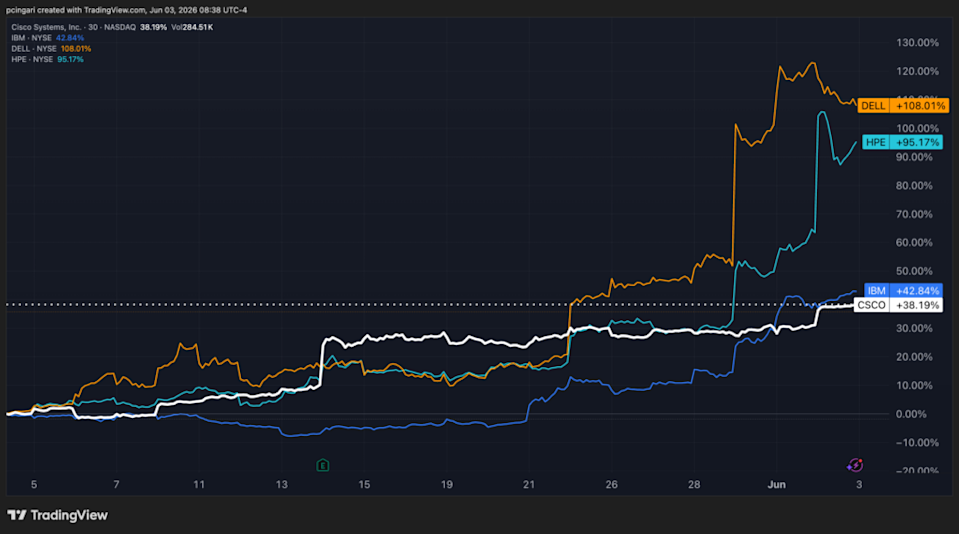
Dell Technologies Inc. and Hewlett Packard Enterprise Co. have roughly doubled in a month.
Cisco Systems Inc. and International Business Machines Corp. have both risen by 40%.
The common denominator is artificial intelligence infrastructure.
Don’t Miss:
Dell Showed How Fast The Demand Is Compounding
The market’s sudden enthusiasm for Dell and HPE stems from a simple realization: building AI requires far more than chips.
Think of the artificial intelligence boom as a new kind of factory. The chips from Nvidia Corp. are the engines. But an engine alone moves nothing.
It needs a chassis, wiring, cooling and a power supply. In the data center those are the servers, the storage and the networking that Dell, Hewlett Packard Enterprise and Cisco build.
Dell’s latest earnings report offered one of the clearest examples.
Dell reported artificial intelligence server revenue of $16.1 billion last quarter, up 757% from a year earlier, alongside $24.4 billion in new orders.
Dell also lifted its fiscal-year AI server revenue outlook to roughly $60 billion.
Jordi Visser, head of AI Macro Nexus at 22V Research, described Dell as sitting at the center of the AI buildout because it serves hyperscalers, enterprises, sovereign customers and cloud providers while supplying servers, storage and networking infrastructure.
Trending: Avoid the #1 Investing Mistake: How Your ‘Safe’ Holdings Could Be Costing You Big Time
Hyperscaler capital spending has climbed from roughly $261 billion in 2024 to an estimated $805 billion this year, and 22V Research, citing Goldman Sachs, sees it approaching $1.6 trillion annually by 2031.
Visser highlighted that Dell’s results show AI demand is expanding beyond Big Tech and into the broader economy.
The result has been a dramatic rerating of the stock.
HPE received a similar boost after investors began treating its AI server business as a major beneficiary of the next wave of enterprise AI spending.
Cisco Hasn’t Participated To The Same Extent
While Cisco has rallied sharply, its gains remain far below Dell’s and HPE’s.
That raises the question: Is Cisco next?
Unlike Dell and HPE, Cisco is not primarily an AI server manufacturer. Instead, it occupies a different but equally important position in the AI ecosystem — networking.
At Cisco Live this week, the company unveiled a series of AI-focused announcements, including Cisco Cloud Control, a new AI-powered network management platform, new Silicon One-powered switches and routers, and additional security products designed to address AI-related cyber threats.
On Wednesday, Goldman Sachs analyst Michael Ng said the event reinforced Cisco’s ability to benefit from customers investing in AI infrastructure and preparing for growing AI-driven security risks.
“We come away from Cisco Live with a deeper understanding of synergies across Cisco’s end-to-end portfolio across networking, observability, and security as customers seek to invest in AI infrastructure, simplify network operations, and prepare for growing AI-driven security risks,” the analyst said.
See Also: Skip the Regrets: The Essential Retirement Tips Experts Wish Everyone Knew Earlier.
Cisco said its next-generation G300 Silicon One chip will deliver roughly twice the speed of its predecessor and support future enterprise and hyperscale networking systems.
Goldman raised Cisco stock’s 12-month price target from $116 to $125, while keeping a Neutral rating.
The Missing Piece: AI Networking
Investors have largely rewarded companies selling the “compute” side of AI.
Networking has received less attention.
Dell’s AI server revenue is already growing at triple-digit rates, whereas Cisco’s AI exposure remains more indirect.
Still, market leadership during technology booms often broadens over time. In the 1990s, Dell, Cisco, IBM and HP were among the companies that built the physical infrastructure behind the internet era.
Three decades later, investors are increasingly asking whether those same infrastructure names could become some of the biggest beneficiaries of the AI era as well.
Photo: Shutterstock
Read Next: Think you’re saving enough for your kids? You might be dangerously off — see why
Building Wealth Across More Than Just the Market
Building a resilient portfolio means thinking beyond a single asset or market trend. Economic cycles shift, sectors rise and fall, and no one investment performs well in every environment. That’s why many investors look to diversify with platforms that provide access to real estate, fixed-income opportunities, precious metals, and even self-directed retirement accounts. By spreading exposure across multiple asset classes, it becomes easier to manage risk, capture steady returns, and create long-term wealth that isn’t tied to the fortunes of just one company or industry.
Arrived
Backed by Jeff Bezos, Arrived Homes makes real estate investing accessible with a low barrier to entry. Investors can buy fractional shares of single-family rentals and vacation homes starting with as little as $100. This allows everyday investors to diversify into real estate, collect rental income, and build long-term wealth without needing to manage properties directly.
Vinovest
Fine wine and rare whiskey have historically moved independently of the stock market, making them a compelling alternative asset. Vinovest manages authenticated, insured portfolios of investment-grade wine and whiskey starting at $5,000 — sourcing, storage, and insurance all handled for you.
FarmTogether
Farmland has historically held its value through market volatility and delivered returns uncorrelated to stocks and bonds. For accredited investors, FarmTogether offers direct access to high-quality U.S. farmland starting at $15,000 — fully managed, with no landlord headaches.
EquityMultiple
For accredited investors looking beyond stocks and bonds, EquityMultiple provides access to vetted commercial real estate deals starting at $5,000, with only ~5% of opportunities passing their due diligence process.
Bitcoin IRA
For investors who want crypto exposure with tax advantages, Bitcoin IRA allows you to trade 60+ cryptocurrencies inside a self-directed IRA or roll over an existing 401(k), with 24/7 trading and institutional cold storage. Minimum $3,000 to start. Crypto investing involves substantial risk of loss and early withdrawal penalties apply.
© 2026 Benzinga.com. Benzinga does not provide investment advice. All rights reserved.