
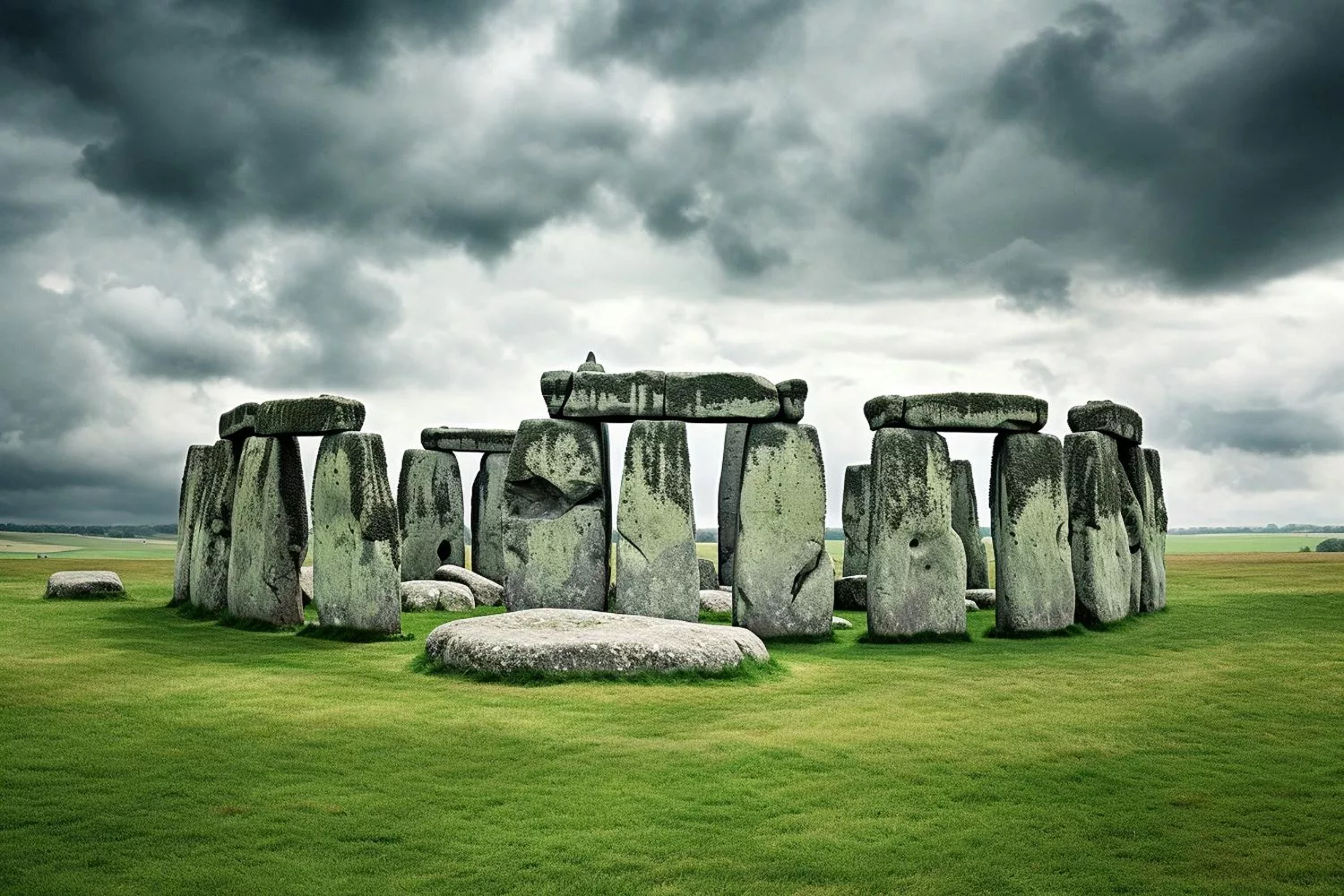
Stonehenge has always been a monument of mysteries, but few stones within its circle have provoked as much debate as the Altar Stone, the six‑tonne sandstone megalith lying at its heart.
New research from Curtin University is now reshaping our understanding of how this colossal block may have traveled across Britain, weaving together geology, glaciology, and human ingenuity into a story of endurance and ambition.
The Altar Stone is believed to have originated in the Orcadian Basin of northeast Scotland, some 700 km from Salisbury Plain. Its sheer distance from Stonehenge raises the central puzzle: how did a block of sandstone from Scotland end up at the ceremonial core of England’s most iconic prehistoric monument?
According to a new study, people were responsible for transporting them across difficult terrain rather than relying on natural Ice Age processes.
Who built stonehenge? Scientists finally solved its mystery
As co‑lead author Dr Anthony Clarke explains, “The findings suggest the journey was far from simple and likely required careful planning across multiple stages.”
Scientists have been debating for decades whether Ice Age glaciers could have carried the stone southward as a so-called glacial erratic, a lump of rock jettisoned far from its source by ice. However, the degree to which the southward vectors of transport from northeast Scotland were both highly localized and limited in distance.
While other potential source areas to the south of the basin appear more consistent with models of glacial dispersal, their unique mineralogical signatures do not correlate well with those of Altar Stone. In contrast, the different types of common sandstone from Caithness are actually closest in terms of their geochemical fingerprinting, e.g., zircon fingerprints and geological signposts.
However, current ice flow models indicate a more extensive northeastward rather than southerly glacial movement from Caithness, thereby obscuring direct glacial transport.
A huge ring of ancient shafts detected near Stonehenge
Of interest is the intriguing possibility that glacial movement pushed the stone into a southeast path towards Dogger Bank, which has since been submerged beneath North Sea waters. This hypothesized glacier route would thus have more than halved the distance prospective humans needed to travel to bring stones to Stonehenge, from a much longer 700 kilometers to around 400 km.
However, this situation comes with a very serious complication: Dogger Bank became submerged by rising sea levels long before the Altar Stone is thought to have made it anywhere near Salisbury Plain. This means that while glacial action may be useful in moving part of the stone, it cannot fully account for its transport.
“The research indicates there were no viable glacial pathways linking the source region directly to Stonehenge, reinforcing the conclusion that human transport was required.”
The Altar Stone was moved, too, but this required great human effort, even with the aid of glacial movement. Those who transported the massive stone across Britain’s rugged landscape needed to communicate and work closely to complete the task. Ancient human willpower and social organization are visible in the stone’s presence at Stonehenge.
The new findings have shown that Stonehenge was not merely a natural formation. The builders employed their knowledge of the landscape and collaboration to accomplish amazing things. The story of the Altar Stone is a partially frozen but mostly human-powered tale with only a one-hundred-year soul-frigid lesson, making Stonehenge an enduring monument to human innovation, impenetrable intrigue, and ancient kinships.
Future investigations aim to pinpoint the Altar Stone’s exact source in northeast Scotland and reconstruct the transport routes used by prehistoric communities. Each new clue adds depth to the story of Stonehenge, not just as a stone monument, but as a monument to human ambition, resilience, and imagination.
Journal Reference:
Anthony Clarke, Remy Veness, Christopher Kirkland, Chris Clark et al. From Highlands to Henge: Refining the Provenance and Transport Pathways of Stonehenge’s Altar Stone. Journal of Quaternary Science. DOI: 10.1002/jqs.70080