
Six families of carbon-rich space rocks have puzzled scientists for years. They look nothing alike. Some crumble at a touch, while others are packed with hard little pellets.
The working assumption has long been that such different rocks must have formed in different parts of the early Solar System.

Computer simulations now challenge that picture. By tracking how two very different types of material collected in a single high-pressure ring just outside Jupiter’s orbit, researchers found that one small patch of ancient space may have produced all six families, one generation at a time.
Dust ring beyond Jupiter
Around four and a half billion years ago, the young Sun sat inside a swirling disk of gas and dust. Tiny grains in that disk bumped into each other, stuck together, and slowly built up into mile-wide rocky bodies. Some of those bodies grew into planets. The rest became the seeds of today’s asteroids.
A team at the Max Planck Institute for Solar System Research (MPS) in Göttingen, Germany, studied this process in detail. They focused on a stretch of time roughly two to four million years in.
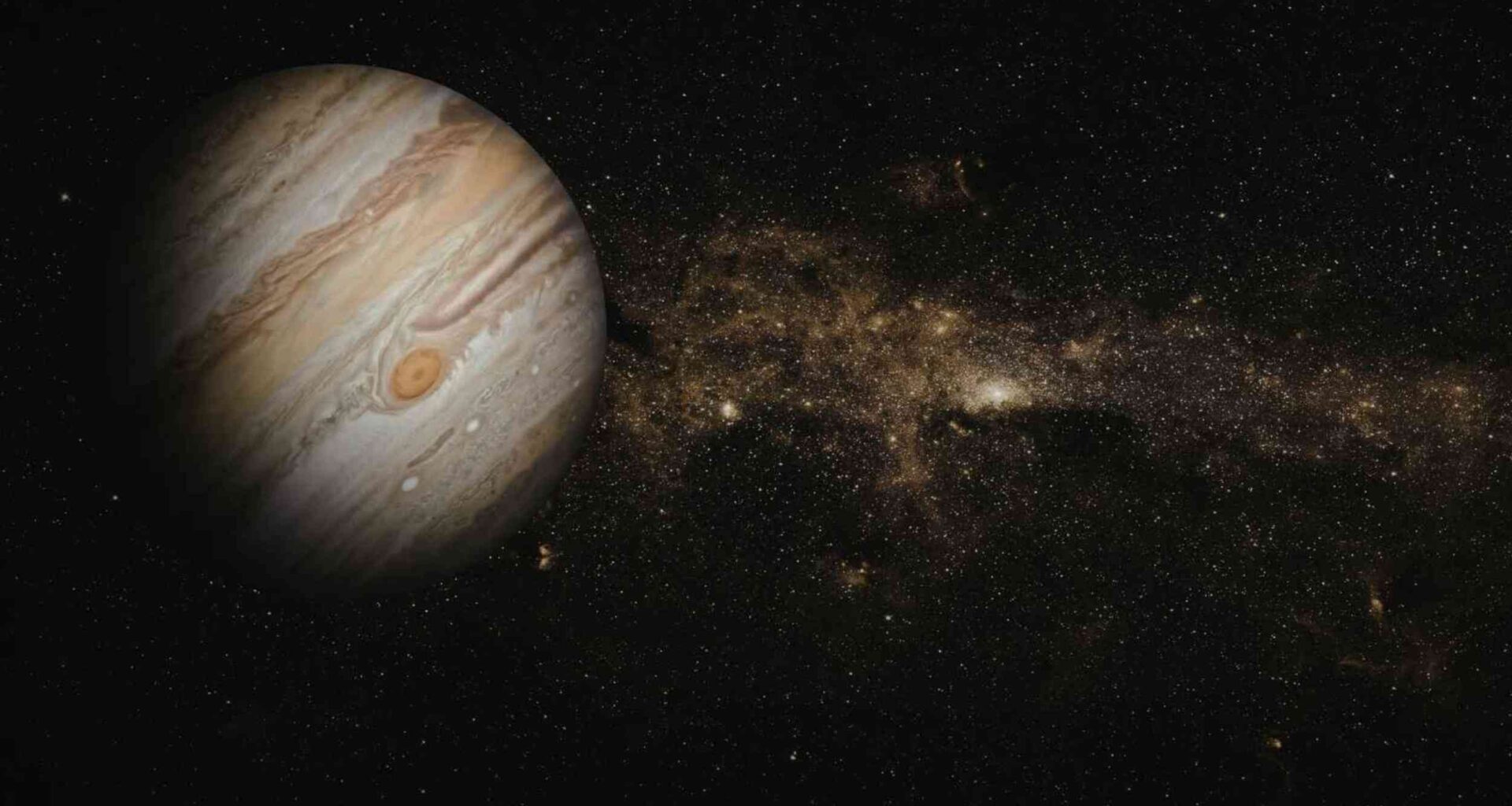
By then, Jupiter had already bulked up and cleared a gap in the disk around its orbit. Just outside that gap, gas piled into a high-pressure ring.
That ring trapped drifting dust – material that otherwise would have spiraled toward the Sun. It pooled in one place, building into a dense reservoir.
Nerea Gurrutxaga is a doctoral researcher at the MPS and the study’s first author. She led the effort to model what that reservoir produced over time.
Clues inside the meteorites
The study leaned on meteorites as physical evidence. These are pieces of ancient rock that survived the fall through our atmosphere, and most are thought to be unchanged splinters of those early bodies. They carry a chemical record of where and when they formed.
The researchers concentrated on carbonaceous chondrites, a carbon-rich, stony kind that earlier lab work had already traced to a birthplace beyond Jupiter. They come in six distinct families.
Some are delicate and powdery, prone to falling apart in the hand. Others hold firm, packed with visible grains set into a finer background.
Those textures point back to two raw ingredients in the early disk. One was soft, dusty material. The other was sturdier clumps that had baked in the hotter inner zones near the Sun, then drifted outward.
For years, matching those ingredients to a specific place and moment had stumped researchers.
How the model works
To test the idea, the team built simulations tracking dust on two scales. The first examined how individual grains collide, stick, or shatter. The second tracked how vast streams of material flow across the disk.
Earlier work had shown a single dust trap could spawn rocky bodies quickly. Nobody had shown one trap producing rocks of shifting composition over millions of years. This was new territory.
That is the part this study contributes. The models suggested Jupiter acted as a firmer barrier for large, tough particles than for fine dust. This caused the blend of material reaching the trap to change over time.
As one ingredient ran low and another flowed in, the trap produced clearly distinct generations of bodies.
In the first half-million years, the crumbly material thinned out – then rebounded over the next million years.
Two distinct populations emerged from the same patch of space. One came from fragile material and the other from harder clumps: two recipes, one kitchen, different shifts.
A long-lived cosmic cradle
The match between the simulated rocks and the real meteorite families was close enough that the team concluded all six likely came from that one dust trap.
It was not six scattered birthplaces, as the variety might suggest, but a single ring that fed itself for millions of years. Lab studies of these rocks now line up with the physics of the early disk.
Thorsten Kleine is the MPS Director and a cosmochemist on the team. He described the meteorites as a reality check on theories of how planets form.
The agreement between the lab rocks and the model’s numbers gave the scenario a weight it had lacked before.
Even older, melted bodies from an earlier generation show the same chemical spread – hinting that they, too, grew inside dust traps.
The team argues the pattern may reach back even further than carbonaceous chondrites. A separate paper has explored how such traps form near growing planets.
Why this discovery matters
The finding reshapes a basic question about our origins. Instead of imagining the asteroid belt’s ancestors forming all over a chaotic disk, the work finds a few privileged spots doing most of the building.
“There is strong evidence that dust traps were the preferred birthplace of planetesimals in our Solar System,” said Joanna Drążkowska, who heads the institute’s planet-formation group.
That has a payoff for studying other stars. Telescopes now routinely image young disks ringed with bright bands and dark gaps, and a recent study catalogued how common these features are.
If rings are where rocks get made, those images may be showing planet assembly lines caught in the act.
For researchers, the trap offers a single, testable cradle. Rather than a vague, disk-wide guess, models and lab samples now have a precise target.
Earlier work struggled to explain how dust survived long enough to build anything. A long-lived pressure ring may solve the timing problem.
A follow-up analysis is now probing how such rings trap and grow material in detail.
The study is published in The Astrophysical Journal.
—–
Like what you read? Subscribe to our newsletter for engaging articles, exclusive content, and the latest updates.
Check us out on EarthSnap, a free app brought to you by Eric Ralls and Earth.com.
—–