
Gianina Schwanecke (RNZ)
Wellington, June 9, 2026
New Zealand Growers and Scientists are working closely with their Indian counterparts to help grow the Kiwifruit and Apple industries, following on from the new trade deal (Free Trade Agreement) between the two countries.
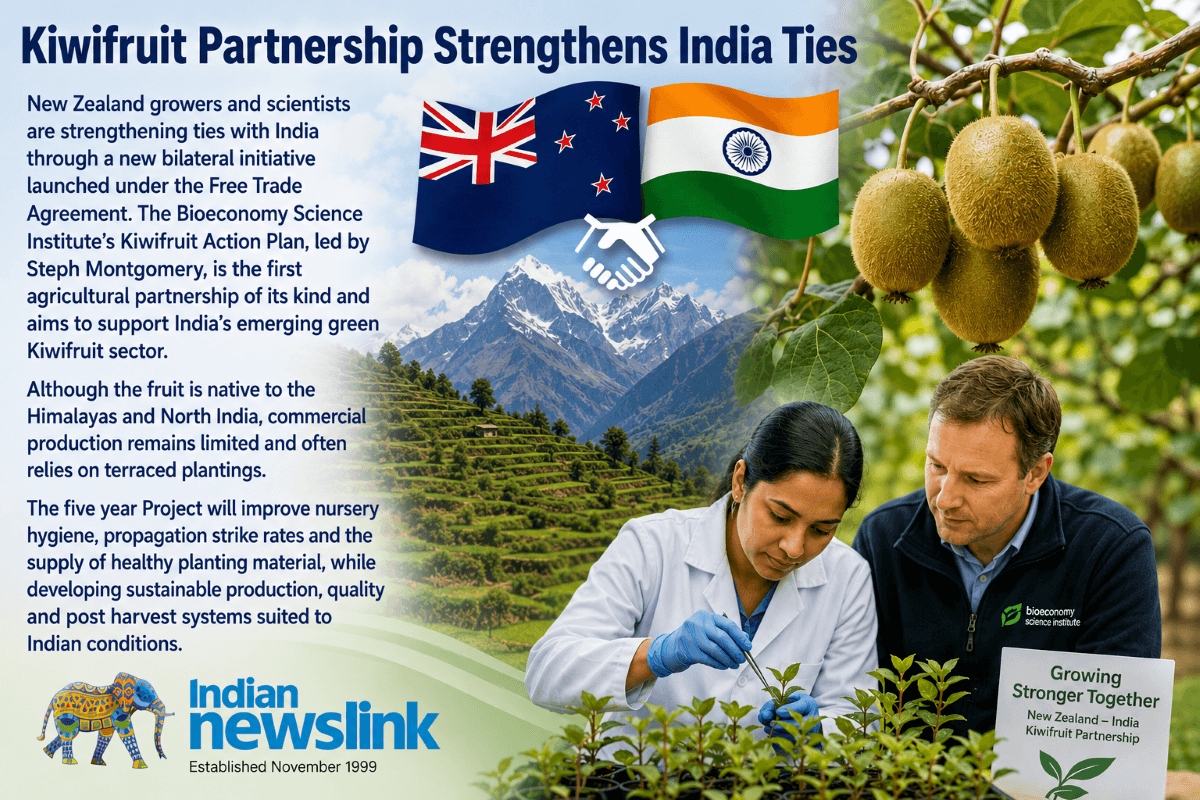
Steph Montgomery is leading the Bioeconomy Science Institute’s collaborative Kiwifruit Action Plan in India – the first bilateral agricultural partnership project to be launched as part of a Free Trade Agreement.
“It is a development project to help the Indian industry develop its nascent green Kiwifruit industry,” she told RNZ.
Sustaining Kiwifruit Production
Ms Montgomery said that while Kiwifruit is native to the Himalayas and North India, and not an uncommon crop there, the industry is less developed and often involves terraced plantings.
The five-year Project aims to develop sustainable Kiwifruit production, quality and supply chain systems for Indian conditions, from nurseries through to end-point consumers and getting that product to market.
“At the moment, the nursery industry is quite rudimentary. So, we are looking at implementing general good nursery hygiene practices and protocols and starting to increase their strike rates for their propagation so that we have good planting material coming out that is healthy,” Ms Montgomery said.
The team would also be working on post-harvest processes, looking at how the fruit is collected and gets to market.
Ms Montgomery said that the partnership complemented New Zealand’s growing season by increasing demand with a year-round supply.
“We are a premium because we do grow some of the best fruit in the world, so it is coming in at the very highest bracket. The idea is that with India being the highest population in the world of 1.4 billion people and also the highest fruit consumers in the world, more people would be able to enjoy Kiwifruit throughout the different demographics of society,” she said.
It would also provide opportunities to better understand how Kiwifruit grow in different conditions, particularly amidst a changing climate.

New Centres of Excellence
As part of the Project, new centres of excellence will be established, essentially research farms for Kiwifruit growing.
“We are working with four different States in the North and Northeast of India, and hence we will have one research farm in each State. We hope to commence in two States this year and in the other two States in the following years. Our scientists from both countries will exchange and spend time in each other’s backyards, which is complementary to building those skills and deepening those relationships. We look forward to a few Kiwifruit farmers going to India and seeing the fruit grown, as they have never thought of it and vice versa,” Ms Montgomery said.
In 2023-2024, India produced about 18,280 tonnes of Kiwifruit from 5390 hectares of orchard.
Adoption of best practice nursery, orchard management and postharvest protocols has the potential to increase Indian Kiwifruit production by up to 10 times.
Apple and Pear Production
Hawke’s Bay Company Prevar develops and commercialises Apple and Pear cultivators, a joint venture owned by the BSI, New Zealand Apples and Pears and its Australian counterparts.
Chief Executive Tony Martin said that the Free Trade Agreement provided increased market access for New Zealand-produced Apples and Pears, including varieties developed by Prevar.
It also created opportunities for New Zealand to share some of its expertise to support the growth of India’s Apple industry.
He said the New Zealand Pipfruit industry has been working with the sector in India since the 1990s, the big difference being that India has not evolved as rapidly in terms of new production systems, improving volumes and storage life.
Mr Martin said that there are opportunities to support the growth of the Apple industry in India.
“Indian fruit is produced at a different time of year compared to New Zealand. Therefore, there will always be an export window for New Zealand-produced fruit to get into the market. India has a large consumer base that New Zealand could not possibly think about reaching, with our production alone,” he said.
Mr Martin said that New Zealand accounts for about 11,000 hectares of Apples and Pears planted across the country, with about 20 million trees.
“India probably has about a billion Apple trees. So, we are not a scale producer,” he said.
Apples and Pears Chief Executive Danielle Adsett said the industry had yet to finalise its Apple Action Plan but was positive about the opportunities it presented.
“We see collaboration and cooperation as quite important for long-term, long-standing relationships. We’ve been active in India supporting their Apple growers since the early 1990s, so this is not new to us,” she said.
The FTA has improved access for New Zealand exporters, with tariffs dropped from 50% to 25% on specified volumes.
“This is all about business confidence, confidence to invest, returns back to growers, and opportunity into the future as the Indian market grows and changes,” Ms Adsett said.
Gianina Schwanecke is a Producer and Presenter at Radio New Zealand based in Wellington. The above Report has been published under a special agreement with www.rnz.co.nz