
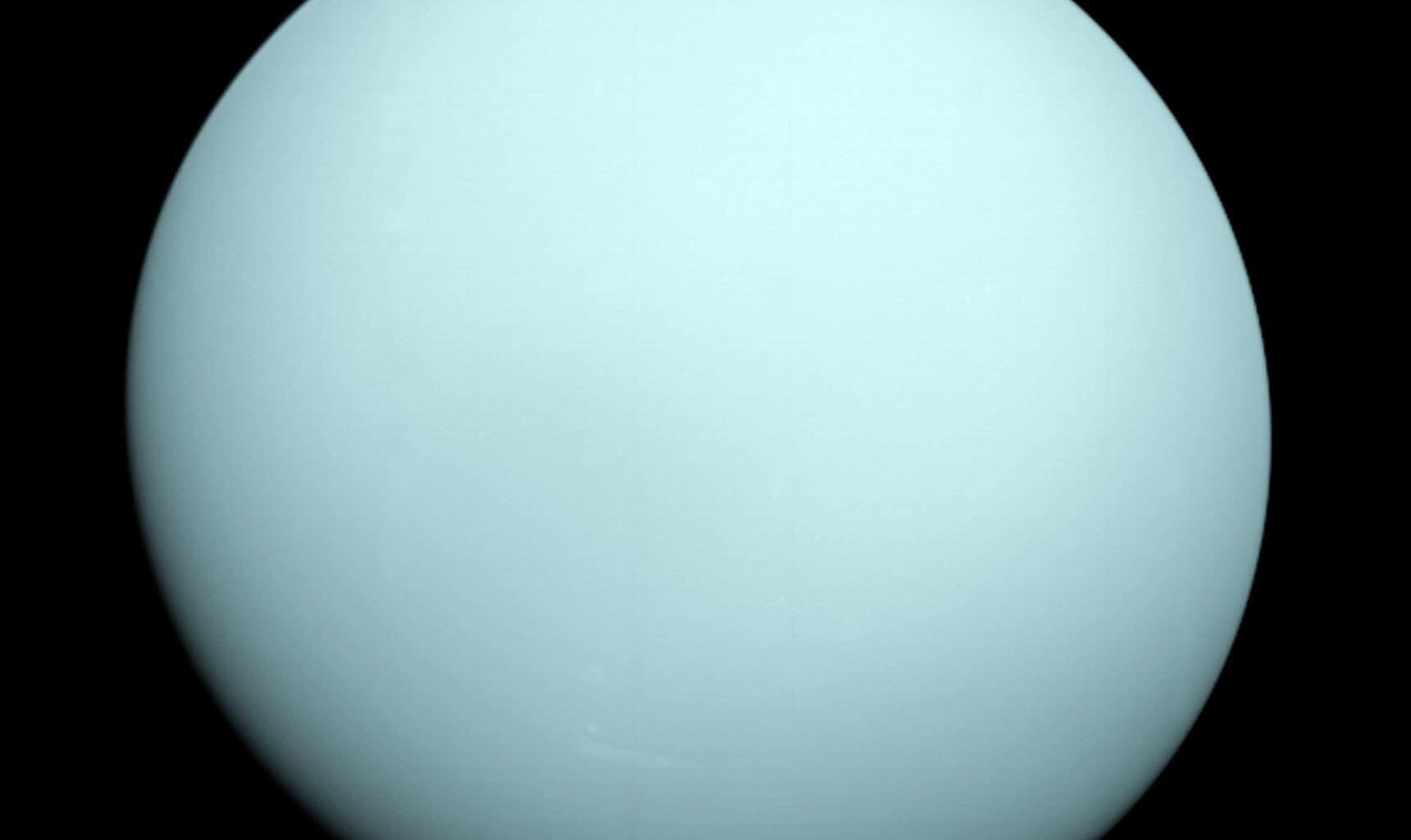
 Uranus as captured by Voyager 2 on December 16, 1986. Credit: NASA
Uranus is already the oddball of the solar system. It rolls around the sun tipped almost completely on its side, like a planet that was knocked over and never got back up. Its moons follow along with that strange tilt, circling the planet’s equator in a system that looks calm today.
A new study accepted for publication in the journal Icarus suggests that calm may be misleading.
According to the research, Uranus’ largest moons may not be ancient survivors from the solar system’s earliest days. Instead, they may be descendants of earlier moons that were battered, broken apart and reassembled at least twice.
The first disaster likely came from the huge impact that tilted Uranus sideways. The second may have come later, when the giant planets were still settling into their current orbits.
A young solar system full of close calls
Today, the outer planets look orderly. But planetary scientists think the early solar system was far more chaotic. In one leading model, the giant planets formed closer together, then their orbits shifted dramatically. Jupiter and Saturn changed position. Uranus and Neptune were shoved outward. In some versions of the story, there may even have been an extra ice giant that was thrown out of the solar system entirely.

This upheaval is often called the giant planet instability, related to what scientists call the Nice Model, named for the French city where the idea was developed, although it’s a nice adjective too. The basic idea: the early outer solar system was crowded, and crowded planets cause trouble. When massive planets swing past one another, their gravity can yank smaller bodies out of place, even moons.
So, what would have happened to the regular moons of Jupiter and Uranus during this violent period? To find out, the researchers started with nearly 10,000 computer simulations of the early outer solar system and chose 122 that ended with a planetary layout resembling the one we see today. Then they asked, during these early histories, would the big moons survive?
For Uranus, the answer was usually ‘no’.
×
Thank you! One more thing…
Please check your inbox and confirm your subscription.

The scientists found that the large moon systems of both Jupiter and Uranus survived in less than 15% of tested cases. Destruction or severe disruption was not a rare outcome. It was the normal one.
Uranus was especially vulnerable. Its outermost major moon, Oberon, orbits approximately 360,400 miles (580,000 kilometers) from the planet. In planetary terms, that’s not a long way. If another giant planet passed within a few million miles, the gravitational tug could stretch, tilt and scramble the orbits of Uranus’ moons.
The study found that if Uranus came 1.8 million miles (three million kilometers), its moon system was basically doomed. Encounters with Jupiter or Saturn could cause near-certain destruction from even farther away.
The moons would not be flung politely into space. They would be pushed onto crossing orbits, and once that happened, collisions would be hard to avoid.
Not gone, but remade
The study does not say Uranus’ moons were vaporized. A better way to think of it is that they were smashed and reworked. When moons collide at high speed, they break apart and leave behind clouds of debris. Over time, that wreckage can gather back together under gravity and form a new generation of moons.
The “twice” part comes from Uranus’ tilt. Most planets spin roughly upright. Uranus does not — its axis is tilted about 98 degrees, almost certainly because something enormous struck it early in its history. That impact would have been catastrophic for any moons already in place. Debris from the collision could have later gathered into a new set of moons. Then the giant planet instability came along and, if the researchers are right, wrecked those too.
One existing moon may carry a hint of this violent past. Miranda is small, icy and strange, with a surface that looks assembled from mismatched pieces. It also contains far less rock than Uranus’ other major moons. This could be a composition the researchers suggest could result from high-speed collisions that scattered lighter, icier material into smaller bodies while larger ones reclaimed the heavier rock.
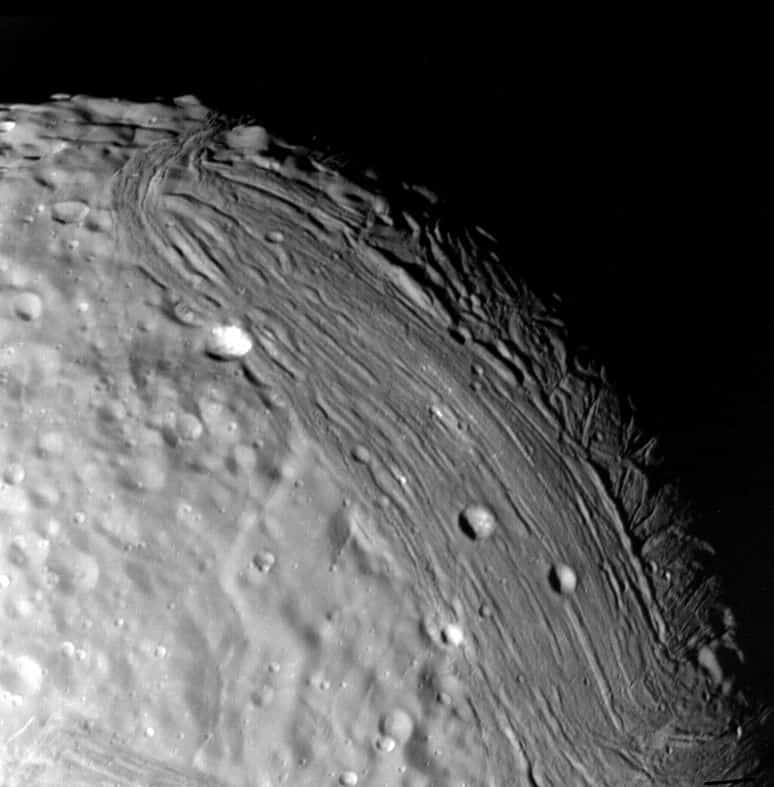 Miranda reveals a complex geologic history in this view, acquired by Voyager 2 on Jan. 24, 1986, around its close approach to the Uranian moon. Credit:
JPL
Jupiter may have gotten lucky.
The study also looked at Jupiter’s moons. Io, Europa and Ganymede are locked in a precise orbital rhythm called the Laplace resonance: for every orbit Ganymede makes, Europa makes two and Io makes four. If those moons had been smashed apart and rebuilt, that resonance almost certainly would not exist today.
Its survival is strong evidence that Jupiter’s system came through the instability intact, but the simulations show that was a rare outcome. Across all 122 tested histories, only a single simulation ended with both Jupiter’s and Uranus’ large moon systems surviving.