

Find winning stocks in any market cycle. Join 7 million investors using Simply Wall St’s investing ideas for FREE.
Bristol Myers Squibb Foundation, linked to NYSE:BMY, is rolling out a new lung cancer detection and care model in underserved Brazilian communities.
The program uses mobile CT units, telemedicine, and local community engagement to support earlier diagnosis and access to curative treatment.
This initiative focuses on healthcare equity and may offer a template that could be applied to other regions over time.
For investors following NYSE:BMY, this move extends the story beyond drug pipelines and quarterly results and into how the company approaches real-world cancer care. Lung cancer is a major global health issue, and access to early screening can be limited in lower income or remote areas. By funding mobile CT scans and training local health workers, the foundation is tying the Bristol Myers Squibb story more closely to outcomes across the full care pathway.
Initiatives like this can matter for how you think about long term company identity, especially in oncology and immunology where Bristol Myers Squibb is already active. While the financial impact of such programs is not always easy to quantify, they can shape partnerships, policy discussions, and reputational positioning that may influence future opportunities.
Wall Street’s queuing for one rocket. While SpaceX counts down to its IPO, other companies tied to the new space race are already in orbit. → 20 Compelling Space Companies watchlist · Global Space Race Investing Ideas screener · Scan the sector by valuation on Rocket Lab’s valuation page.
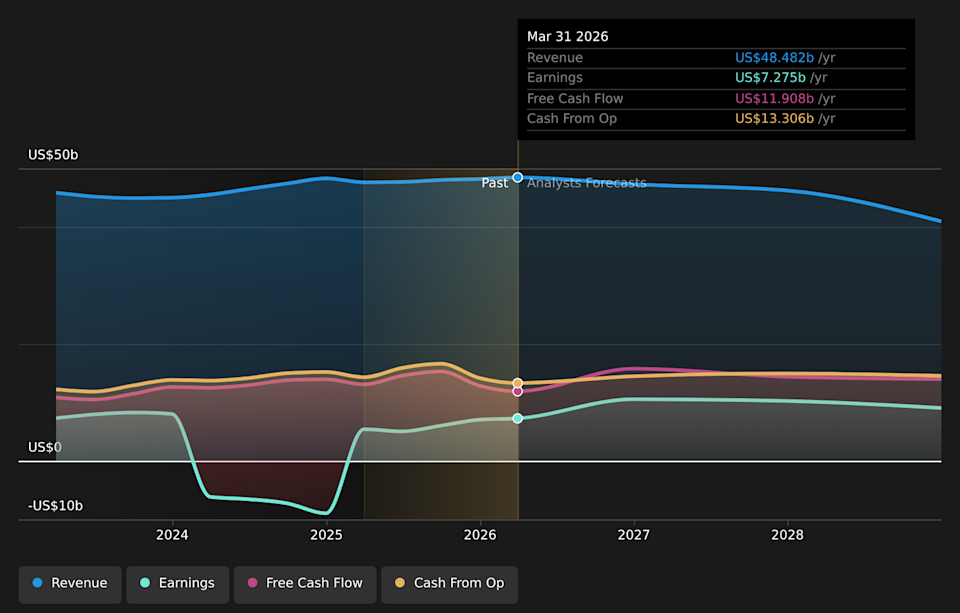 NYSE:BMY Earnings & Revenue Growth as at Jun 2026
This lung cancer program sits at the intersection of Bristol-Myers Squibb’s oncology focus and its broader access-to-care ambitions. For you as an investor, the immediate effect is more about company identity than near term revenue. By backing mobile CT units, telemedicine links and local training in Brazil, the foundation is helping build earlier-stage diagnosis pathways where advanced disease has often been the default. That kind of system-level work can support future uptake of therapies from any manufacturer, but it also positions Bristol-Myers Squibb as a long-term partner for governments and NGOs, which can matter when large oncology tenders or public-private projects are discussed. Peers like Merck, Roche and AstraZeneca also invest in cancer access programs, so this initiative helps Bristol-Myers Squibb stay visible in that conversation rather than competing on drug labels alone.
How This Fits Into The Bristol-Myers Squibb Narrative
This lung cancer effort aligns with the narrative that Bristol-Myers Squibb is leaning on oncology depth and partnerships to support long term relevance in high-need diseases.
It also highlights that some resources go into non-commercial activities, which may increase expectations around responsible pricing and access in future negotiations.
The narrative focuses heavily on late stage pipeline and patent cliffs, while this Brazil program shows a separate lever, long term health system engagement, that is not fully captured in those pipeline discussions.
Knowing what a company is worth starts with understanding its story. Check out one of the top narratives in the Simply Wall St Community for Bristol-Myers Squibb to help decide what it’s worth to you.
The Risks and Rewards Investors Should Consider
⚠️ Programs that rely on public funding and local capacity can be hard to scale or sustain, so outcomes may fall short of expectations even with strong clinical intent.
⚠️ Stronger presence in underserved markets can increase scrutiny on pricing and patents across the portfolio, which analysts already flag as a key risk for Bristol-Myers Squibb.
🎁 Building trust with clinicians, health ministries and communities may support longer term demand for immuno-oncology and other cancer drugs compared with peers like Merck and Roche.
🎁 The model, if replicated, could support incremental volume in emerging markets over many years by shifting more patients into earlier, potentially treatable stages of disease.
What To Watch Going Forward
From here, keep an eye on how often Bristol-Myers Squibb and its foundation report concrete metrics such as numbers of patients screened, referred and treated, and whether similar programs appear in other regions. Watch for any links between this kind of access work and future commercial partnerships or tenders in Latin America and other emerging markets, especially in oncology where the company is active alongside AstraZeneca and Roche. Also monitor whether analysts begin to reference these access programs in their risk and ESG discussions, since that can influence how the wider market frames Bristol-Myers Squibb’s long term cancer strategy.
To ensure you’re always in the loop on how the latest news impacts the investment narrative for Bristol-Myers Squibb, head to the community page for Bristol-Myers Squibb to never miss an update on the top community narratives.
This article by Simply Wall St is general in nature. We provide commentary based on historical data and analyst forecasts only using an unbiased methodology and our articles are not intended to be financial advice. It does not constitute a recommendation to buy or sell any stock, and does not take account of your objectives, or your financial situation. We aim to bring you long-term focused analysis driven by fundamental data. Note that our analysis may not factor in the latest price-sensitive company announcements or qualitative material. Simply Wall St has no position in any stocks mentioned.
Companies discussed in this article include BMY.
Have feedback on this article? Concerned about the content? Get in touch with us directly. Alternatively, email editorial-team@simplywallst.com