
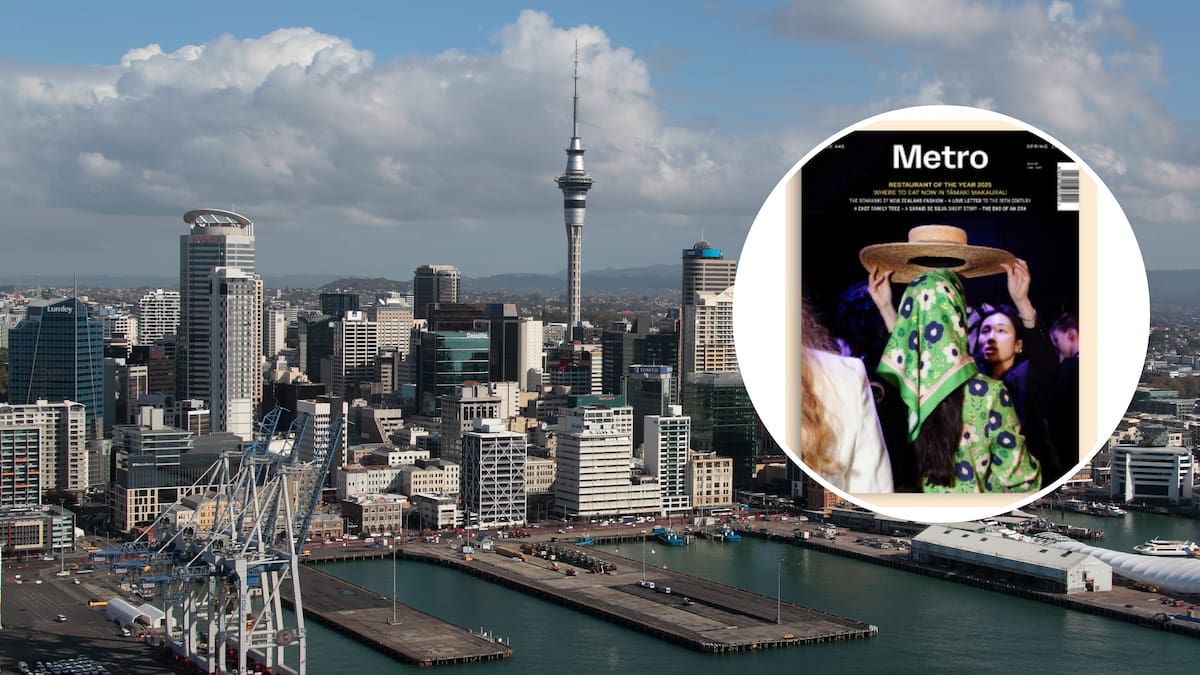
The Herald reported last year that Metro was losing its four fulltime staff – including the editor – as part of a radical shake-up of its business model.
Metro’s new owners and publishers, Hannah Kidd and Simon Farrell-Green. Photo / supplied
Editor Henry Oliver penned a farewell editorial, “Goodbye to all this”, in issue 448, in which he paid tribute to the magazine and three other departing fulltime staff, food editor Charlotte Muru-Lanning, art director Sam Wieck and commercial director Lucy Janisch-Fitzgerald.
“The magazine will be in new hands, with new ideas about what its role should be, what form it should take and how it should fit into the life of the city beyond 2025,” Oliver wrote.
“I’m sure it won’t be the magazine I’d make, that things will be done in ways I wouldn’t do them, but that’s also true of many of the versions of Metro that came before me.”
At the time, Metro publisher Still Group – owned by Japanese-New Zealand businessman Hideaki Fukutake – confirmed that there had been changes.
“I hope to get the finances back into a position where we can afford fulltime staff,” Still projects director Sam Johnson told the Herald at the time. “For now, we are engaging guest editors.”
Under Johnson, the magazine produced issue 449 – a summer 2026 edition – but the print edition has since been on hold.
Metro’s most recent print edition was published last summer.
“As many of you will be aware, the economics of print continue to tighten. Despite the care and effort that goes into each issue, the current model is no longer sustainable,” Metro subscribers were advised in March.
“With that in mind, we’ve made the decision to pause regular print production for now, and shift our focus to Metro’s digital, newsletter and event offerings, which we’ll develop and share with you in due course.”
Farrell-Green and Kidd founded home architecture magazine Here in April 2020 after Bauer Media closed its New Zealand magazine operation. Farrell-Green had previously been an editor with the company.
He and Kidd said today that the acquisition of Metro represented a significant milestone.
“We believe in publishing and making things worth reading,” Kidd said in a statement.
“Here has shown you can thrive as an independent title – leading with your values and doing things with heart. Those are things Metro has always done too.”
Metro was first published in 1981 – the year that the South African rugby team toured a riven New Zealand – under its famous and longest-serving editor, the late Warwick Roger.
Metro magazine’s pioneering editor, Warwick Roger.
Its pages have showcased generations of New Zealand’s finest journalists and writers and, in an era before the internet and well before social media, the musings of the most famous gossip columnist of all, Felicity Ferret.
It was acquired by Still in 2023.
“We want to acknowledge Still’s guardianship and support in enabling the transition of the title to us,” Farrell-Green said.
“We don’t take this on lightly – Metro is an iconic brand, and we’re honoured to be its new guardians.”
Johnson said in the statement: “We always want to play the role that makes the most sense, whether owning, supporting, sponsoring, or passing on to others to help grow great New Zealand companies.
“We are delighted to have supported Simon and Hannah in building a consolidated magazine business to see Metro continue for Tāmaki Makaurau Auckland.”
Farrell-Green and Kidd also announced today that art director Shannon Gibson would be joining the team. Gibson spent 17 years in London on the FT Weekend Magazine, a weekly supplement to the Financial Times.
In his final editorial last year, Oliver said his length of service was “by my count, second only (but a distant one) to that of founding editor Warwick Roger – an honour (or what this magazine might have once called a ‘dubious achievement’)“.
“I mention only to highlight my hope that I will not keep it. From the next issue onwards, Metro will inevitably be a new and different version of itself, just as it has always been during its reinventions (sometimes by chance, sometimes by the times, sometimes by personnel, sometimes by force) over the years.
“Any publication that lasts 40+ years has to die and be reborn; to shed skin and start again; to find new ways to speak to and about the city; and (I’m afraid it must be said) to work financially in a rapidly changing industry and a struggling economy.”
Metro previously faced an uncertain future when it was one of various titles that closed temporarily in 2020, after German publisher and then owner Bauer Media suddenly shut up shop in New Zealand at the start of the Covid pandemic.
The magazine was eventually rescued by entrepreneur Simon Chesterman, who – in turn – sold it to Fukutake’s Still Group in 2023.
“Metro has made a significant cultural offering to Auckland and New Zealand since 1981, which makes it special and enduring,” Fukutake said in a statement, shortly after the acquisition was confirmed.
“I respect the work of the team and look forward to seeing the magazine grow its cultural reach in Auckland and around New Zealand.”
One of Metro’s greatest pieces of journalism was published in June 1987 and exposed the practices of doctors at New Zealand’s leading women’s hospital.
“The article by Sandra Coney and Phillida Bunkle led to a Commission of Inquiry, headed by Dame Silvia Cartwright, that helped strengthen patients’ rights and saw the establishment of a national cervical screening programme,“ Metro reported.
When doctors are wrong it can be catastrophic, as Sandra Coney and Phillida Bunkle showed in their 1987 Metro magazine article An Unfortunate Experiment. Photo / NZME
Coney told TVNZ in 2023: “We had a whisper from a friend who was at the Auckland medical school about a study that was going to come out that showed that women had not been properly treated with abnormal smears.
“We knew it was serious right from the beginning – it was just putting together how it had happened.
“One of our big worries was that no one would want to publish it, that they would be scared to put it out there.”
With the good came some bad – Metro was sued in 1994 by newspaper columnist Toni McRae after a reference to her in one of the Felicity Ferret columns. McRae was awarded damages of $375,000, later reduced to $100,000.
Editor-at-Large Shayne Currie is one of New Zealand’s most experienced senior journalists and media leaders. He has held executive and senior editorial roles at NZME including Managing Editor, NZ Herald Editor and Herald on Sunday Editor and has a small shareholding in NZME.