
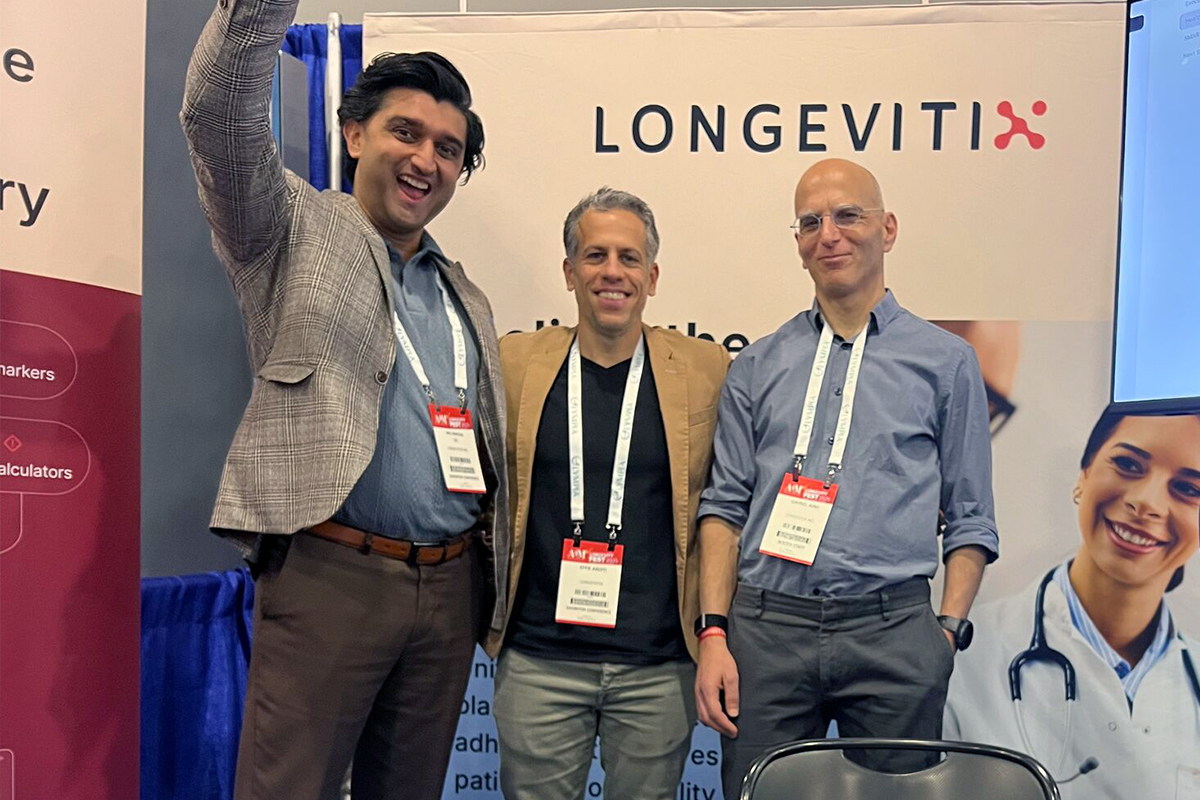
New clinical intelligence system aims to help physicians navigate fragmented data and deliver continuous preventive care.
Longevity medicine no longer has a data acquisition problem; it has an interpretation crisis. Biomarkers, advanced diagnostics and wearables are generating unprecedented volume – the question is no longer whether clinicians can gather the data, but whether they can do anything coherent with it.
US-based company Longevitix has launched a clinical intelligence platform designed to address precisely that problem. The AI-powered system aggregates data from multiple sources – including laboratory testing, wearable devices, clinical notes, intake forms and medical histories – and presents physicians with synthesized assessments, personalized intervention plans and patient-facing reports. The platform is aimed at longevity, preventive, concierge, integrative and functional medicine practices seeking to deliver more continuous models of care without increasing administrative burden.
Longevity.Technology: Preventive medicine is often described as a data problem, but increasingly it looks more like a synthesis problem. The labs, wearables, imaging and -omics are all piling up nicely, thank you very much; meanwhile, the physician is left trying to turn the biomedical equivalent of a junk drawer into a coherent clinical strategy. Longevitix is entering a space where longevity clinics need more than dashboards and abnormality flags – they need infrastructure that can distinguish signal from noise, established guidance from frontier suggestion and useful trajectory from mildly expensive curiosity. The promise here is not that AI replaces clinical judgment – that way regulatory indigestion lies – but that it may finally give clinicians a way to practice longitudinal, systems-based prevention without requiring each consultation to become an archaeological dig through PDFs, portals and wearable exports. The test, as ever, will be whether such platforms can move beyond elegant workflow into measurable outcomes; in longevity medicine, actionable insight is a lovely phrase, but biology remains stubbornly unimpressed by lovely phrases. To find out more about how the company approaches evidence hierarchies, multi-system clinical reasoning and the economics of prevention, we sat down with Effie Arditi, CEO and Co-Founder of Longevitix.
Evidence at the frontier
The evidence landscape in longevity medicine is, to put it politely, uneven. Physicians are routinely asked to weigh interventions with decades of data behind them against approaches that are compelling on paper – mechanistically coherent, biologically plausible – but whose clinical credentials remain provisional.
 Effie Arditi, CEO and Co-Founder of Longevitix
Obscuring those distinctions is precisely what Arditi wants to avoid.
“Our platform is designed to help physicians make the best possible decisions and mitigate risks involved,” he explains. “The knowledge library is built with source-credibility filters and a five-tier evidence framework – from Society guidelines, Cochrane reviews, high-powered RCTs ranking, through expert consensus, and emerging signals – preprints, early-phase trials, translational mechanistic work.”
The aim, he continues, is not to flatten different forms of evidence into a single recommendation, but to provide clinicians with the context required to make informed decisions.
“Every recommendation, diagnostic hypothesis, root-cause attribution, supplement or pharmacologic intervention and underlying biological mechanism is presented with its evidence tier and direct source link. The physician sees the citation, the tier, and the mechanistic rationale at the point of decision.”
As the longevity sector continues to mature, questions of evidence quality and clinical governance are becoming increasingly important. Arditi believes transparency is essential if clinicians are to navigate the space responsibly.
“This preserves physician agency: the platform surfaces the current evidence frontier without collapsing the gradient between standard-of-care and emerging,” he explains. “The physician and patient remain the decision makers. The platform’s role is transparent evidence retrieval and synthesis, not autonomous determination, so physicians can see their interventions pathways, potential risks and mitigation steps.”
When systems collide
Patients rarely present with risks confined to a single physiological domain. Metabolic dysfunction, inflammation, cardiovascular health, hormonal status, sleep quality and psychosocial stress often interact in ways that are difficult to disentangle, particularly when viewed through isolated datasets.
Arditi says Longevitix was designed to reflect that reality.
“Human biology is not siloed to systems, so we designed Longevitix to reflect that. A patient may have metabolic signals, inflammatory signals, cardiovascular risk, hormonal shifts, sleep disruption, and stress physiology all interacting at once. Sometimes those signals point in the same direction. Sometimes they create ambiguity.”
The platform uses specialist models focused on different organ systems, with their outputs contributing to a broader assessment of patient health.
“Each organ-system model is domain-trained and operates as an expert specialist agent, contributing its own view of the patient,” he says. “These ‘experts’ are cross-connected and communicate in a way that resembles medical grand rounds.”
That multidisciplinary approach is intended to create a more complete picture of patient risk while acknowledging that biology does not always offer straightforward answers.
“Their outputs are then integrated into a unified clinical picture by evaluating patterns, confidence, severity, trajectory, and clinical context.”
Importantly, Arditi says the system is designed to expose uncertainty rather than conceal it.
(L–R): Effie Arditi (Cofounder & CEO), Gaby Hayon (Cofounder and CTO) and Dr Neil Panchal (CMO).
“When signals conflict, the platform surfaces the ambiguity rather than forcing a simplistic answer. It builds combined signal strength from longitudinal trajectories across systems.”
Where meaningful disagreement remains, human oversight takes precedence.
“When signals point in materially different directions, the system flags the conflict for escalation to the physician-in-the-loop (PIL), who arbitrates the clinical interpretation and, when warranted, engages the treating physician directly for case-specific alignment,” Arditi explains.
The economics of prevention
The platform’s emphasis on continuous care runs headlong into one of preventive medicine’s more intractable problems. Clinical technology has moved fast; reimbursement systems, organized around episodic encounters and established disease, have not kept up.
Arditi sees that tension as part of a familiar pattern.
“We believe preventive and longevity medicine will follow a path we have seen before in healthcare: innovation often starts in the private market, where patients, employers, or forward-looking clinics are willing to pay for a better model, and then the traditional system adopts the parts that become measurable, evidence-based, and economically defensible.”
He points to telehealth, remote patient monitoring and hospital-at-home programs as examples of innovations that initially emerged outside mainstream reimbursement structures before gaining broader acceptance.
The economic rationale for prevention, he argues, is becoming increasingly difficult to ignore.
“The economic logic is becoming impossible to ignore,” Arditi explains. “According to the CDC, 90% of the nation’s $5 trillion in annual healthcare expenditures are for people with chronic health conditions. So, continuing to spend almost all of our healthcare dollars after disease has already started is not a sustainable model. A shift toward earlier detection, prevention, adherence, and continuous care has to happen and is happening.”
Arditi cites insurer Curative as an example of how some payers are beginning to experiment with prevention-oriented models.
“Curative, the insurance company, is an interesting early signal in this direction. Their insurance model is built around a preventive baseline visit, personalized care planning, and removing financial barriers to in-network care. That shows that some payers are already experimenting with plan designs that reward proactive care rather than waiting for disease progression.”
For now, the company’s focus remains on longevity, preventive and concierge practices, but Arditi believes the data generated by these environments may ultimately help shape broader healthcare adoption.
“Today, the first adopters are concierge, functional, longevity, and preventive clinics,” he says. “Over the next 3 to 5 years, as platforms like ours generate structured data, adherence metrics, earlier risk identification, and measurable outcomes, we believe parts of this model will become increasingly relevant to payers and broader health systems. It will happen when it becomes operational, measurable, and clinically governed. Companies like us are helping prove that new model.”
Building the missing layer
A decade of innovation has left longevity medicine rather well-equipped to measure human health. What it has not solved is what to do with the answer. Biomarkers proliferate, wearables become ubiquitous, datasets grow denser – and the question has quietly shifted from whether medicine can generate more data to whether clinicians can act on it soon enough to change anything that actually counts. Longevitix is betting it has built the layer that finally makes that possible.
Photographs courtesy of Longevitix. Main image shows (L–R): Dr Neil Panchal (Chief Medical Officer), Effie Arditi (Cofounder & CEO) and Gaby Hayon (Cofounder and CTO)