
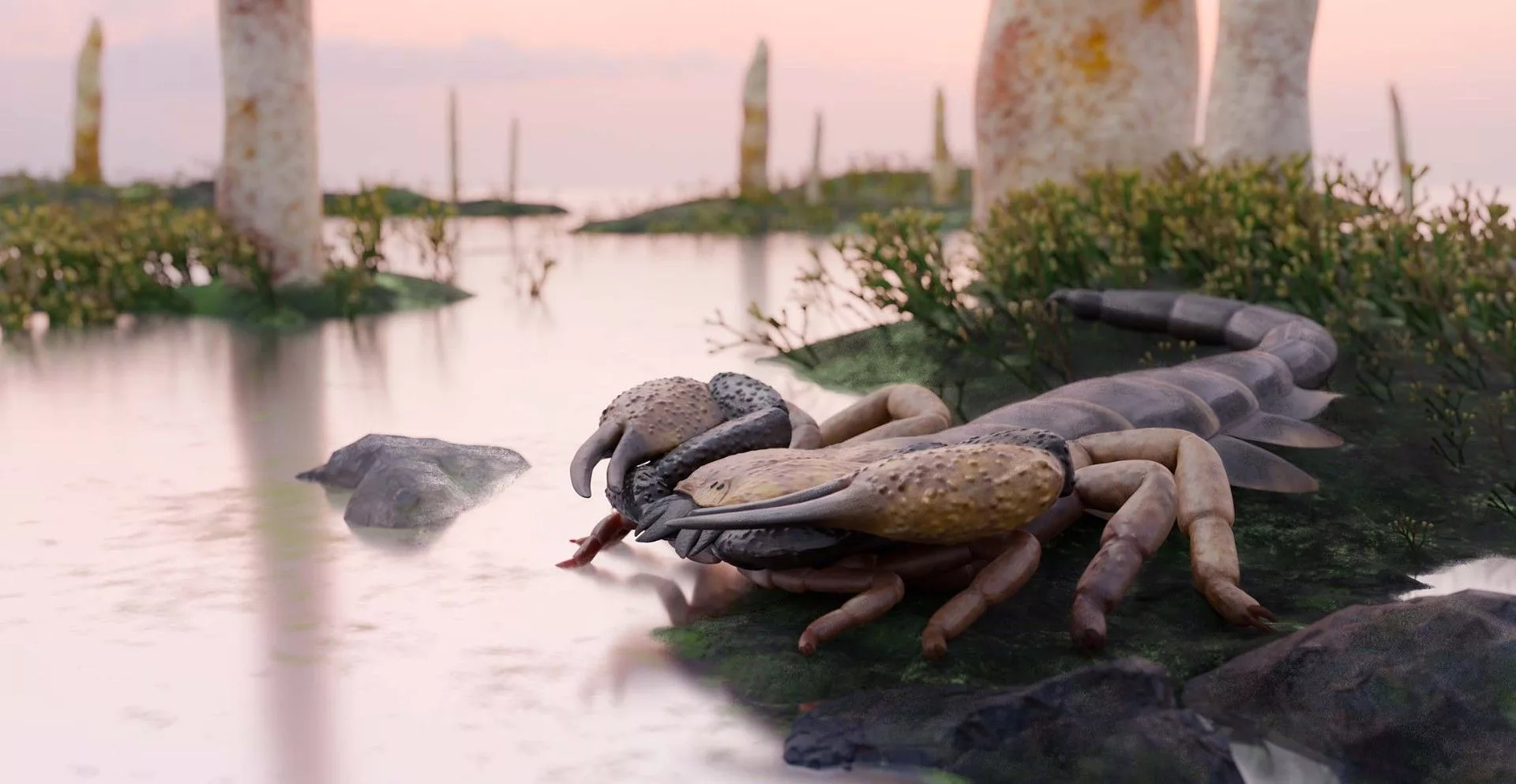
from the Old Red Sandstone in England and Wales reveal a giant predator of the Early Devonian: A scorpion that stretched over a meter long.
Originally described as Praearcturus gigas, this taxon has confused paleontologists for more than a century, with its phylogenetic position shifting among higher taxa with each subsequent generation of research. Now, a modern re-examination confirms its position as one of the largest known fossil scorpions.
When Henry Woodward first identified Praearcturus in 1871, he thought the specimen was a giant woodlouse-like crustacean. The name reflects that initial view, taking inspiration from Arcturus, a group of living woodlice.
But because the fossil was only incompletely preserved, there was plenty of room for disagreement. In the 1980s, paleontologists postulated that the fossil was a gigantic scorpion, but the evidence was scanty and did not include the diagnostic telson or tail sting.
Venom shape untangles scorpion family tree
The debate continued until researchers used near-field optical microscopy and tomographic scanning to examine the fossil more closely. The data confirmed that the specimen from the mine was a scorpion. It also showed anatomical features distinct from those of known arachnids.
Having pedipalps that reached 16 centimeters and a presumed whole-body length of more than one meter, Praearcturus was a formidable predator. The chelae are specially adapted for grasping prey, with fixed and movable fingers. Furthermore, one of the coxae had a stridulatory surface, suggesting that sound production was possible.
The sternum, which has an unusually elongated triangular shape with a deep central groove, is nearly identical to that of Eramoscorpius, a well-preserved Silurian Canadian scorpion.
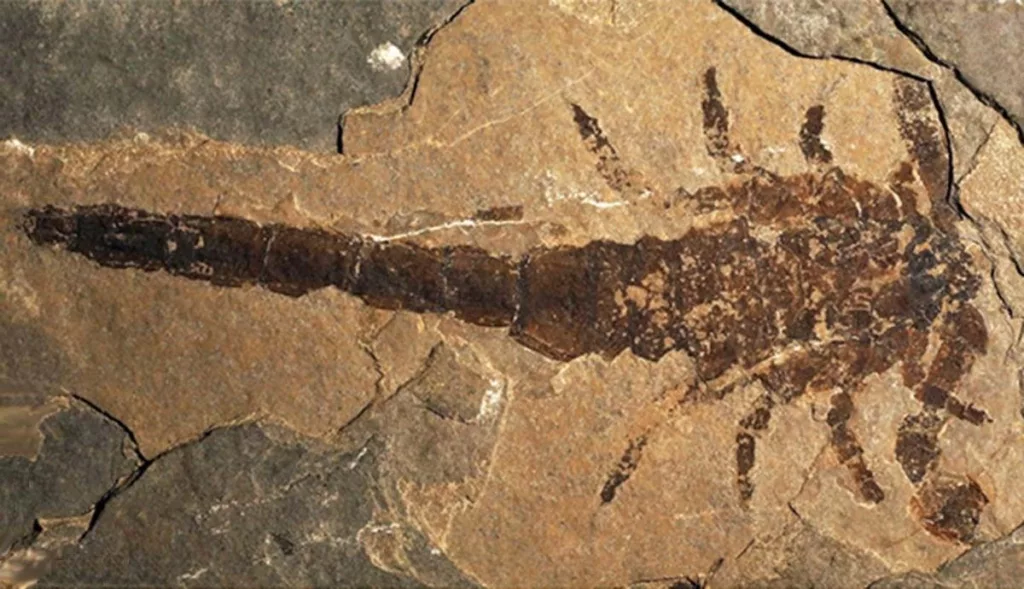 The discovery of Eramoscorpius (pictured) finally provided the fossil evidence to prove Praearcturus was a scorpion after all. Image adapted from © Dunlop & Garwood via PeerJ
“Eramoscorpius was named from a well-preserved fossil, and is clearly a scorpion,” says Dr Richie Howard, lead author of the study and Curator of Fossil Arthropods.
Scientists revealed the oldest known scorpion on Earth
“One key feature of its anatomy is the sternum, which is a long triangular structure with a groove running down the middle that’s on the bottom of the carapace. Praearcturus is a similar age to Eramoscorpius and also has one of these structures. So, this shows beyond doubt that Praearcturus must be a scorpion.”
The fossils suggest that Praearcturus did not live only on land. Some specimens even have flap-like epimera, which are anatomical features similar to those found in modern lobsters and crabs. These features, found in river sediments, indicate an amphibious environment.
“Without complex ecosystems to support Praearcturus on land, these animals probably spent part of their lives hunting in water,” Howard explains. “Some of the fossils found in Wales show that they had flap-like structures known as epimera that are similar to those found in lobsters and crabs.”
Dr Greg Edgecombe, co-author and fossil arthropod expert, adds: “The lines are blurred between arthropods living on the land and in the sea when Praearcturus was alive. Our best family trees from DNA sequences suggest that scorpions are closely related to other arachnids with which they share book lungs, such as the spiders.”
Scientists discovered stinging trees in Australia that secrets scorpion-like venom
“This predicts that they are descended from an air-breathing ancestor. If this is the case, then Praearcturus is an example of an animal that likely returned to the water after its ancestors moved onto land.”
The Early Devonian was a time when life on land was starting to grow. Plants just a few centimeters tall covered the floodplains. Fungi spread across wet soils, and small arthropods were exploring life on land. Into this delicate ecosystem came Praearcturus gigas, a predator with few competitors.
“When we think of giant arthropods, people tend to think of enormous millipedes like Arthropleura or the dragonfly-like griffinflies,” Howard says.
“But these species lived in the Carboniferous Period, at least 55 million years after Praearcturus, once land-based ecosystems had time to develop. Instead, Praearcturus lived when life on land was starting, and the ancestors of reptiles, mammals, and birds were yet to leave the water.”
“It suggests that this species might have grown so big because there weren’t any other large predators, allowing it to dominate its environment.”
Other fragments unearthed at Portishead in North Somerset indicate that, for that, as long as another 40 million years after that, Praearcturus survived. Still, these specimens are assigned to it with caution. Additional field discoveries will be needed both to help ascertain its temporal range and to elucidate questions that remain regarding its specific ecological role.
What is clear is that Praearcturus gigas was not an ordinary scorpion. It was a giant that blurred the lines between land and water. It was a predator that thrived in a world still figuring out how to support complex life. Its story reminds us that evolution often takes bold risks. Sometimes, it leaves behind creatures that are hard to classify.
Journal Reference:
Richard J. Howard, Russell J. Garwood, Gregory D. Edgecombe, David A. Legg. A revision of Praearcturus gigas: a giant scorpion from the Lower Devonian (Lochkovian) of Britain. Palaeontology. DOI: 10.1111/pala.70064