
At the Fieldays event at Mystery Creek on Wednesday, the Government announced policies to fund the acceleration of these tools in the hope of sustaining agricultural productivity and profitability, while also improving environmental standards.
Agriculture Minister Todd McClay said in a new Ministry for Primary Industries report this morning that many of these technological tools would be in “widespread use by 2030″.
But that is the deadline for New Zealand to achieve a 50% reduction in net emissions below gross 2005 levels, which is referred to as its NDC1 target.
Projections show it will be difficult to achieve that target. Both Luxon and Finance Minister Nicola Willis have referred to NDC1, set under the previous Government, as being ambitious and tough to meet.
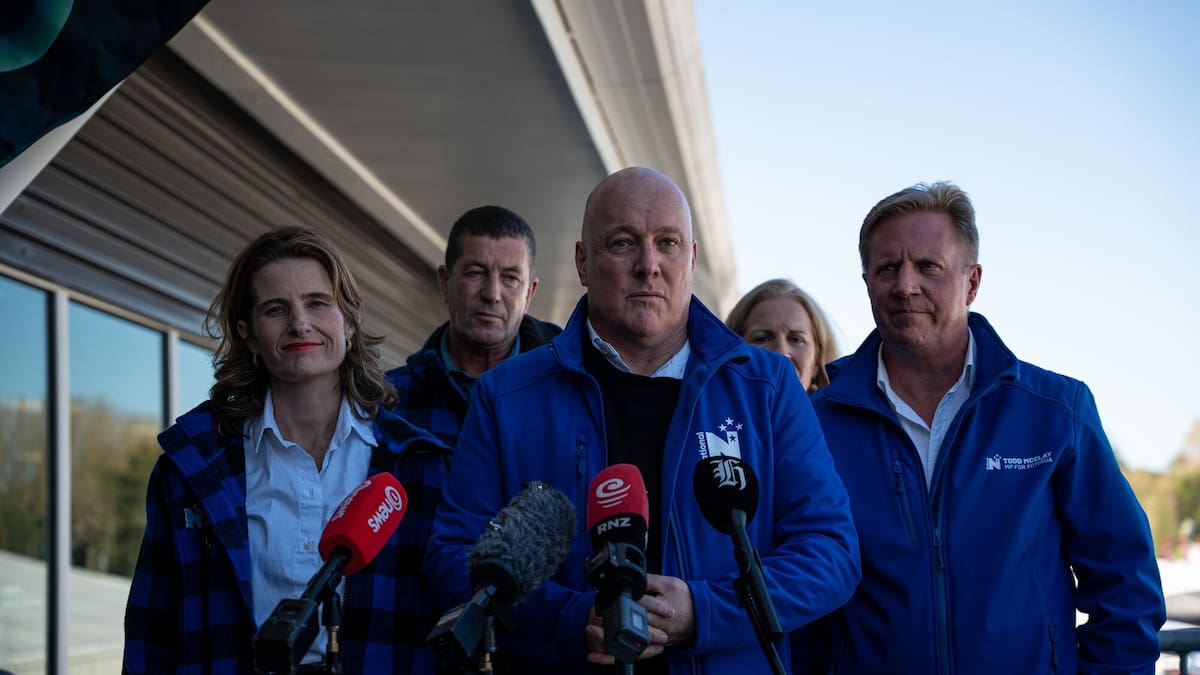
National has placed emphasis on farmers adopting new technologies. Photo / Alyse Wright
Luxon told the Herald yesterday that the Government would “give it a good go”, but also insisted “we’re not sending billions of dollars offshore”.
He highlighted what the Government was doing to help the adoption of emission-reduction technology, but did not give any further details of steps to hit the NDC1.
Today’s Treasury paper does not reflect any Government decisions or suggest that it intends to use offshore mitigation to hit the target.
But it highlights “potential costs under different domestic emissions scenarios, using purchase price assumptions based on observed international mitigation transactions”.
“The estimates in this publication represent the Treasury’s best evaluation of possible fiscal costs based on currently available information,” the paper says.
“This analysis only considers the potential fiscal costs arising from purchasing offshore mitigation to meet NDCs; it does not seek to reflect the broader range of actions New Zealand may undertake under the Paris Agreement or other climate-related commitments.
“The results should be read as an assessment of fiscal risk, rather than a set of expected costs, intentions or recommendations. Actual costs will depend on future policy decisions, market developments and international arrangements, and the results do not attempt to capture the full range of possible outcomes.”
For offshore mitigation to count as part of New Zealand’s NDC, the Treasury said it had to be authorised under the Paris Agreement framework, properly accounted for and transferred as “internationally transferred mitigation outcomes” or ITMOs.
In modelling the potential costs, Treasury said there is a “high degree of uncertainty”.
It noted that the degree of domestic action would determine the level of offshore mitigation that could theoretically be used, that New Zealand’s strategy for offshore mitigation could affect costs, and that there could be changes to prices in the future.
“This analysis relies on observed prices for offshore mitigation transactions that have been initiated by other countries to date.
“Only a small number of transactions have occurred so far, many of which lack published details, and most relevant markets are still developing.
“Additionally, the types of offshore mitigation transactions that have been disclosed may not be representative of the broader market. As a result, these initial price signals provide only a limited indication of possible future costs.”
The Government has been making announcements at Fieldays. Photo / Tom Eley
The modelled cost range is far below the upper range of an estimate in 2023, which was $23.7b.
The Treasury says the price of observed ITMO purchases has been “towards the lower end” of the price range used three years ago. New Zealand is also on track for lower domestic emissions than previously forecast.
Beyond the NDC1 in 2030, there is NDC2 in 2035, which is more closely aligned with New Zealand’s domestic emissions track. There is likely to be less of a gap between what can be done domestically and the overall target, meaning less offshore mitigation may be needed.
The Treasury modelled that the cost of this could be between $200 million and $1.6b, depending on the level of emission reductions targeted.
Jamie Ensor is the NZ Herald’s Chief Political Reporter, based in the press gallery at Parliament. He was previously a TV reporter and digital producer in the Newshub press gallery office. He was a finalist in 2025 for Political Journalist of the Year at the Voyager Media Awards.