
“It’s almost a step forward and a step backwards,” Petersen said.
“The floods of a few weeks ago deposited about 200ml [of silt] in parts of the work that had been dredged.
“It’s going to be an ongoing issue. Every time we have a flood, we get large amounts of silt coming down the river.”
Petersen said dredging options for the next few months were being worked on.
His report said additional depth had been created to improve access for Coastguard Whanganui, enabling vessel launching across a wider range of tidal conditions.
“While this work has been beneficial, dredging remains one of the most significant operational risks facing the port,” it said.
Councillor Glenda Brown asked, “for the community listening in”, what the highlights had been at the port for the last financial quarter.
Petersen said there had not been a lot.
Operating income was down because the cargo ship Anatoki no longer used the port, and discussions with its owner, Coastal Bulk Shipping, on other opportunities were in “very early days”, he said.
Councillor Glenda Brown asked about highlights at the port for the financial quarter. Photo / Mike Tweed
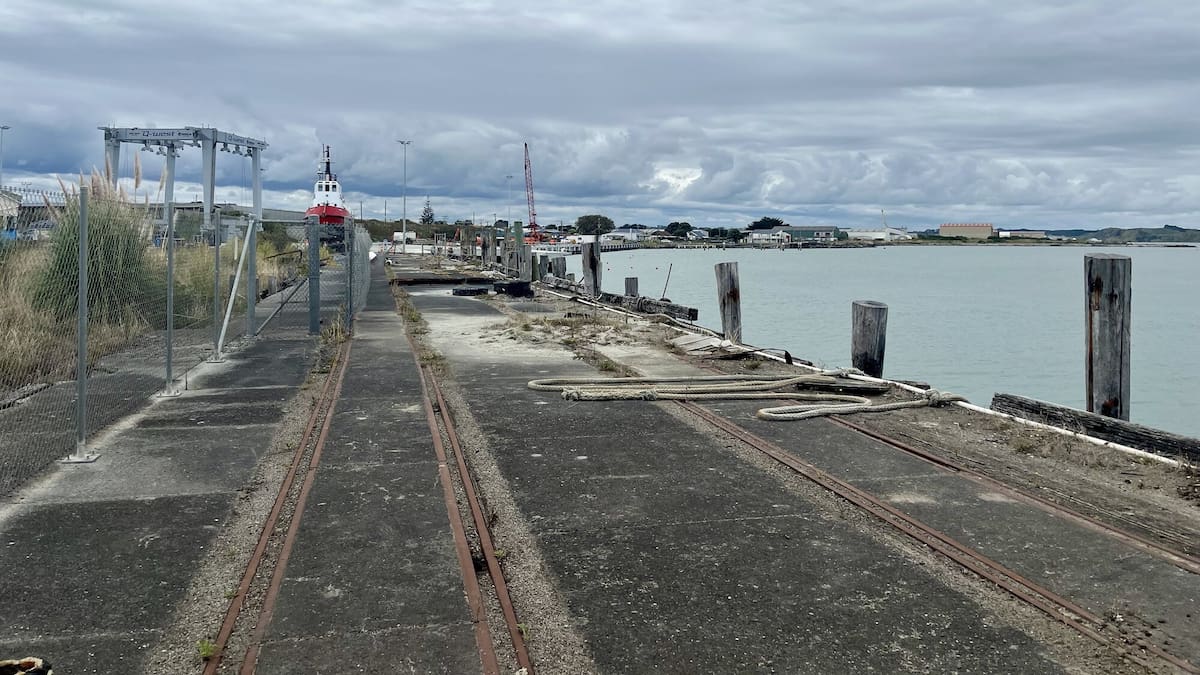
His report said stages one (a heavy pavement vessel hardstand and concrete structures over the water) and three (Wharf 3 rebuild) of the port’s redevelopment project were nearing completion, with design and pricing options for stage two (Wharf 2 rebuild) being developed.
Brown asked Petersen if work at Wharf 1 and Wharf 3 had gone well.
He said there were still cost and contamination issues.
“I wouldn’t be honest if I was saying it was all beer and skittles; there have been challenges in the project.”
The Chronicle reported in February that an independent review of the entire redevelopment project was underway, following unbudgeted spending of $4.2 million to remove contaminated materials.
The review is being conducted by Peter Leslie of PDL Consulting, with draft results presented at a councillor workshop in March.
Petersen told the Chronicle this week that the review was “covering a range of complex issues” and had no official completion date.
“We are working through it very methodically,” he said.
Port project director Dave Withington told councillors the hardstand project cost about $13.5m, Wharf 3 cost $10.8m, and $360,000 had been spent on designs and planning for Wharf 2.
“The dredging solution is currently running at $4.2m, [there are] a bunch of project costs in the region of $4m [and] contamination [is] close to $6m.”
About $3.1m had been spent on the port’s trade waste treatment plant, he said.
The redevelopment has a budget of about $50m, split between the council ($37.5m) and central Government ($12.5m).
It is part of the Whanganui Port revitalisation project Te Pūwaha, a partnership between the council, Q-West, Horizons Regional Council, Whanganui District Employment Training Trust and hapū collective Te Mata Pūau.
Mike Tweed is a multimedia journalist at the Whanganui Chronicle. Since starting in March 2020, he has dabbled in everything from sport to music. At present, his focus is on local government, primarily the Whanganui District Council.