
 Image credits: NASA.
Sending a satellite into space used to be a massive undertaking.
Satellites were often the size of a van or a bus, built by government agencies or aerospace giants, and launched at enormous cost. Once in orbit, they could spend decades relaying calls, watching the weather, mapping the planet, or spying on rivals.
That world still exists. But it’s no longer the whole story.
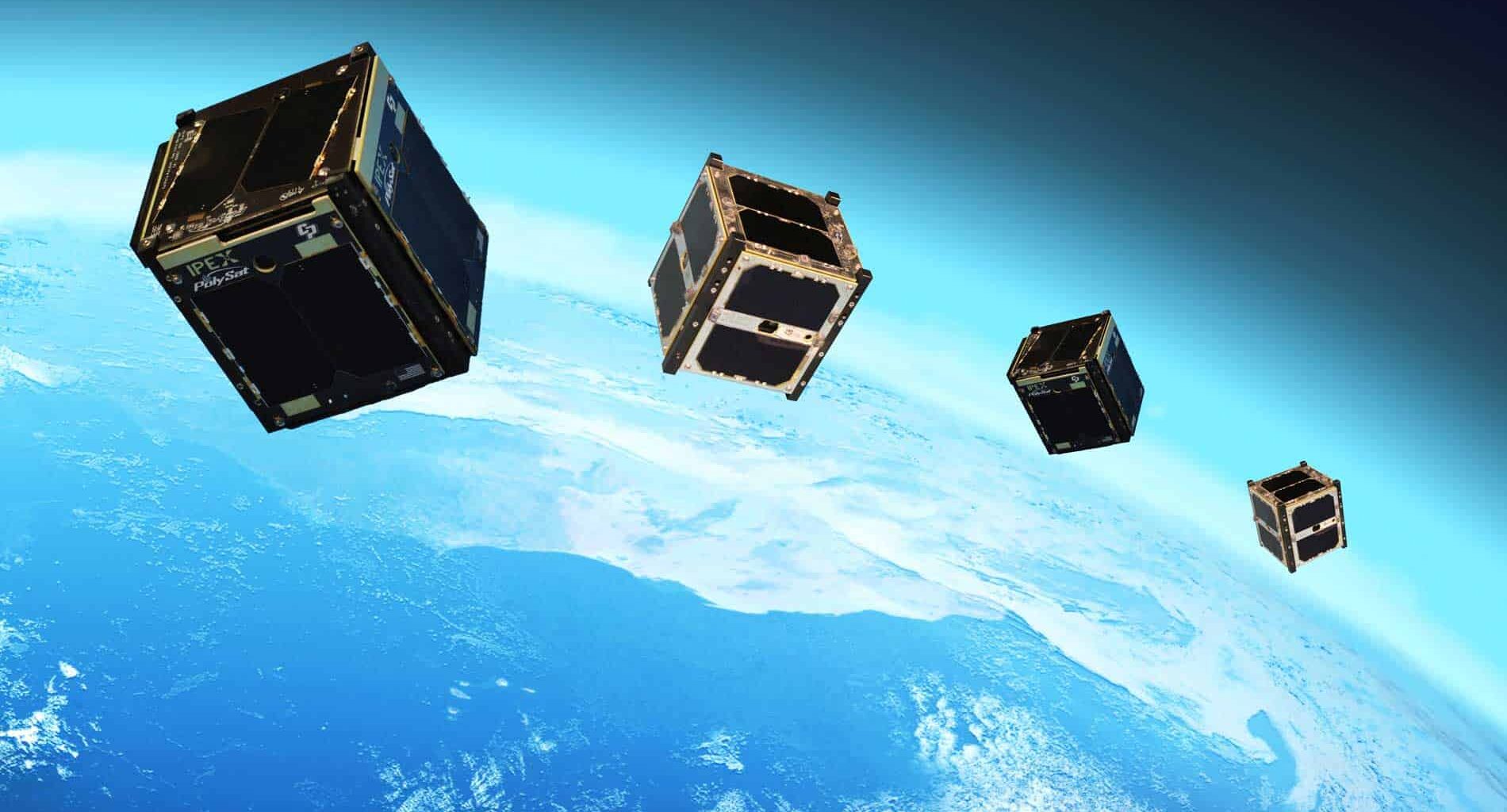
A new class of spacecraft has slipped into orbit: nanosatellites. These are very small satellites often built around the CubeSat format, though their name can be misleading. These satellites aren’t nanoscopic (that would be something), but rather measure around 10cmx10cmx10cm and weigh no more than a kilogram. In this small space, they pack sensors, solar panels, radios, batteries, processors, and software designed to do one focused job.
Some watch the Earth, while others test new technologies. Many of them help students learn how space missions work. A few have even gone beyond Earth orbit. But there’s a catch. As space becomes easier and cheaper to reach, it is also becoming more crowded.
Space Has Become More Accessible
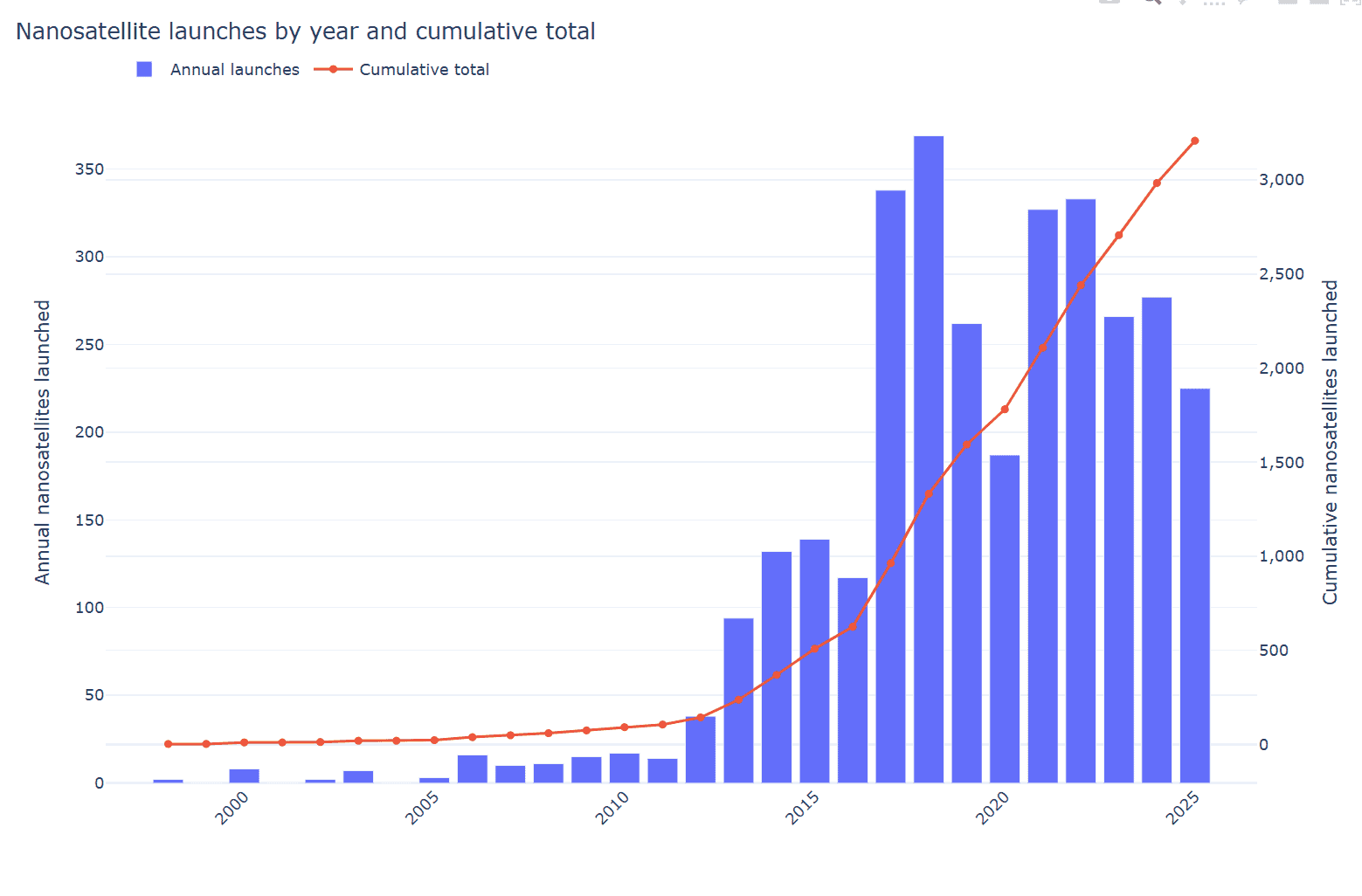 Chart by ZME Science.
According to the Nanosats Database, 3,209 nanosatellites had been launched by January 1, 2026. Nearly 3,000 of them were CubeSats.
The idea started modestly. CubeSats were originally a way to teach students how to build satellites without requiring the budget of a national space agency. Early missions were often simple. Imagine things like radio beacons, technology demonstrations, student experiments, and proof-of-concept missions.
This approach proved to be very successful.
×
Thank you! One more thing…
Please check your inbox and confirm your subscription.
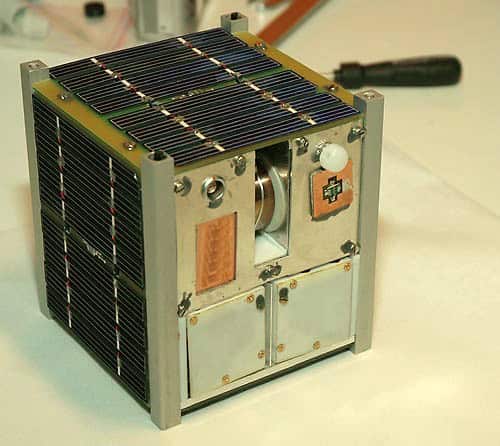 Cubesat example. Image via Wiki Commons.
For universities, CubeSats turned space engineering from an abstract subject into something students could actually build, test, launch, and operate. Young engineers could follow a mission from design to orbit.
Then, the technology improved.
It started with even more miniaturization. Cameras, radios, batteries, processors, solar panels, attitude-control systems, and miniature propulsion units all became smaller and more capable. The same trend that shrank phones and cameras also made it possible to pack serious computing power into spacecraft weighing only a few pounds.
A CubeSat that once might have done little more than beep from orbit can now monitor crops, track coastlines, test new communications systems, study space weather, or demonstrate a propulsion system.
Almost overnight, companies realized they also wanted in on this opportunity.

Launch Got Cheaper Too
Technology was only part of the shift. The economics of launch also changed.
Historically, putting a satellite into orbit meant building an expensive one-time-use rocket and securing a rare, costly launch opportunity. CubeSats changed that equation because they were small enough to ride alongside larger payloads. The economics changed even more in favor of nanosatellites once companies like SpaceX made reusable rockets routine.
The result was a flood of experimentation.
 Distribution of nanosatellites by use. Light blue is “Deorbiting/debris”, pink is “interplanetary.” Credit: ZME Science.
A Crowded Frontier
CubeSats have lowered the barrier to space.
They have allowed smaller countries to train engineers, test instruments, join international missions, and claim a place in the orbital economy. The same is true for startups and research groups that would once have had little chance of flying hardware in space.
But access is still uneven. Although 94 countries have nanosatellites in space, the vast majority of them are still American.
 Chart by ZME Science.
The satellites themselves are also growing. They’re still petite but a bit heftier than previous generations in order to accomodate increasingly sophisticated hardware.
The original CubeSat unit, known as 1U, is a cube 10 centimeters on a side. But many modern CubeSats are built from several units joined together: 3U, 6U, 12U and larger. The spacecraft are still small by traditional standards, but many don’t really fit the “shoebox” description anymore. Some are closer to briefcases or small suitcases.
Larger CubeSats can carry more power, better antennas, more capable instruments and propulsion systems. They can do more than beep from low Earth orbit. People want the piggyback advantage but also want to make it more powerful.
Some have gone even farther. CubeSats have been used in missions beyond Earth orbit, including lunar and interplanetary missions. The Nanosats Database lists 18 interplanetary CubeSats as of the start of 2026.
 Credit: ZME Science.
It’s Getting Crowded Up Here
For all the excitement, there is a growing problem. We’re treating Earth’s orbit too much like an unlimited resource. It is not.
The majority of nanosatellites aren’t built to last very long. In fact, they’re being built to last no more than 5 years.
 Chart by ZME Science.
Even small satellites occupy real orbital space. Some reenter quickly, burning up in the atmosphere after weeks or months, but others can remain aloft for years before their dragged into the atmosphere by gravity. The next era of spaceflight seems to run into a sustainability problem. We need ways to ensure that even these small satellites don’t stay up after they stop working and don’t pollute our orbit.
The space debris problem isn’t new, but it’s becoming much more prevalent.
Big Future for Small Satellites
CubeSats won’t replace large satellites. That much is clear. They can’t carry the same instruments, power systems or shielding. A major telescope, weather satellite or planetary probe can still so much more.
But that’s not the point.
 Chart by ZME Science.
CubeSats make space feel less like a towering ambition and more like a workshop or a research project. They’re opening up an entirely different type of space race, enabling people to try out strange and risky ideas. But at the same time, the nanosatellites have become a swarm, clogging up the orbit.
So, the next challenge is not simply to launch more of them. It is to launch them better.
Nanosatellites showed that space does not have to belong only to the biggest players. Now they have to show that a more open space age can also be a more careful one.