
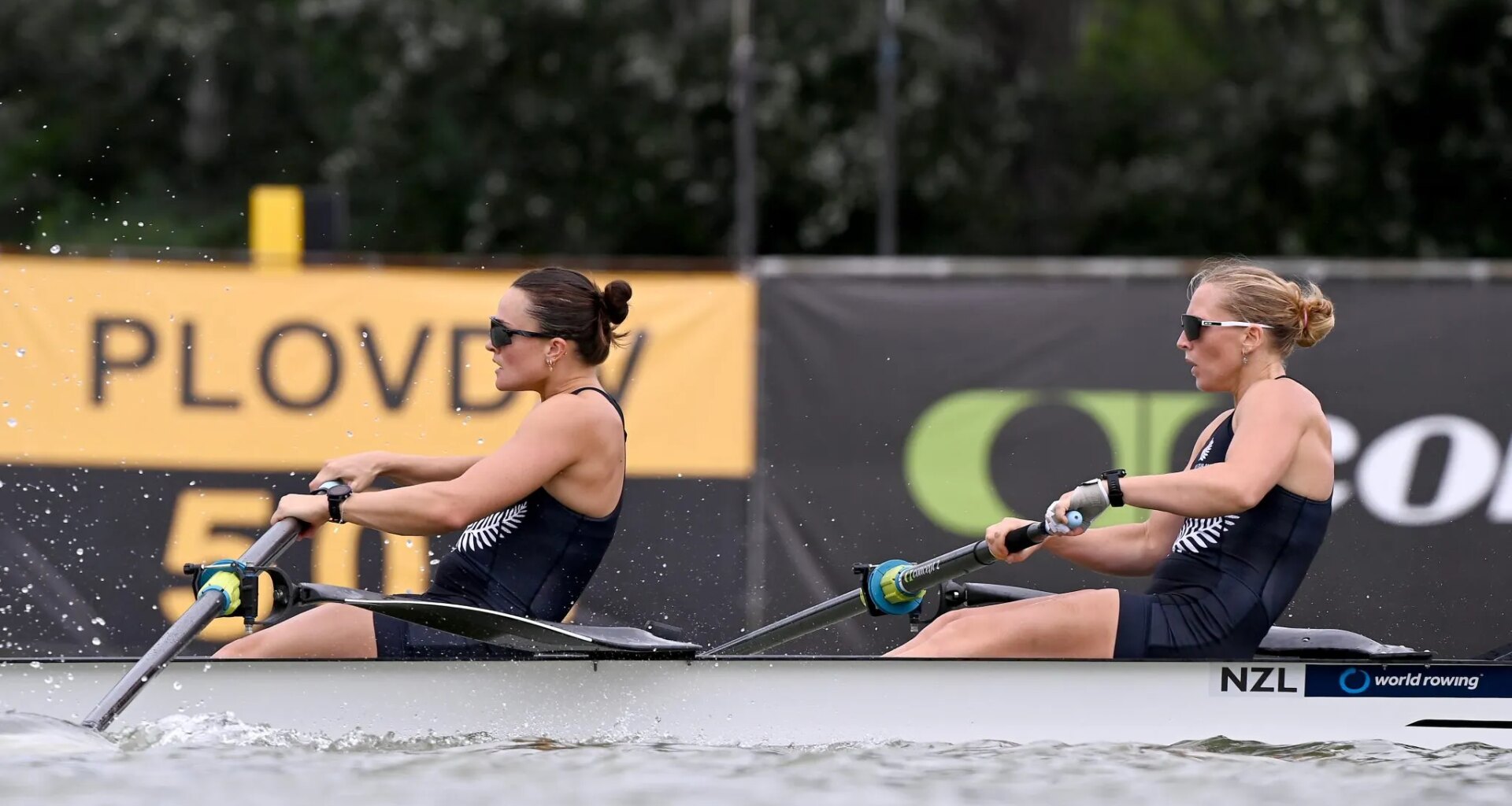
Big-nation absences give NZ crews chance to race without fear.
Some of the New Zealand crews might have thought they were in a parallel universe on day one of the World Cup Plovdiv regatta in Bulgaria.
A big chunk of the leading nations from Seville two weeks ago have gone on training camp, and those that have returned for this round are mostly new combinations.
That gave some of the New Zealand boats little opportunity to compare themselves against, but plenty of runway to try different things without fear. It was a day to sharpen internal focus.
World champions Ben Taylor and Oli Welch are the benchmark in the Men’s Pair so their focus is only ever on how fast they are going and not worrying about anyone else.
Their time in winning heat two, in tail conditions, suggested that philosophy won’t be changing anytime soon. Ben and Oli led all the way to cross in 6min19.01sec, less than three seconds off their PB from the heats at the worlds last year. Serbia was second (6.29.76) and China third (6.34.24).
The next fastest winner was Italy from heat one in 6.26.07.
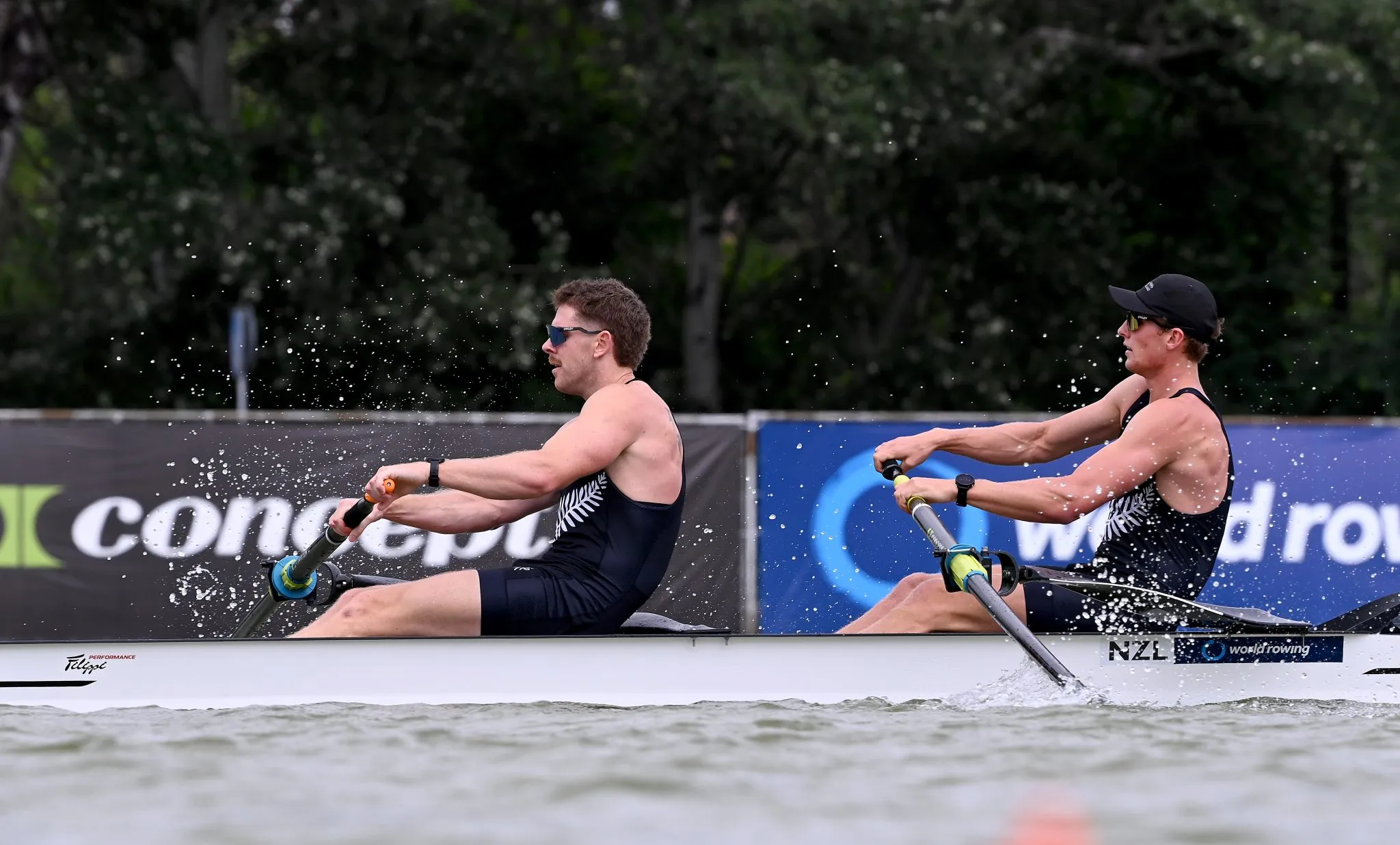
Ben Taylor and Oli Welch led all the way in their heat of the Men’s Pair to cross in 6min 19.01sec, less than three seconds off their PB from the heats at the World Championships last year.
Katie Lush and Juliette Lequeux didn’t get much time in the pair before they left for Europe last month, after Alice Fahey withdrew with injury. Despite that, they won the B Final in Seville.
They drew Czechia and the Abraham sisters from Chile in their heat, the gold and bronze medal winners from Seville, which did give them an opportunity to chart their progress.
The Abrahams crossed in 7.01.42, Czechia in 7.04.63 and New Zealand in 7.05.62.
Katie and Juliette put out a big challenge to the Czechians in the final 200m but were unable to reel them in.
”We didn’t realise how close we were to them so it’ll be cool in the final to see if we can give it a crack a bit earlier,” says Katie. ”I think we’ve definitely closed the gap from Seville. Those crews were a bit ahead of us there, so to narrow that margin is a step in the right direction.”
Time in the boat has been the key.
“I think especially for me being in bow seat, just like figuring out how to follow and lean on Katie a bit more,” says Juliette. “Our first 500 today just felt a lot more connected to each other.”
Instead of a parallel universe, Finn Hamill and Ben Mason were in a different world in their heat this time round, winning in 6.08.79, nearly eight seconds up on the other two quadruplets in the Abraham family from Chile, Ignacio and Alfredo.
”I think we did what any reasonable crew would do and just completely changed everything coming into here,” says Finn.
That started with him jumping into stroke seat.
Finn and Ben’s time was just 0.18s outside their best-ever time at this level, recorded in the semifinals at World Cup Varese last year.
”It’s nice to see we’ve still got it,” says Finn.
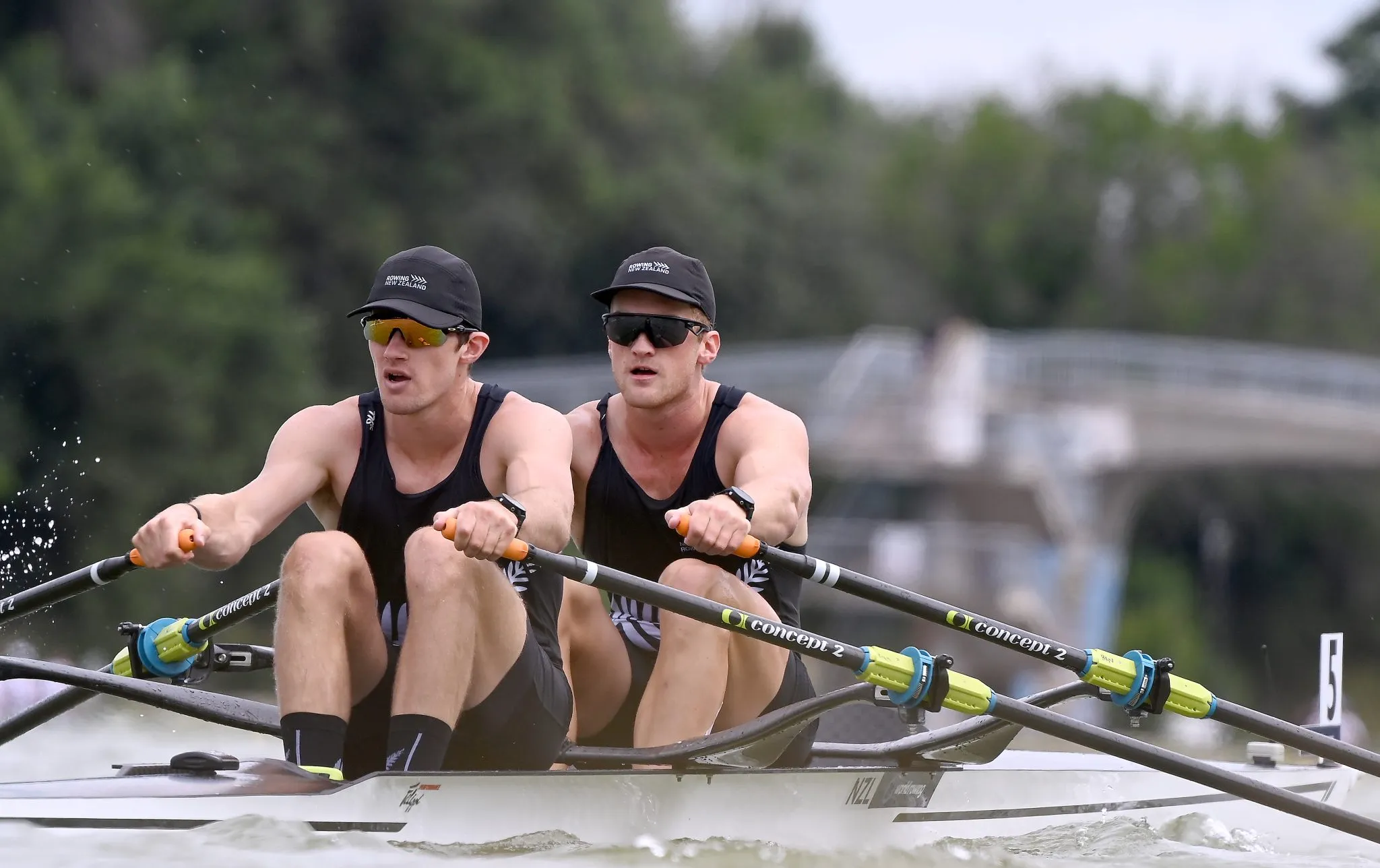
Finn Hamill and Ben Mason’s time in their Double Sculls Heat was just 0.18s outside their best-ever time at this level, recorded in the semifinals at World Cup Varese last year.
Eva Hofmans and Sophie Egnot-Johnson were second in the C Final of the Women’s Double Sculls in Seville. On Sunday night they’ll race their first ever A Final at this level, after finishing second in their heat (6.55.55) behind the United States (6.53.74).
They also suffered in the transition from New Zealand to Europe, says Sophie.
“We were going quite well back home and then with the travel and whatnot we kind of lost our mojo a little bit and were really struggling to find it before Seville.”
They’ll get another chance at an American crew with great pedigree – Lauren O’Connor was 10th in the Women’s Single at last year’s worlds and Kristina Wagner was ninth in the double at the Paris Olympics, not that Sophie’s taking note.
“To be honest I don’t really like looking into who I’m racing. I don’t want to scare myself!”
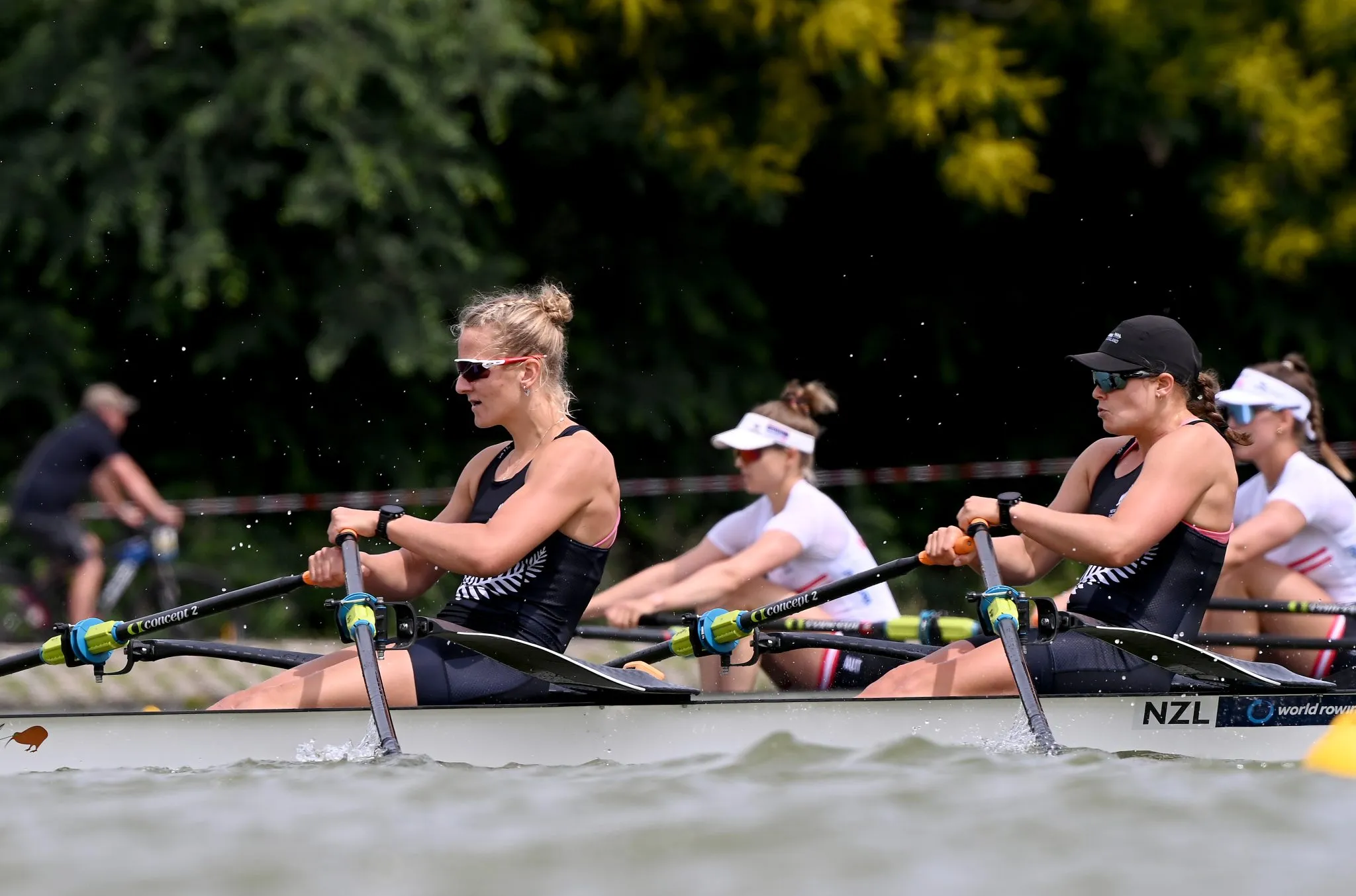
Eva Hofmans and Sophie Egnot-Johnson will race their first-ever A Final at this level, after finishing second in their double sculls heat (6.55.55) behind the United States (6.53.74).
The Women’s Four looked like a different event from two weeks ago.
In Seville, there were eight entries and Alana Sherman, Isla Blake, Kate Haines and Ella Cossill overhauled Great Britain in the final few strokes to go straight to the A Final.
In Plovdiv, New Zealand was the only crew back from that medal race two weeks ago, with the Brits, Ireland, the Netherlands, Australia and Poland all absent.
That left the Kiwis chasing the best lane in a preliminary race against the USA, Italy, China, Austria and Romania.
New Zealand finished second in (6.26.71) behind the United States (6.19.80).
”Clearly they’re a top-tier crew and are putting some good speed out there,” says Isla. “It’s great to be putting ourselves up against a quick crew like that, we can only learn. It’s cool to be able to race them in the prelim and then have another opportunity in the A final on Sunday.”
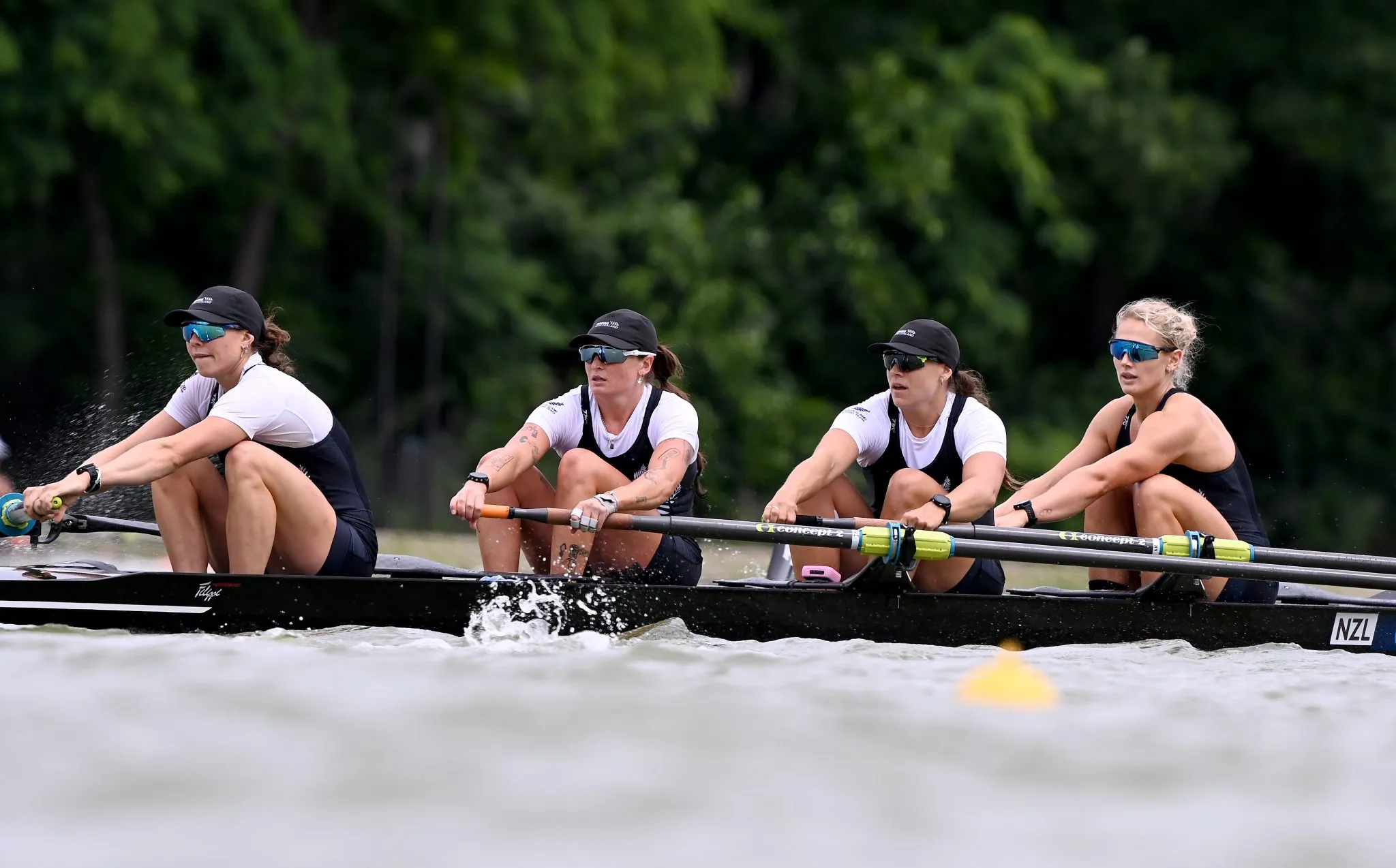
Alana Sherman, Isla Blake, Kate Haines and Ella Cossill finished second in the preliminary of the Women’s Four behind the United States.
The Men’s Four of Fred Vavasour, Campbell Crouch, Harry Fitzpatrick and Josh Vodanovich were in a similar situation to the Women’s Four.
Four crews from the final in Seville – Great Britain, France, the Netherlands and Denmark – skipped this round. Only New Zealand and Romania were back in Plovdiv, and the Romanians boated an entirely different crew.
That left the Kiwis in a four-boat heat against Ukraine and two crews from China.
New Zealand finished third (5.51.22) behind China (5.48.41) and Ukraine (5.51.09) but were quick enough to make Sunday’s A Final.
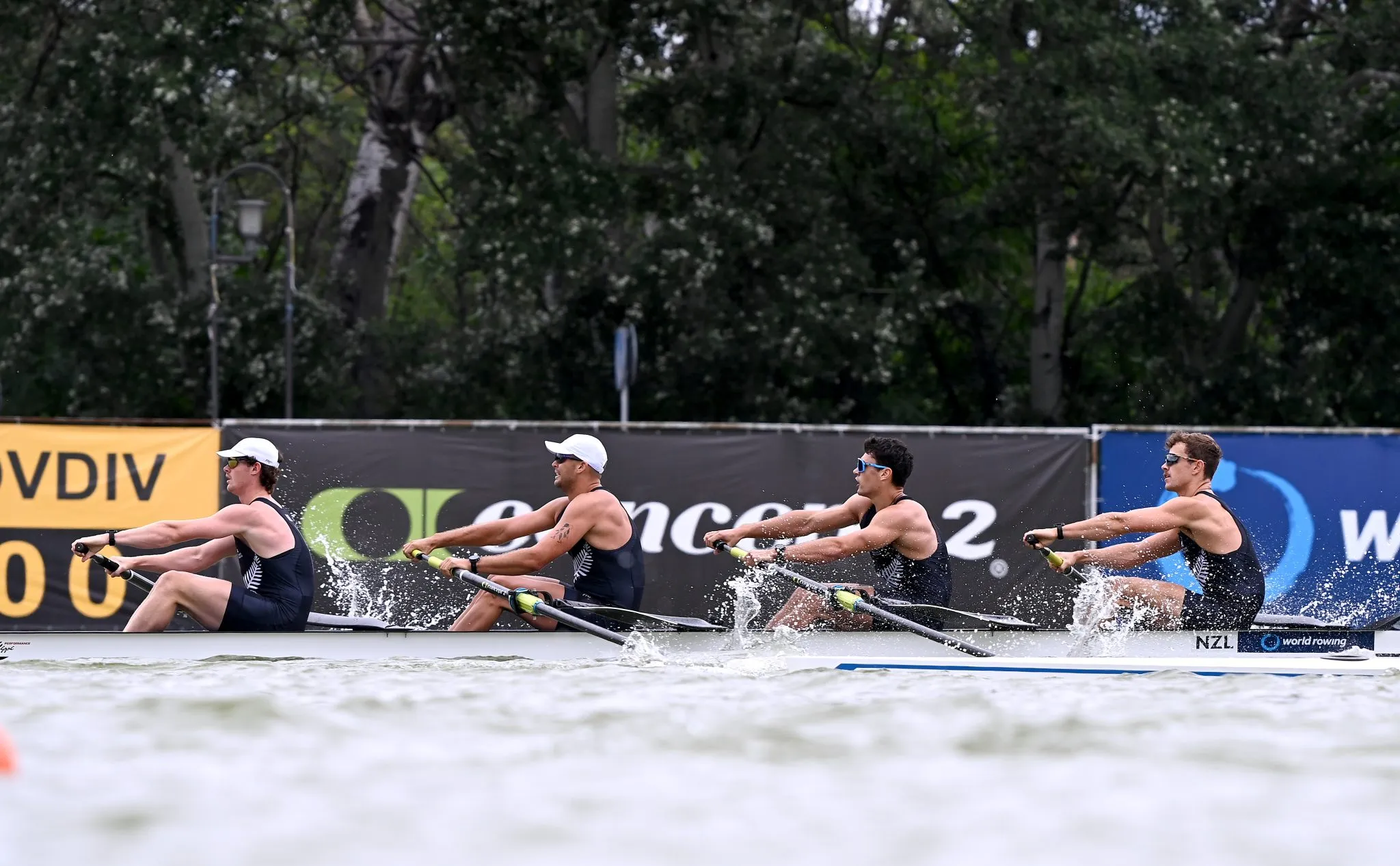
The Men’s Four of Fred Vavasour, Campbell Crouch, Harry Fitzpatrick and Josh Vodanovich finished third in their heat (5.51.22) behind China (5.48.41) and Ukraine (5.51.09) but were quick enough to make Sunday’s A Final.
Both New Zealand’s Quadruple Sculls raced prelims.
The Women’s boat of Olivia Hay, Stella Clayton-Greene, Beckie Leigh and Veronica Wall had no one to compare their progress against after finishing sixth in the A Final in Seville. Four of those finalists – Germany, Great Britain, Switzerland and Canada – aren’t in Plovdiv and Romania is boating a completely different crew.
Czechia, the USA and China are opening their World Cup season with new crews as well.
So, the New Zealand crew looked to the things they could control.
”We’ve made a lot of changes in our boat with the equipment and how we’re rowing,” says Liv. “We’ve just taken a bit of a different approach to the stroke – rowing longer, getting more out of each stroke and more distance per stroke.”
New Zealand finished third, crossing in 6.25.54 behind the USA (6.13.31) and China (6.20.63).
”I definitely think we’ve taken steps in the right direction,” says Liv. “We’re still fine-tuning and figuring things out along the way, and what was awesome about the prelim today is that it was an opportunity to test and see if it was working and we’re going to keep fine-tuning for the final as well.”
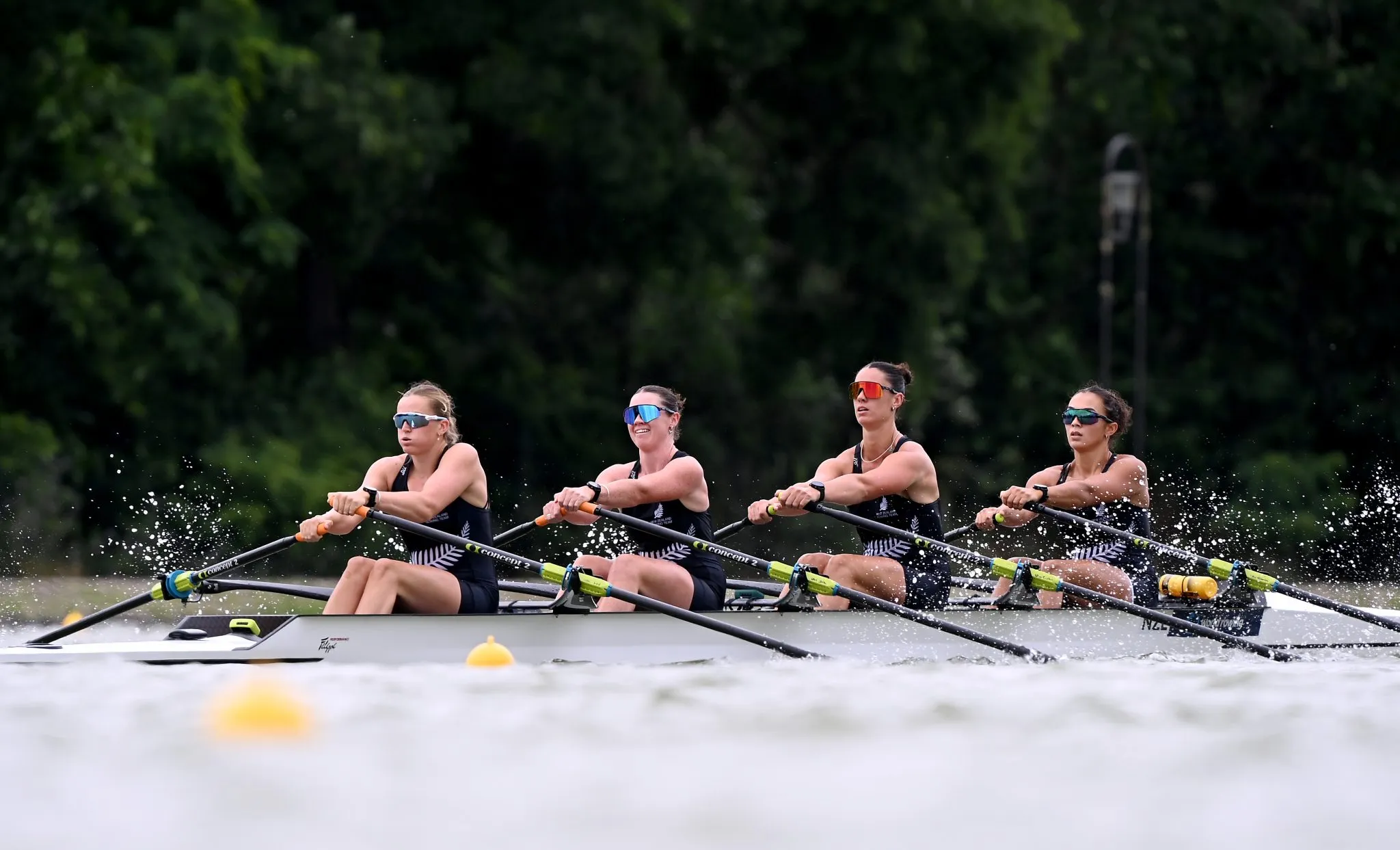
The Women’s quad of Olivia Hay, Stella Clayton-Greene, Beckie Leigh and Veronica Wall finished third in their prelim, crossing in 6.25.54 behind the USA (6.13.31) and China (6.20.63).
The Men’s Quad of Arie Magasiva, Callum Tutbury, Oscar Ruston and Ben Olifiers could have looked across from lane one of their preliminary and been forgiven for not recognising a single athlete from the regatta two weeks ago. Only Romania and Czechia were back from Seville but both crews had completely different lineups.
New Zealand was sixth in 5.58.83. Italy won in 5.39.18.
The competition is growing, and only getting stronger.
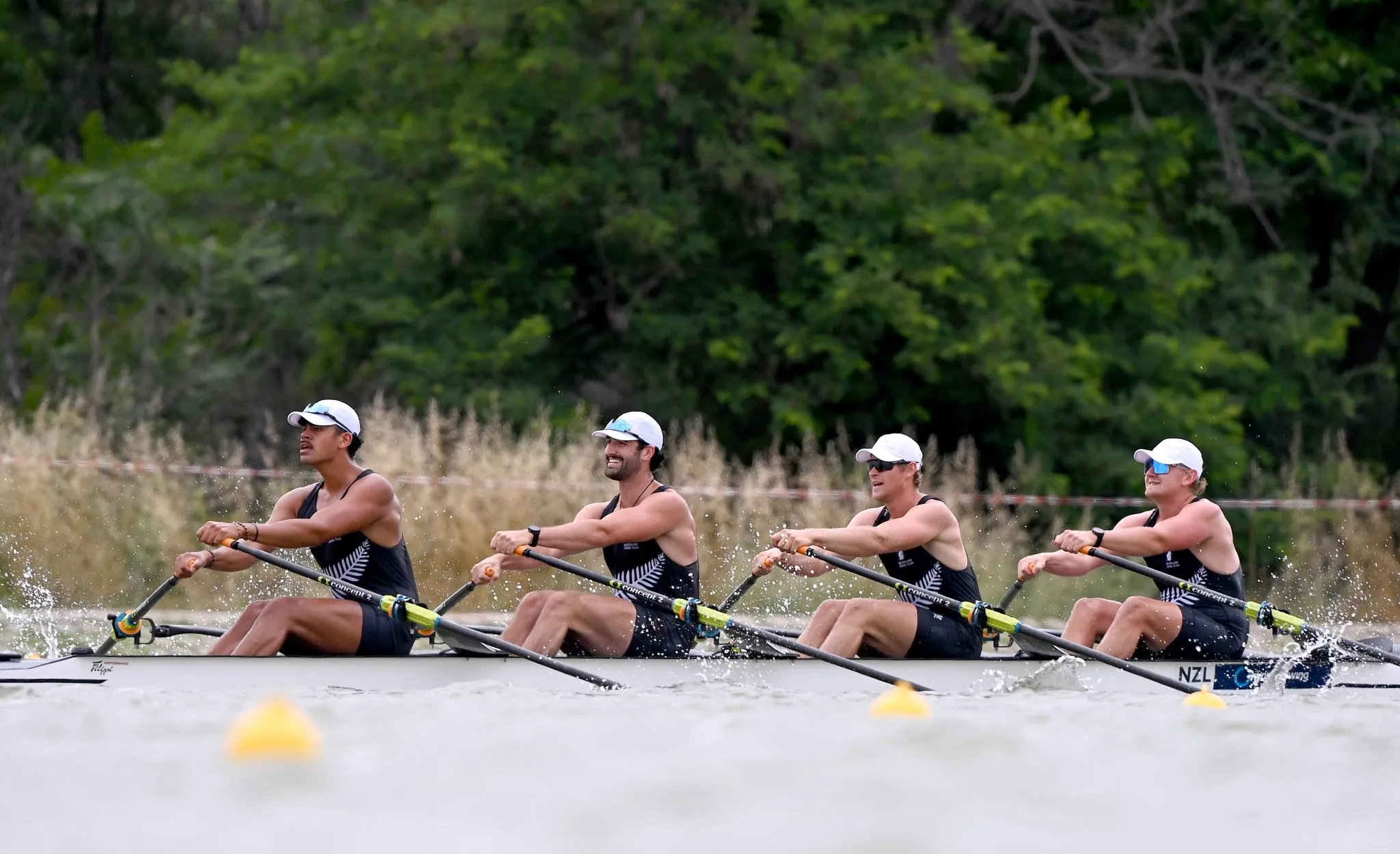
The Men’s Quad of Arie Magasiva, Callum Tutbury, Oscar Ruston and Ben Olifiers were sixth in their prelim in 5.58.83. Italy won in 5.39.18.
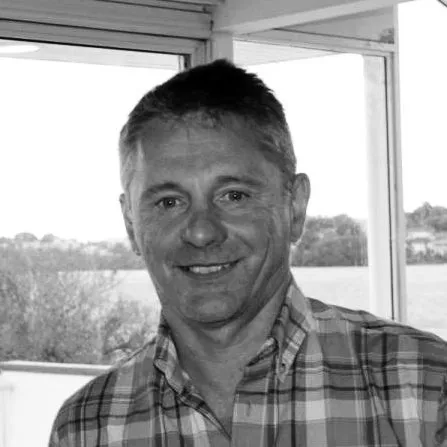
Andy Hay is a freelance producer, writer and Maadi Cup-winning coach. He was cox of the world champion New Zealand eight of 1982 and ’83. He is NZ Olympian #446.