
“Are you really at peace? Are you ready for it?” Polata’ivao asks.
In rehearsals, only a small group of cast and crew hear the story. Soon, hundreds of strangers will be watching.
“Are you ready for that? Are you at peace with people coming into your life and your world? Because even if they are not those names, they are lives that you know.”
“The generosity in giving something like this as a gift to our people, is very, like all great pieces, great stories, great theatre, it opens up stuff to be spoken about, to come forth,” she says.
Sons of Vao playwright/co-director Vela Manusaute. Photo / NZ Herald
For Manusaute, the answer has taken more than four decades.
“It’s taken a long time for me to get this story out,” he says.
“It deals with me, deals with who I am, it deals with my background, deals with why I am, because of my father and all that.
“He passed on. We didn’t say goodbye. So it was time for me to write something.”
More than 20 years after his father’s death, the play became a chance to lay down the anger he had carried for decades. At its heart, Sons of Vao is about making peace with the past.
“I can’t carry the hate. I can’t carry that anger. I can’t carry that. So what can I do about it? I can write. I can create.”
Writing became a way to process experiences he had carried for years.
“It’s not my life, but the energy is my life,” he says.
“The core is my story, who I am.”
Theatre has shaped that journey since he was a teenager. After being kicked out of Selwyn College, drama teacher June Renwick persuaded the principal to give him another chance.
“I got kicked out of school, and she went and told the principal to let me back in.”
Polata’ivao describes Renwick as “the teacher who saved him”.
Now in her late 80s, Manusaute’s former drama teacher will be in the audience on opening night. He says her presence at the premiere feels like a chance to come full circle and say thank you.
“It’s some kind of a gift for her, to say thank you,” he says.
Renwick introduced him to drama at a time when expressing emotions did not come easily.
“Drama has always been, it’s hard on me, you know, we don’t show our feelings. I think drama is the best thing for me.
“Remember, I can cry and laugh on the spot.”
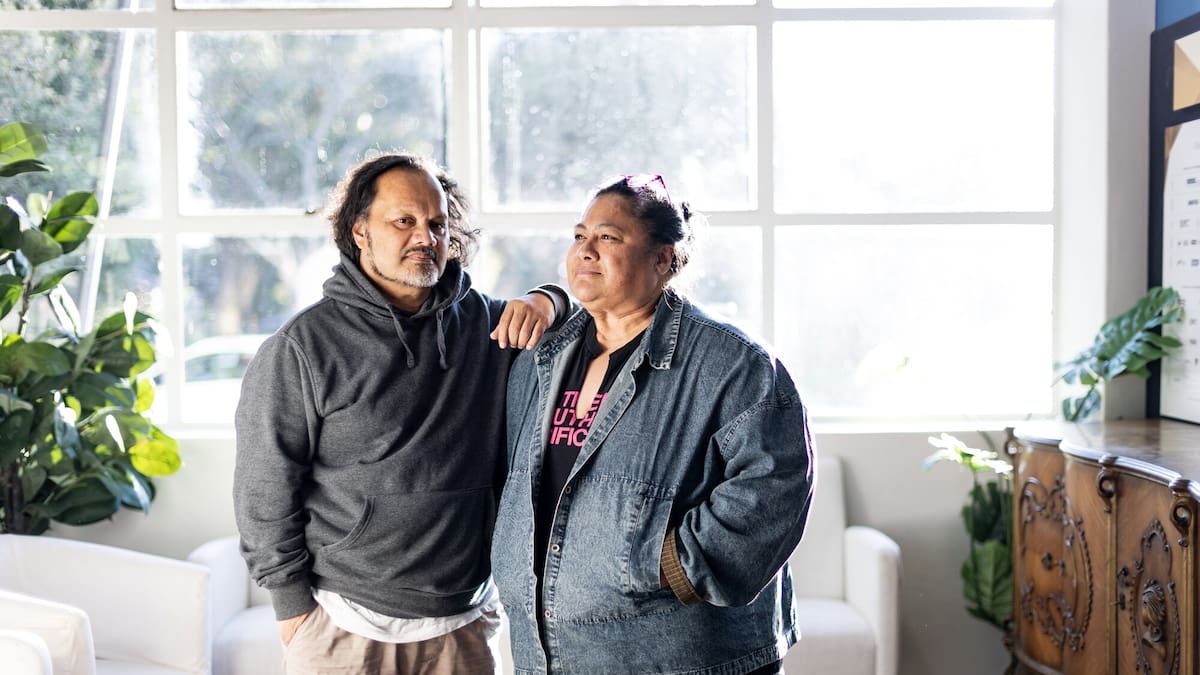
Sons of Vao playwright/co-director Vela Manusaute with co-director Anapela Polata’ivao.
Theatre took him to Toi Whakaari New Zealand Drama School, where he was accepted on his fourth attempt.
“I got in the fourth time into drama school because I didn’t fit the mould. But I’m still here after 37 years.”
“You came here as a boy, and you left as a man,” he says of his time at drama school.
The pair met in 1995, when a Pacific Theatre production featuring Polata’ivao visited Toi Whakaari during Manusaute’s first year at drama school. It was the beginning of a partnership that has spanned more than three decades, as life partners and creative collaborators.
Manusaute became Toi Whakaari’s first Niuean graduate in 1996. Polata’ivao followed a few years later, emerging from the gruelling, highly disciplined training that shaped her career as an actor, director and writer.
After graduating in 2002, Polata’ivao challenged Manusaute to think about the next generation of Pacific artists.
“There was absolutely no work for us,” Manusaute says. “The only way was, we need to create something.”
Together, they would go on to build a family and establish Kila Kokonut Krew, a company that helped create opportunities for Pacific artists and bring more Pacific stories to the stage.
Polata’ivao remembers those early years as a time of fearlessness.
“We were very unafraid.” Asked whether she would have achieved the same things without Manusaute beside her, she doesn’t hesitate. “No, I don’t think so.”
Manusaute is quick to acknowledge Polota’ivao’s role in everything they built together.
“Bell’s always been the cornerstone of our success because she’s real. She keeps me real,” he says.
“I’m Niuean-Samoan. She’s full Samoan. She’s the head girl of Ōtāhuhu College. I’m the head boy of the bus stop. Creativity brought us together.”
Now they find themselves working on perhaps the most personal project of their careers.
For Polota’ivao, directing Sons of Vao offered a deeper understanding of the man she has spent more than 30 years alongside.
“The wonderful Bells here, we’ve been together over 30 years. And finally she gets to read the play,” Manusaute says. “She said, ‘Oh my God, you make sense.’”
The play revealed experiences and relationships that shaped him long before they met.
Epine Bob Savea and Brett Taefu during rehearsals for Sons of Vao. Photo / Andi Crown
Polata’ivao says she admires his willingness to expose those parts of himself.
“I know I’m not brave enough to be able to put myself on the line like this.”
While rooted in Manusaute’s own experiences, Sons of Vao explores issues familiar to many Pacific families. At its heart are fathers and sons, expectations of masculinity, and the impact unresolved pain can have across generations.
Asked about discipline, Polata’ivao says the conversation extends beyond physical punishment.
“There’s a discipline, physical, and then there’s the abuse, psychological.
“Like someone’s figure, someone’s tone, someone’s way they look at you, it all contributes to it.
“I think that’s what Val’s written here as well. It’s those different layers.”
For Manusaute, theatre has provided a language for emotions that many Pacific men are often taught to suppress.
“Drama has helped me articulate my feelings, for myself, who I am, and never be shy of who I am.”
He says those experiences shaped the kind of father he wanted to be. Together, he and Polata’ivao raised a daughter and two sons.
As Sons of Vao heads to the stage, the next generation is already involved, with their youngest son helping behind the scenes during rehearsals.
“My words speak for itself.
“I’ve learned words are powerful.”
Polata’ivao believes stories like Sons of Vao create opportunities for conversations many families struggle to have.
“There has to be hope. Everyone has to go, ‘He came through it okay.’ There’s got to be hope. And there has to be the next day, to get better and better and better, as people.”
For Manusaute, the possibility that the play might help someone else makes the vulnerability worthwhile.
“If they come and they feel inspired by telling their story, that’s fantastic.
“This is my story. You’re coming to my world.”
The conversation he never had with his father has become a play. For Manusaute, it is a way of making peace with the past and letting go of the anger he carried for years.
Sons of Vao runs from June 18 to July 5 at the ASB Waterfront Theatre in Auckland.