
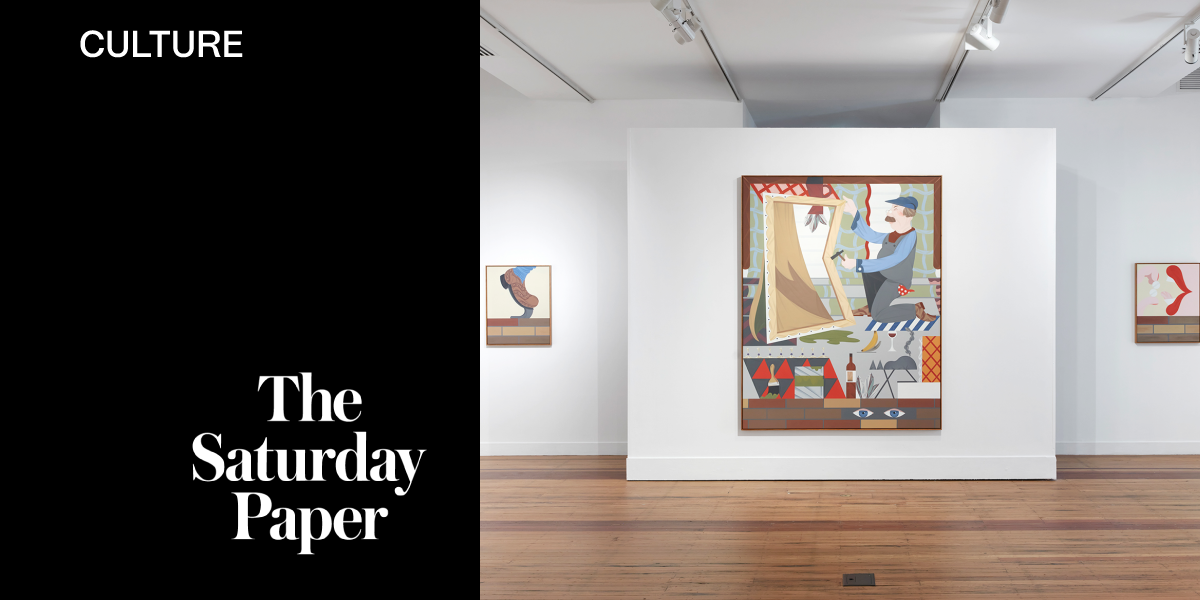
For many artists, art school often marks a period of profound growth, as they move beyond the early promise realised in high school and are immersed in a community of equally talented peers, drawn from far beyond their previous, limited orbit. This environment can foster creative breakthroughs, and it is also an intensely social space, where lifelong friendships and alliances are formed.
The experience is frequently shaped by self-doubt, complex and sometimes confusing ideas, and long nights spent grappling with fundamental questions: What am I about? What am I trying to say? What does my art mean? Am I good enough to even be here?
Art school is known for its high attrition rate: only a small proportion of graduates go on to sustain careers as artists. For those who do, the conceptual struggles and relationships forged during this time often become foundational to their practice.
Recently, the National Art School (NAS) in Sydney’s Darlinghurst partnered with Brisbane’s Institute of Modern Art to open a mid-career survey, Artist’s Mouth, of one of NAS’s most lauded graduates, Mitch Cairns. The exhibition honours both two decades of the National Art School gallery and the 20 years since Cairns graduated. Curated by Lucy Latella and the Institute of Modern Art’s director, Robert Leonard, it charts Cairns’s development from student to mainstay Australian artist.
The National Art School opened in 1922 and its alumni have included Margaret Olley, John Olsen, Ken Done and Brett Whiteley. Cairns continues this tradition. He is best known to general audiences as the winner of the 2017 Archibald prize with a portrait of his artist partner, Agatha Gothe-Snape.
Artist’s Mouth is a wonderfully celebratory experience, offering an intimate insight into an artist’s mind.
For many, Cairns is considered an “artist’s artist”, a painter who has worked consistently to develop a practice with depth and vision. On a cold night in May at the opening of Artist’s Mouth, established painters could be seen staring intently at his veils and layers of paint, not entirely sure how he rendered them.
The paintings possess an intensity of detail and a love of the modernist impulse that resists fashionable painting but nonetheless feels contemporary and urgent.
Early works from around the period of his graduation, such as a quiet floral still life with the imaginative title A World of Care (Compulsory Health Insurance) (2006), establish a starting point that frames the development towards more recent paintings. What is clear is the consistency of image-making and how recognisable his style is across the subsequent two decades. One also gets a strong sense of humour and the poetic, and an unflinching foundation of idiosyncrasy. His works have graphic immediacy and are built up through thin layers of paint, successively applied to create a sense of depth and body.
Cairns graduated into a world where the art market was at its strongest for decades, months before the global financial crisis. At that time, digital works and video art were de rigueur. In some quarters, Cairns’s works seemed to represent a tradition in decline.
The exhibition reveals a young artist with the courage of his convictions. Another early text-based work, emblazoned with the title Sleeping Wonderfully Warm with Geraldine Doogue (2007), points to his contrarian and wilful nature. Cairns describes his impetus for venerating the radio host in text on a large banner that hangs proudly at the start of the exhibition: “Every Saturday morning my radio alarm clock would wake me to the sounds of Doogue’s Saturday Extra and I would spend the morning drifting in and out of sleep, listening to her, and I just realised there was an image possibility around the sound of her voice on a Saturday morning.”
There are more literal portraits of a variety of subjects, from artists Peter Powditch and contemporary Elizabeth Pulie to businessman Reg Richardson. There is also a self-portrait of the artist as a lemon tree. Several works are related to his child, Roland. Cairns is an artist who seemingly processes the world around him through making – the things and people close to hand. Bricks, cigarettes, windows and trees speak to the immediate environment but are also autobiographical.
The broadly chronological nature of the show demonstrates both the artist’s progression and consistency, showing key elements of his practice and significant influences, such as concrete poetry, The Goon Show and cartooning. It also reflects the pedagogical underpinning of the art school, an unflinching belief in the atelier model, where artists are taught by other artists. Cairns worked at the art school as a painting teacher, passing on skills and direction to a newer crop of artists who benefited from his wisdom as he benefited from others’.
Artist’s Mouth is a wonderfully celebratory experience, offering an intimate insight into an artist’s mind. It exemplifies the strengths of the best survey exhibitions, those that trace a clear trajectory and allow viewers to witness an artist refining and defining their practice over time.
This exhibition has been staged with both bravery and intent, sharpening the edges of the works rather than softening them into a polite presentation. It embraces rigour, passion and momentum.
“Art school was paradise; I loved it, and it was as good as I had hoped it would be,” Cairns says. “Returning to the school to stage an exhibition like this is thrilling. I ended the opening night with five artists I studied with. We’re all still in contact, all still making work, and that’s something I definitely didn’t foresee when I left art school. It was special.”
There was a hopeful sense that, somewhere in the opening-night crowd, where art world glitterati mingled with wide-eyed students, the next Mitch Cairns might have been present, glimpsing a possible trajectory, gaining the confidence to be themselves and to paint their truth.
Mitch Cairns: Artist’s Mouth is showing at the National Art School, Sydney, until July 11.