
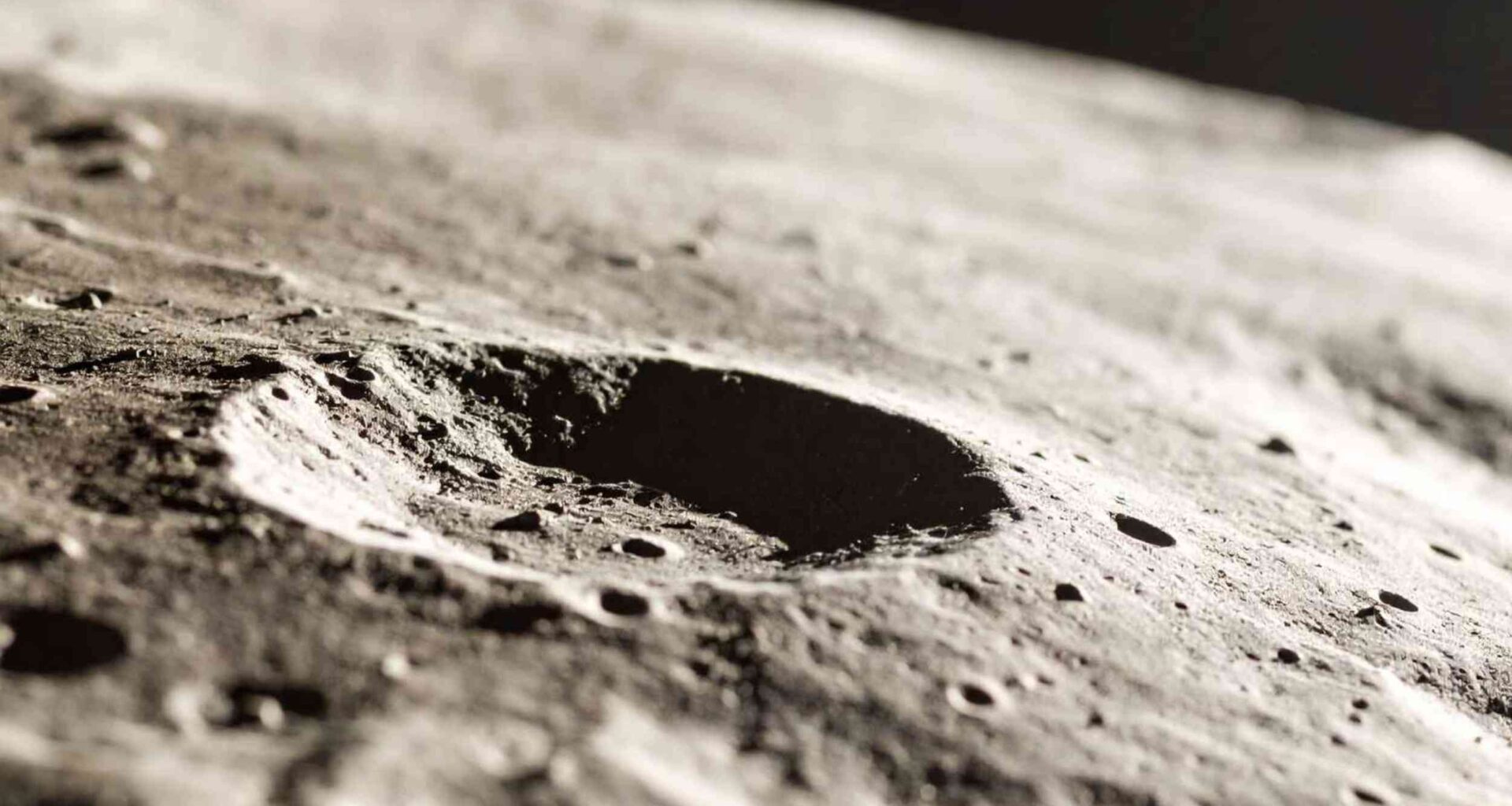
The rocks Apollo astronauts carried home have anchored what we know about the Moon’s makeup. They came from a handful of landing spots, every one of them near the lunar equator.
What the rest of the surface is made of, all the way to the shadowed poles, is far less certain, pieced together from limited orbital data. A telescope small enough to hold in two hands might finally change that.
An unfinished lunar map

The Moon’s chemistry is a record of how it formed and cooled. Scattered across its surface, the elements trace ancient eruptions and the scars left by old impacts.
Read that recipe everywhere and scientists could test the leading ideas about how the Moon formed. No one has the complete reading yet.
Orbiting probes long ago charted heavier elements like iron, potassium and thorium across the globe, as one early survey showed. The lighter ones – oxygen, magnesium, aluminum, silicon – kept slipping through.
Reading the Moon’s glow
One method is built for exactly those light elements. X-ray fluorescence depends on the Sun, which constantly sprays the Moon with X-rays.
When those rays hit the surface, atoms soak up the energy and fire back X-rays of their own, each element with its own telltale signal. A detector in orbit reads those signals and works out the chemistry below.
In the simulations behind this study, oxygen showed up strongest at nearly a full count per second, with iron next and metal traces weaker. Faint, but detectable.
Where earlier missions stalled
X-ray fluorescence is not new to the Moon. Apollo 15 and 16 carried detectors that mapped which elements sat where over roughly a tenth of the surface, and later probes from India and China pushed the coverage further.
Every attempt hit the same walls. The method needs a solar flare to light up the ground, and flares arrive on no schedule; the detectors also wore down in space, smearing the faint signals of light elements together.
The poles were hardest of all. Sunlight grazes them at a shallow angle, and the X-rays come in weak.
Recent work leaned on machine learning trained on returned rocks to stretch thin data into fuller maps, though they still need checking against real measurements.
Light enough to fly
The concept now drawing attention comes from Tokyo Metropolitan University (TMU). Airi Toida and Yuichiro Ezoe, a physics professor there, adapted a telescope built for another purpose – a small Japanese satellite called GEO-X, meant to image the faint X-ray glow around Earth.
Its optics are the real trick. Rather than one heavy mirror, the device uses lobster-eye optics – a dense grid of tiny square channels that bounce X-rays off their walls toward the sensor.
That layout gives it an unusually wide view of the ground, so a single flare lights up a broad patch all at once. Older detectors couldn’t manage it – the heavy hardware needed to aim them ruled out a real telescope.
The whole unit weighs under 22 pounds, light enough to ride along on a spacecraft already heading elsewhere. Its sensor also came through a radiation test harsher than anything expected in lunar orbit, losing barely any sharpness.
Two years to answers
Toida and Ezoe never launched anything. They poured the telescope’s real specifications into a simulation, set it circling over the poles roughly 2,500 miles up – near the path planned for NASA’s Gateway station – and let the model run.
The numbers came back encouraging. Five elements – oxygen, iron, magnesium, aluminum and silicon – could be mapped across the entire Moon in about two years, each square about 45 miles on a side.
No earlier instrument had managed a complete map of the lighter elements across the whole Moon, poles included.
A feather-light telescope with a wide enough view to catch those unpredictable flares is what made full coverage plausible. A genuine first.
Sharper with more eyes
One telescope is only the start. Stack 25 into a five-by-five array and the strip of ground it watches widens 25 times, which lets the spacecraft drop to a lower orbit without losing sight of the surface.
From about 1,050 miles up, that array would sharpen each square to roughly 18 miles on a side. The same five elements, mapped in close to a year. And sodium, never charted well from orbit, would surface within two.
There is a catch. Running 25 instruments draws far more power than one, so any real mission would weigh that cost against the sharper, faster picture.
What the map unlocks
A full map would arrive at a useful moment. Space agencies are aiming missions at the lunar south pole, where craters that never see sunlight may hold water ice, and planners need to know what the ground is made of before choosing where to land.
What this study shows is that the tool may already exist, shrunk down and tested, rather than waiting to be built. A compact X-ray eye on a small satellite could fill the blanks Apollo and every orbiter since have left behind.
The telescope has not flown. Not yet. But the case for mounting one on a future lunar orbiter now rests on hard numbers, and a complete chemical portrait of the Moon – something we have never held – looks within reach.
The study is published in Earth, Planets and Space.
—–
Like what you read? Subscribe to our newsletter for engaging articles, exclusive content, and the latest updates.
Check us out on EarthSnap, a free app brought to you by Eric Ralls and Earth.com.
—–