
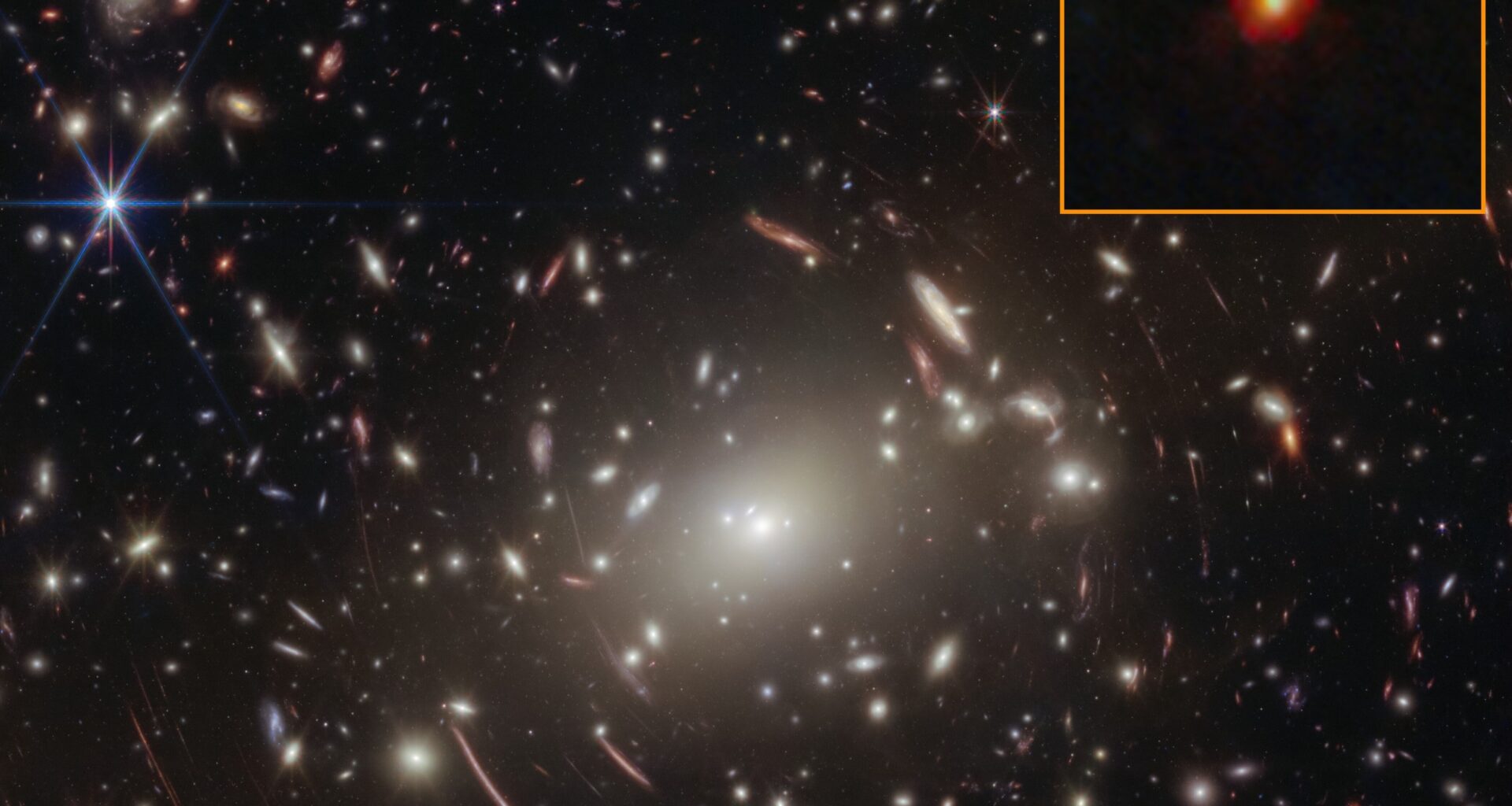
Little red dots have puzzled astronomers ever since NASA’s James Webb Space Telescope discovered them in 2022.
These small, unusually bright objects appeared in the early universe and quickly became one of astronomy’s biggest mysteries.

They are surprisingly common despite their great distance. Scientists have spent the past few years debating what they really are.
Some wondered whether they challenged current ideas about how the universe evolved. Others suspected there was a simpler explanation hidden in the data.
A newly studied object called GLIMPSE-17775 is now helping researchers put together a much clearer picture.
A distant red dot
GLIMPSE-17775 lived about 1.8 billion years after the Big Bang. Although incredibly distant, it received a boost from a natural phenomenon called gravitational lensing.
A massive galaxy cluster located between Earth and the object bent and magnified its light, allowing astronomers to see details that would normally remain hidden.
The result was extraordinary. Webb collected a 30-hour spectrum of the object, and the magnification effect made it equivalent to roughly 80 hours of telescope observations.
That produced more than 40 spectral lines, making it the most detailed spectrum ever obtained for a little red dot.
“I think part of the scientific community is converging on a singular picture – that little red dots can be explained by black hole star models. But none of the previous little red dots have all of the pieces of evidence in the same place,” said Vasily Kokorev from the University of Texas at Austin, lead author of the study.
“With GLIMPSE-17775 we can test these models because of how deep and amazing this source’s spectrum is.”
Piecing together a cosmic puzzle
A spectrum acts like a fingerprint of light. By separating light into different wavelengths, astronomers can identify elements, temperatures, motion, and other physical properties of distant objects.
For GLIMPSE-17775, the spectrum revealed a remarkable amount of information.
“When we saw the spectrum for the first time, it was like having all the pieces of a puzzle scattered on the floor,” said Kokorev.
“We picked up each piece of the puzzle, measured the lines, and started combining the different pieces into a mosaic. Maybe a few pieces looked like nothing at first, but then a couple of them came together, and we realized that there was something there.”
The evidence pointed repeatedly toward the same explanation. Researchers believe the object contains a rapidly growing supermassive black hole wrapped inside a thick cocoon of gas. This idea is known as the BH* (black hole star) scenario.
Signs of a hidden black hole
Several independent clues emerged from the data. The team found that spectral signatures from hydrogen, oxygen, and helium did not match what would be expected from a simple rotating cloud of gas.
Instead, the observations showed a broadening effect called electron scattering, which suggests that dense gas surrounds the source.
Another clue came from what researchers called an “iron forest.” The spectrum contained 16 separate iron lines. Along with specific oxygen signatures, these features require a powerful energy source capable of exciting atoms to very high states.
The spectrum also revealed both helium fluorescence and helium absorption. Each of these signals points to a dense environment surrounding an energetic central object.
Taken together, the evidence supports the idea of a supermassive black hole actively feeding on nearby material while hidden inside a thick shell of gas.
Why little red dots look so unusual
One reason little red dots puzzled astronomers is that many appear surprisingly faint in X-rays. Normally, actively growing black holes produce strong X-ray emissions.
The BH* model offers a simple answer. The surrounding gas cocoon may absorb much of the X-ray radiation before it can escape into space.
Researchers also investigated another feature commonly associated with little red dots known as the Balmer break. This characteristic dip in light was weaker in GLIMPSE-17775 than expected.
To understand why, the team combined Webb observations with data collected by NASA’s Hubble Space Telescope through the Frontier Fields and BUFFALO programs.
The combined observations suggest that a large host galaxy surrounds the object. Stars within that galaxy likely contribute extra blue light, reducing the strength of the Balmer break.
The mystery of our universe
When little red dots first appeared in Webb’s observations, some scientists questioned whether existing models of galaxy formation could explain them.
If these objects were enormous galaxies packed with stars, they seemed to have grown far too quickly after the Big Bang.
The new findings suggest a different explanation. If much of the light comes from gas surrounding growing black holes rather than from huge populations of stars, the objects become easier to fit into current theories of cosmic evolution.
“Everything fits, nothing is broken, and I think that makes the puzzle that is our universe even better,” said Kokorev.
“Looking ahead, I’m eager to dive deeper and learn about what is powering the central engines of little red dots.”
“While we think it’s a black hole, there are some other interesting theories being proposed, which is exciting. Maybe in a year or two, we’ll have the final answer to what powers these sources.”
Image Credit: NASA, ESA, CSA, Vasily Kokorev (UT Austin)
—–
Like what you read? Subscribe to our newsletter for engaging articles, exclusive content, and the latest updates.
Check us out on EarthSnap, a free app brought to you by Eric Ralls and Earth.com.
—–