
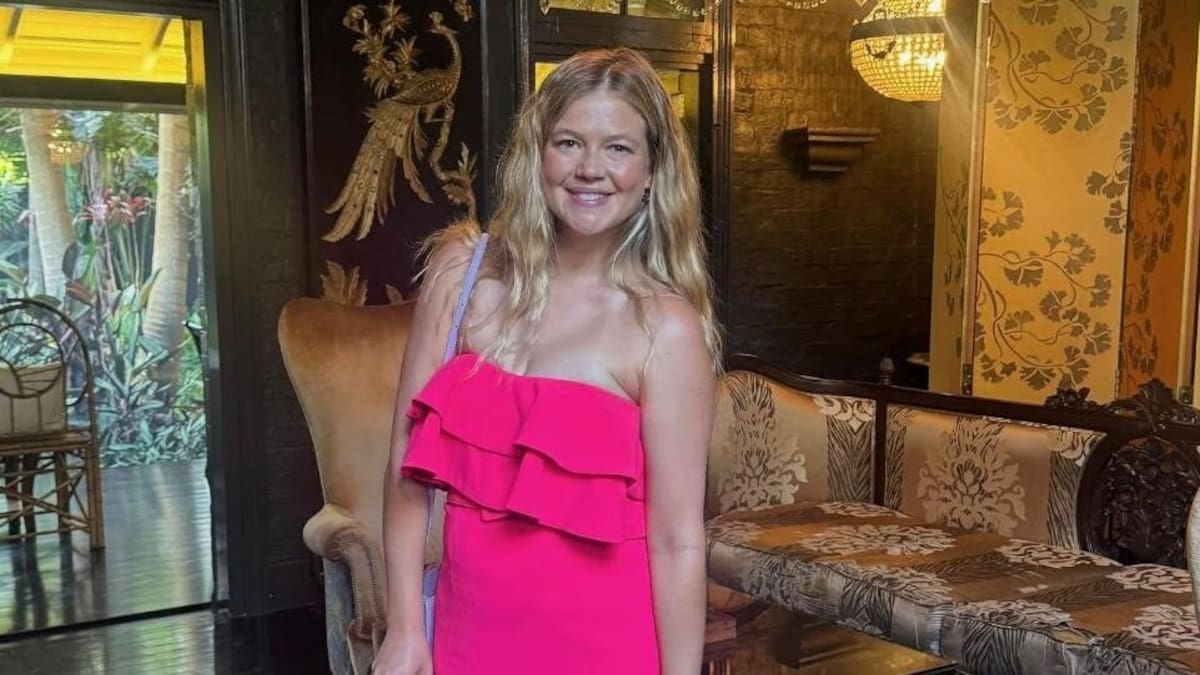
They said she has more surgeries scheduled for the coming days.
A GoFundMe campaign to help in her recovery.
Leah Stewart suffered severe and life-threatening injuries with multiple bites across her arms and legs.
“Leah Stewart is a dedicated and loving mother, a passionate teacher and Coogee local,” her family said.
“As a family we are shocked and devastated that this could happen to our beloved partner, daughter, and mother who is so full of life and energy.”
Coogee is a popular eastern suburbs beach, near the iconic Bondi Beach.
Sydneysiders have been left stunned by the attack.
Beaches in Sydney’s eastern suburbs reopened on Monday morning, two days after the attack.
Meanwhile, the brother of a surfer who was killed by a shark last year is supporting widespread drone use on Sydney beaches following the attack.
Support for drone surveillance
Mike Psillakis lost his twin brother, Mercury, in September 2025 when he was fatally attacked by a shark while surfing near Dee Why.
The 57-year-old surfboard shaper from Sydney’s northern beaches told the Today show on Monday morning that drones were the “way to go” when it came to protecting beachgoers.
“Everyone’s really concerned regarding this situation, and I think we can take steps to minimise the interactions between sharks and humans,” Psillakis said.
“I think AI drones are the way to go. My brother, and the attack on Saturday, could have been prevented by drones.”
Psillakis said losing access to Sydney beaches would equate to a loss of “identity” and “culture” and also expressed concern for local tourism should Australians not be able to safely access beaches across the country.
Sydney’s Coogee Beach is a popular spot for swimming.
His views are supported by Leonardo Guida, who has worked in marine conservation and sustainability for more than a decade.
Guida told NewsWire there would be “no silver bullet” when it came to shark management, but advancements in drone and AI technology could be “really useful” in harm minimisation.
“Drone technology is really useful in environmental conditions where the water is relatively clear and you do get a quite clear visual of the species,” he said.
“There’s currently research being conducted into AI which can allow drones to automatically detect what species is swimming in the water based on its size and shape and the way it moves.
“When combined with weather patterns and shark movement, all of these factors could be used to develop some kind of alert system or predictive model.”
Guida said advocacy for culling, which has exploded after the Coogee attack, was factually flawed.
“Culling has been around for nearly 100 years as a state-sanctioned programme, and it is, by all measures, ineffective,” he said.
“When it comes to sharks, the knee-jerk reaction is to take an eye for an eye. We assume if there’s less of them, there’s less chance of a bite. Unfortunately, that’s not the reality of it.
“Basically, the ocean is working as it should and the more people are aware of this, the better informed we can gauge the risks we’re willing to take when we go into the water.”
Surf Life Saving NSW chief executive Steven Pearce told Channel 7’s Sunrise most patrolled beaches along the NSW coast were also monitored by drone pilots during the summer months, but patrols in winter months are “scaled back” significantly.
“During the summer, we do around 80 locations up and down the coastline, but that’s scaled right back in winter because we just don’t see the population and visitation down at the beaches,” Pearce said.
“We do about 13 beaches up and down the NSW coast [in winter].”
Pearce said Surf Life Saving NSW runs more than 100,000 flights every year, but Coogee Beach was one of the only areas with flight restrictions imposed on pilots due to it being within a flight path.
“If we had drones flying there, we would have been able to see a lot of sea creatures … I’m not saying it wouldn’t have happened but I’m saying the water clarity was so great that it would have been quite easy to spot.”
Sign up to Herald Premium Editor’s Picks, delivered straight to your inbox every Friday. Editor-in-Chief Murray Kirkness picks the week’s best features, interviews and investigations. Sign up for Herald Premium here.