
Formation, productivity and dissolution of persistent scientific collaborations
Not all members of a scientific team collaborate in the same way. In science, a team is often composed of core members, who work persistently and recurrently together over the years, surrounded by transient members, who come and go in the collaboration. Since the exact set of co-authors can change from paper to paper, this makes following the trajectories of teams much more complicated than the careers of single individuals. To study team careers, our first step is thus to identify persistent scientific collaborations from empirical data. We analyze a large dataset collected from OpenAlex43,44, consisting of 205 million journal papers and conference proceedings published since 1900, covering 90 million scientists across various scientific disciplines. From the publication records, we build a hypergraph40 of scientific collaborations, where each hyperedge encodes the set of co-authors of a paper, and use a statistically validated approach41,42 to extract those groups of scientists that have persistently published together over their careers (Fig. 1, see the Methods for a detailed description of the data and the methodology). Through this procedure, we identify 511,550 persistent scientific collaborations. Throughout the paper, we refer to these groups of scientists either as “cores”, “core teams”, or “persistent teams/collaborations”, while we call a “team” any group of co-author, consistently with previous literature.
Fig. 1: Identification of cores of persistent collaborators.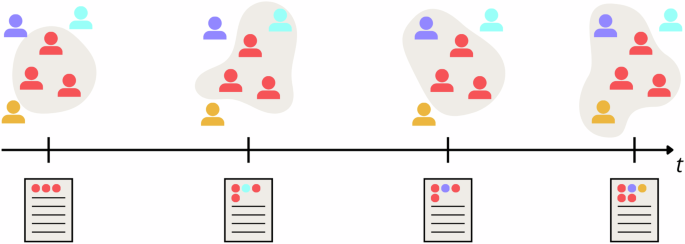 The alternative text for this image may have been generated using AI.
We build a temporal hypergraph encoding scientific collaborations, where each set of authors of a paper is represented as a hyperedge (gray-shaded areas; see Methods for details). Typically persistent core members (red), who consistently collaborate, do not work in isolation, but often publish together as part of larger teams which also include transient members (other colors). We identify sets of statistically significant collaborators and investigate the temporal careers of such persistent cores.
We begin by investigating the typical number of members in persistent scientific teams. We compute the distribution of core sizes (Fig. 2a), finding that the greatest percentage of cores (42%) have 3 members, followed by cores of size 2 (31%) and 4 (20%). Larger persistent collaborations are rarer, with the fraction of cores of size 6 or higher being less than 1 in 100.
Fig. 2: Formation, productivity and dissolution of persistent team cores.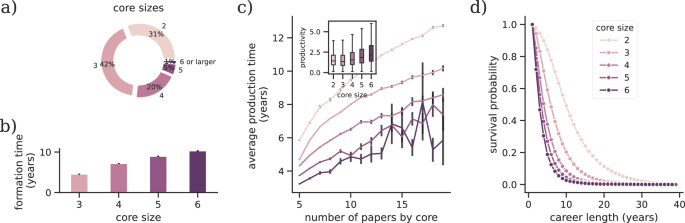 The alternative text for this image may have been generated using AI.
a Distribution of the number of scientists per team core. b Formation time of cores as a function of core size. c Production time for a given number of papers for cores of different sizes. Inset: average number of papers published per year as a function of the core size. d Survival probability of a core as a function of the career length, i.e., the time since its formation.
Typically, the formation of a core team requires a significant amount of time. Indeed, a persistent team may start as a small number of scientists working together, and gather further members around it later on. We thus ask: How fast do cores assemble? To examine this, we evaluate the time elapsing from the first publication authored by any subgroup of core members to the first publication authored by all members of the core. We refer to this quantity as the formation time. Note that, by our definition, core teams of two members are established with a formation time of zero. The average formation time for cores of different sizes is shown in Fig. 2b. We observe that smaller cores gather faster than bigger ones. In particular, cores of three members typically take 4.6 years to form, while larger cores take more and more time to gather, i.e., 7.3 years for cores of size 4, 9.2 years for cores of size 5, and 10.4 years for cores of size six. Furthermore, we note that a certain percentage of cores are formed instantaneously, i.e., they have a formation time of zero, meaning that the first publication by the core includes all of its members. Out of all cores of size 3, nearly 16.8% assembled instantaneously. For larger cores, this number drops to 5% for size 4, 2.3% for size 5, and only 1.4% for size 6.
After their formation, core teams start collaborating and publishing about their research. While the efficiency of persistent collaborations is hard to quantify, as we have no information on how long they worked on a publication, we can analyze their career in terms of the number of joint publications as a function of time. To this end, we consider all cores of a given size that have published a certain number of scientific papers and measure the average time taken to produce them (Fig. 2c). Moreover, we compute the yearly production rate, i.e., the productivity, for different core sizes (inset). Our analysis reveals that bigger cores outproduce smaller cores, taking less time on average to publish the same number of articles. Such a result calls for an in-depth analysis of how persistent scientific teams communicate, coordinate, and organize as a function of the number of their members45. Our observation may also partly explain the increasing dominance of teams in the production of science and arts11.
Though they may persist for a long time, all scientific collaborations eventually end. Therefore, we examine the typical lifespans of persistent scientific teams. We calculate the survival probability of cores as a function of the career length, i.e., the time elapsed from their first to their last publication. We find that smaller cores are typically more persistent (Fig. 2d). For instance, nearly 45% of scientific duos work together for at least 5 years, while some of them can keep working together for as long as 30 years after their first joint publication. Larger cores, instead, have shorter careers: For instance, it is highly atypical for core teams of 4 or more scientists to continue publishing together after 10 years since their first publication. Multiple factors can explain these findings. Even assuming that the members of persistent collaborations have the same chance of dropping out, because it is enough that one member leaves a core to terminate it, larger cores are more fragile46. Additionally, as larger, persistent collaborations take more time to form (e.g., more than 10 years for cores of size six), there is a higher chance that any of their members will end their careers, thereby terminating the core. Furthermore, larger teams may require higher organizational and coordination costs45, making them more complex to keep together, hence less stable. Further studies should aim at disentangling the various mechanisms underlying this pattern.
Collaboration patterns, including team dynamics, vary across scientific disciplines. We thus analyze the influence of specific scientific domains on the formation, productivity, and dissolution of persistent scientific collaborations. Our results indicate that cores in biomedical sciences, physical sciences, and engineering differ significantly in terms of size, formation time, production time, and career length (see Supplementary Fig. S1).
Composition of persistent collaborations
The members of a persistent collaboration can be identified by various characteristics, including age, academic affiliations, and scientific expertise. Understanding the composition of persistent teams in terms of the individual characteristics of their members, i.e., whether they overlap, match, or integrate, can shed light on the mechanisms that facilitate long-lasting collaborations. For instance, a persistent team may show age-homophily among its members or, instead, it may comprise young researchers and older, experienced scientists, e.g., a long-standing collaboration between mentor and mentee. To understand the role played by age in persistent collaborations, we compute the career age of each scientist in the core (i.e., the time passed since the scientist’s first publication), which we then use to characterize the age composition of persistent teams at the time of core creation (i.e., the first joint publication).
We divide scientists into three age groups, namely young (“Y”, career age less than 7 years), emerging (“Em”, between 7 and 14 years), and established scientists (“Es”, more than 14 years). We thus assign each core to one of 7 possible categories based on the age groups of its members. We distinguish cores where all scientists belong to the same age group (only young, only emerging, or only established), cores where two age groups are represented (young + emerging, young + established, or emerging + established), and cores with scientists from all three groups. The percentage of each category in the data is shown for various core sizes in Fig. 3a. For dyadic cores, the most predominant age composition at time of assembly is a young and an established scientist working together, a typical Student-Professor motif. This is followed in frequency by the young+emerging motif. For triadic cores, the mixed age composition, i.e., Y+Em+Es, likely corresponding to the typical PhD-PostDoc-PI core, starts to be a prominent age composition. Still, the dominant composition is of only Young + Established researchers. Beyond triads, mixed cores become increasingly common. We also analyze how the formation time and career length of a core vary as a function of its age composition, revealing shorter assembly times and longer careers for core teams featuring younger members (Supplementary Figs. S2, S3).
Fig. 3: Composition of persistent scientific cores.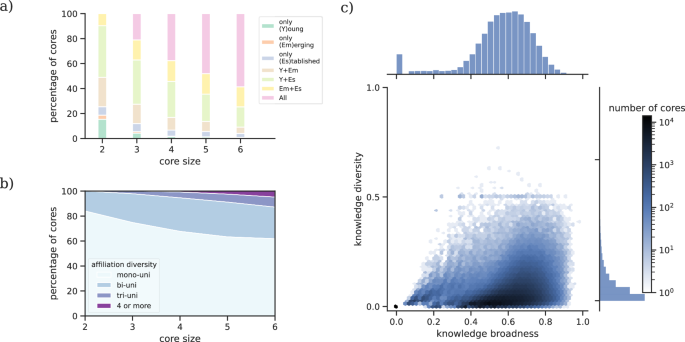 The alternative text for this image may have been generated using AI.
a Percentage of each possible age composition of the core as a function of core size. b Percentages of cores that are spread across 1 (mono), 2 (bi), 3 (tri), and 4 or more universities as a function of core size. c Interdisciplinary diversity. The joint distribution of knowledge diversity (quantifying cross-member conceptual distances) and knowledge broadness of the team (entropy of the sum of individual concept vectors of members). For monodisciplinary cores where all members belong to the same field both knowledge broadness and core diversity are zero.
Next, we characterize how diverse persistent collaborations are in terms of academic affiliation. We will refer to this as the affiliation diversity of the cores. To quantify it, for each paper of the core, we consider the set of affiliations that the members have at the time of publication, and evaluate the minimum number of affiliations needed to represent all members of the core. For illustration, consider a core of 3 members, A, B, and C, having the affiliations A:[MIT, UCSD], B:[MIT, UCSD], C:[MIT]. In this case, the minimum number of affiliations needed to represent the core is 1, as all members share one affiliation (MIT). Instead, if we consider the case A:[Caltech, UCSD], B:[UCSD, Indiana], C:[Caltech], we would need at least 2 affiliations (Caltech and Indiana) to cover all members of the core. As the core members can change academic affiliation during the lifetime of the collaboration, we evaluate the minimum number of affiliations for each article published and define the affiliation diversity of the core as the most common value. An example of mono-university core is that of Murray Gell-Mann and Richard Phillips Feynman (both Nobel laureates for Physics), who worked together on particle physics at the California Insitute of Technology. Conversely, Alberto Abadie (the inventor of the synthetic control method for econometrics) and Guido Wilhelmus Imbens (2021 Nobel laureates in economics) moved between different universities, and while they shared their affiliation (Harvard University) during their collaboration, they published most of their papers while being a different institutions. Figure 3b shows the fraction of cores of different sizes being covered by one, two, or three universities. In contrast with an increasing trend to collaborate remotely47, we note that 75.8% of cores are situated at the same university, hinting at the importance that common institutions play in sustaining long-term collaborations. It is also worth noting that cores that are not based at the same university are usually located at 2 universities (21.7%), while only very rarely persistent collaborations span 3 or more institutions (2.5%). Geographically speaking, 78.1% (84.7%) of cores are situated within the same country (continent). We also find that co-presence at the same institution is associated with a shorter formation time and a longer lifespan of the core (Supplementary Figs. S2, S3).
Finally, we aim to comprehend how diverse the core members are in terms of their scientific expertise, namely, whether the core teams are mono-disciplinary or interdisciplinary. To achieve a data-driven understanding of the extent to which topic composition affects persistent collaborations, we measure two complementary dimensions of team interdisciplinarity, namely knowledge broadness and knowledge diversity. Knowledge broadness captures the breadth of the combined expertise of the persistent core. Knowledge diversity, by contrast, quantifies how diverse team members are with regard to the disciplines they are associated with. Both measures range from 0 to 1, where 1 is achieved for maximum values of multidisciplinarity of the team (broadness) and topic complementarity across members (diversity; see Methods for details). Knowledge broadness and diversity measure different but complementary characteristics of the scientific expertise of the cores: The first describes how different the topics associated with the core are. The second captures how different the member of the core are in terms of their expertise. For instance, Tage Shakti Rai, Alan Fiske (both anthropologists), and Steven Pinker (a popular psychologist) form a diverse core, although it does not encompass a broad spectrum of scientific disciplines. The opposite example is the core with Dharshan Kumaran and Demis Hassabis (2024 Nobel laureate for Chemistry), who share a similar, broad expertise in neuroscience, computer science, and cognitive science.
Figure 3c shows the joint distribution of knowledge broadness and knowledge diversity across the cores. We observe that only a small fraction of cores, almost 3%, are completely mono-disciplinary, namely all members work in one scientific field. Also, we notice that the density of cores tapers off as diversity increases, with few cores having a diversity larger than 0.5. This suggests that the core members should have a minimum amount of disciplinary overlap for their collaborations to persist. The vast majority of cores, however, are broad in their knowledge base (over 50% have more than 0.6). In particular, a significant proportion of cores (~9.1%) work at the interface of several disciplinary fields, as they display a value broadness larger than 0.75. Yet, knowledge diversity never gets close to its maximum value, which would correspond to a core where no shared topics exist between its members. This highlights the importance of topic overlap to sustain persistent collaborations. These patterns emerge from non-trivial processes underlying the formation of cores, and cannot be explained by a random selection of core members (see Supplementary Fig. S4). Moreover, we find that cores with low knowledge diversity across members take less time to form and have longer careers, further supporting the association between team persistence and topic synergy, whereas low knowledge broadness, on the other hand, is associated with shorter lifespans and a slower formation process (Supplementary Figs. S2, S3).
In the SI we discuss core exclusivity, namely the tendency of the members to publish exclusively with the core, and provide an analysis of the demographics and contribution of the transient members surrounding core teams (see Supplementary Fig. S5).
Core team success
Peak performance in individual scientific careers is known to be randomly distributed, a result known as the random impact rule23. In other words, the most-cited article in a scientist’s career can be, with an equal probability, any paper they published, from the first to the very last publication. Analyzing the publication history of persistent scientific collaborations (Fig. 4a), we aim to understand the pattern of success in core team careers, and how their composition affects their impact. To examine whether cores’ careers also exhibit the random impact rule, we adopt a similar methodology as23,48 and measure the relative position N* of the highest-impact paper in a core’s career, i.e., in the sequence of its N publications. We measure the impact as the number of citations after five years (c5), normalized to account for inflation and large variations between different disciplines49. Figure 4b shows the cumulative distribution function P(≤N*/N), namely the probability that the most-cited work of a core appears before the N*-th publication. We observe that the function nearly follows the cumulative probability of a uniform distribution, indicating that the highest-impact article of a core can be published at any point in the career. While the most-cited article can occur at any time, the average impact of a core throughout its career can show non-random patterns. In particular, our analysis captures a higher average impact in the first half of the career compared to the second half, hinting that freshness in an early career may bring a higher impact (Supplementary Fig. S6). Our findings are in agreement with results showing how the team freshness has a positive effect on the team impact39. Another universal feature of individual creative careers is the presence of hot streaks, periods of clustered high-performance works observed in various contexts, from science50,51 to arts and other creative domains52. Our results show a tendency for cores’ highest-impact publications to be clustered, i.e., to occur close to each other in the career, thus confirming the presence of hot streaks (Supplementary Fig. S7).
Fig. 4: Temporal dynamics and composition-based correlates of core success.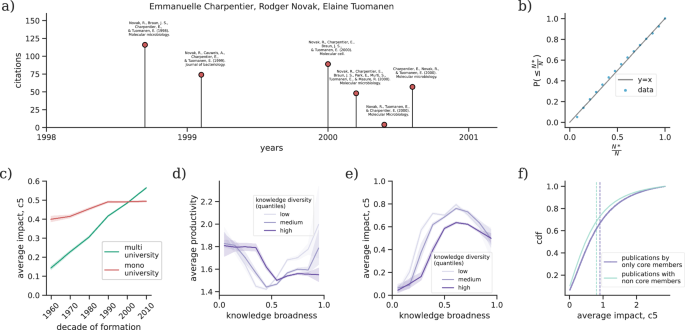 The alternative text for this image may have been generated using AI.
a Number of citations received by publications of a persistent collaboration involving the Nobel laureate Emmanuelle Charpentier (Nobel Prize in Chemistry, 2020). b Cumulative distribution P(≤N*/N) for cores with total papers (N)≥10, where N*/N denotes the order of the highest-impact paper in a core’s career, varying between 1/N and 1. The cumulative distribution of N*/N is almost a straight line with slope ≈ 1, indicating that N* has roughly the same probability to occur anywhere in the sequence of papers published by a core. c The average impact of cores that formed in a given decade, where cores are separated into those co-located at the same university, and others with multiple institutions. d Average productivity as a function of knowledge broadness of the core. Cores are divided into bins of increasing knowledge broadness. Cores are also assigned categories according to core diversity into 3 equal-sized categories – low, medium, high. e Average impact as a function of knowledge broadness of the core. f Cumulative probability distribution of average impact of team publications authored solely by the core members or involving transient, non-core members.
Having characterized the diversity of persistent collaborations in terms of age, affiliations, and scientific expertise, we are now interested in understanding how those features contribute to their academic success. First, we measure the average paper impact, i.e., the average normalized number of citations after five years, for all possible core age compositions in our data. Cores composed of members from the same age groups typically perform worse than collaborations with scientists from multiple age groups (Supplementary Fig. S8). Besides the age composition, the working location of a core team can affect the impact of the work it produces. To test this, we compare the average paper impact after five years for mono and multi-university cores. In agreement with previous research14, at the aggregated level, we observe that multi-university teams are more successful than mono-university ones (Supplementary Fig. S9). Additionally, we find that international cores are more productive and gain more citations than collaborations within a single country (Supplementary Fig. S10), similarly to previous studies16,53. However, a time-resolved analysis of the average impact, consisting in comparing mono and multi-university cores as a function of the year of formation, reveals a more nuanced picture (Fig. 4c). We find that the impact advantage of multi-university cores is a recent phenomenon. Mono-university cores formed before the 2000s have on average a higher impact compared to multi-university collaborations formed during the same years. However, while more recently formed mono-university cores do not show a significantly higher impact compared to older collaborations, multi-university cores formed in the last decade have almost three times the impact of cores started in the 60s.
Hence, multi-university cores formed after the year 2000 are more successful than mono-university cores formed in the same period. A possible explanation for this observation lies in recent technological progress, from the development of computer-based mailing systems to the advent of the internet and other communication technologies, which have enhanced the experience of remote collaboration, limiting the logistical advantage associated with working in close physical proximity.
In addition to impact, we look at the productivity of core teams as a function of knowledge broadness, grouping cores based on the level of knowledge diversity, i.e., low, medium, and high diversity, respectively (Fig. 4d). We find that the relationship between productivity and knowledge broadness approximately follows a U shape. This suggests that cores with a focused approach are more productive than those with moderate levels of diversity. However, productivity increases once again for cores exhibiting the highest degrees of broadness. For a given broadness, cores with larger knowledge diversity show higher productivity. As an additional analysis, we study how productivity depends on the core composition in terms of age and academic affiliation, finding no significant impact of these features (Supplementary Fig. S11).
Next, we investigate core team success as a function of the knowledge diversity and broadness of its core members. In Fig. 4e, we show the average c5 of the core publications as a function of the knowledge broadness, grouping again cores based on their knowledge diversity. We observe an inverted U-shaped relationship between impact and knowledge broadness of the core, for all classes of knowledge diversity, with intermediate values of broadness supporting the highest impact. When the knowledge broadness of a core is very low, the impact of a team’s work might be limited to narrow disciplinary fields. Yet, when a core’s knowledge base becomes too broad, its work yields a lower impact. On one side of the spectrum lie the cores such as that formed by John Lewis Selfridge, Bryant Tuckerman, Samuel Standfield Wagstaff, Derrick Henry Lehmer (one of the founding fathers of computational number theory), and John Brillhart (Lehmer’s PhD student), who worked on number factorization within the Cunningham project: Their knowledge broadness is very small (0.17), and so is their normalized c5 score (0.23) On the other side, we find collaborations like that between Laura Diaz Anadon (a researcher on climate, energy, and innovation policy, lead author for the Intergovernmental Panel on Climate Change (IPCC) 7th Assessment Report), Valentina Bosetti (an expert in environmental and climate change economics, lead author for IPCC 5th and 6th Assessment Reports), Erin Baker (focused on technological change and energy), and Lara Aleluia Reis (an expert on energy and pollution): Their expertise spans multiple scientific disciplines (their value of knowledge broadness is 0.88), but their impact remains limited (normalized c5 score: 0.01). Similar observations were made at the level of single works, where the highest impact is obtained in papers that display a balance between conventional and atypical combinations of prior work12. Furthermore, we find that, for almost any value of knowledge broadness, knowledge diversity has a negative relationship with the average core impact. All in all, our findings complement previous results on the complex relation between disciplinary diversity and impact in teams19.
We conclude our analysis by assessing the role of transient members on core team performance. We classify core publications into two groups, namely those authored exclusively by core members and those including other contributors, and evaluate the average impact for these two categories. Only cores with at least one publication with non-core members and one with only core members are kept for a fair comparison. Figure 4f shows the distribution of the average c5 across scientific cores for the two groups of papers. The analysis reveals that publications involving transient members generally show lower impact compared to those authored by the core only, suggesting that even though transient members add diversity to the team (see Supplementary Fig. S12), they might not boost impact.