

Make better investment decisions with Simply Wall St’s easy, visual tools that give you a competitive edge.
If you are wondering whether Alphabet at US$369.35 is still priced fairly or already running ahead of itself, the starting point is understanding what the current market data actually says about value.
The stock has returned 1.7% over the past week, is down 6.9% over the last month, and shows gains of 17.2% year to date and 109.5% over the past year, which can change how investors think about both upside and risk.
Recent headlines have focused on Alphabet’s role in artificial intelligence, search, and cloud services, as well as ongoing regulatory scrutiny around competition and data practices. Together, these themes help explain why the stock price has been active and why opinions about future risk and reward can differ.
Simply Wall St currently gives Alphabet a valuation score of 2 out of 6. The next sections will break down how different valuation approaches arrive at that result and will also point to a more complete way to think about value at the end of the article.
Alphabet scores just 2/6 on our valuation checks. See what other red flags we found in the full valuation breakdown.
Approach 1: Alphabet Discounted Cash Flow (DCF) Analysis
A Discounted Cash Flow, or DCF, model estimates what a stock could be worth by projecting future cash flows and then discounting them back to today using a required rate of return. It is essentially asking what tomorrow’s cash is worth in today’s dollars.
For Alphabet, Simply Wall St uses a 2 Stage Free Cash Flow to Equity model based on cash flow projections. The latest twelve month free cash flow is about US$95.40b. Analyst and extrapolated projections have free cash flow reaching US$187.49b in 2030, with intermediate years ranging from roughly US$21.77b in 2026 to US$340.16b in 2035, with later years extrapolated rather than directly forecast by analysts.
Discounting these projected cash flows back to today gives an estimated intrinsic value of US$330.64 per share. Compared with the current share price of US$369.35, the model suggests Alphabet trades at roughly an 11.7% premium to this DCF estimate, which indicates that, on this specific cash flow view, the stock appears overvalued.
Result: OVERVALUED
Our Discounted Cash Flow (DCF) analysis suggests Alphabet may be overvalued by 11.7%. Discover 47 high quality undervalued stocks or create your own screener to find better value opportunities.
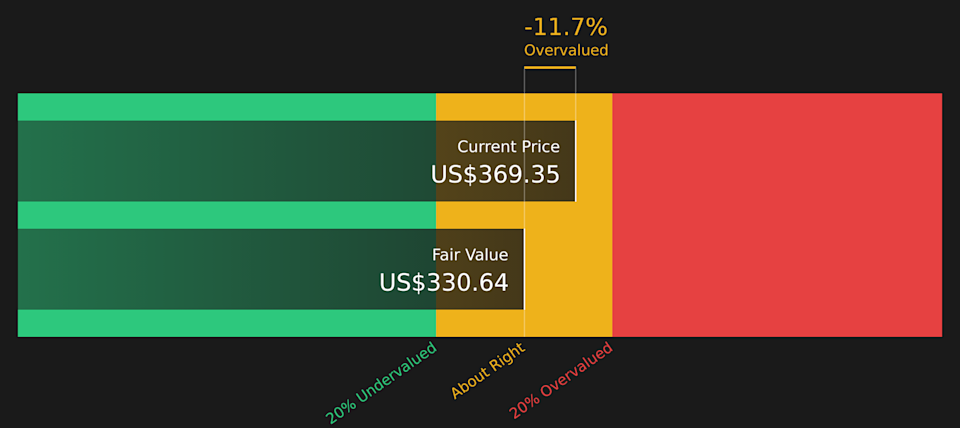 GOOGL Discounted Cash Flow as at Jun 2026
Approach 2: Alphabet Price vs Earnings (P/E)
For profitable companies, the P/E ratio is a useful yardstick because it links what you pay directly to the earnings the business is already generating. It is a quick way to see how many dollars investors are paying today for each dollar of current earnings.
What counts as a normal or fair P/E depends on how investors see two things: expected earnings growth and the level of risk. Higher expected growth or lower perceived risk can support a higher P/E, while slower growth or higher risk usually calls for a lower one.
Alphabet currently trades on a P/E of 28.13x, compared with an industry average of 12.63x for Interactive Media and Services and a peer group average of 35.54x. Simply Wall St also calculates a proprietary Fair Ratio for Alphabet of 39.05x. This Fair Ratio reflects factors such as earnings growth, profit margins, industry, market cap and risk, so it can be more tailored than a simple comparison with peers or the broad industry.
Since Alphabet’s actual P/E of 28.13x is below the Fair Ratio of 39.05x, this approach suggests the stock may be undervalued on earnings.
Result: UNDERVALUED
 NasdaqGS:GOOGL P/E Ratio as at Jun 2026
P/E ratios tell one story, but what if the real opportunity lies elsewhere? Start investing in legacies, not executives. Discover our 20 top founder-led companies.
Upgrade Your Decision Making: Choose your Alphabet Narrative
Earlier the article mentioned that there is an even better way to think about valuation. This is where Narratives come in: a simple way for you to connect a story about Alphabet with a set of numbers like fair value, future revenue, earnings and margin assumptions, then see how that story stacks up against the current price.
On Simply Wall St’s Community page, Narratives let investors spell out how they see Alphabet, link that view to a forecast and a fair value, then compare that fair value to today’s share price to decide whether the stock looks expensive or cheap on their assumptions, rather than relying only on a single model result.
Because Narratives update when new news, earnings or valuation inputs are added on the platform, they give you a living view of Alphabet, from more cautious outlooks that cluster around fair values near US$230 per share through to very optimistic cases that sit above US$430. This allows you to see in one place how different investors connect the same business facts to very different conclusions about value.
For Alphabet however we will make it really easy for you with previews of two leading Alphabet Narratives:
On Simply Wall St, investors have created several different takes on what Alphabet is worth and how its future could play out. The two below sit on opposite sides of the debate and use very different assumptions, which is exactly what you want to see before you form your own view.
Fair value: US$433.00
Valuation gap: around 14.7% below this fair value on the narrative’s numbers
Revenue growth assumption: 23.53%
This bullish Q1 2026 narrative centers on Alphabet as an AI and cloud infrastructure platform, with AI related capital spending viewed as a key driver for future cash flows.
It highlights a diversified set of engines across digital ads, Google Cloud, YouTube, Android, and Other Bets, supported by a large cash position and low debt.
Regulation, ad cyclicality, and AI search competition are flagged as risks, but the author still sees a wide moat and justifies a higher fair value than the current price.
Fair value: US$228.21
Valuation gap: around 61.8% above this fair value on the narrative’s numbers
Revenue growth assumption: 5.16%
This more cautious Q2 2025 narrative focuses on detailed earnings and cash flow projections that lead to a lower fair value estimate than the current share price.
YouTube Shorts, Google Cloud, and Gemini are all seen as attractive, but the author still values the stock using inputs that point to more modest revenue growth over time.
The conclusion is that the stock only looks appealing to this author at a much lower entry price, illustrating how different growth and return assumptions can push fair value well below the market price.
Together, these two narratives show how the same business data can support very different conclusions about Alphabet’s value depending on the revenue growth, margins, and required returns you plug in. If you want to see the rest of the community’s work and how their fair values compare with today’s US$369.35 share price, the full range of narratives is only a click away on Simply Wall St.
Do you think there’s more to the story for Alphabet? Head over to our Community to see what others are saying!
NasdaqGS:GOOGL 1-Year Stock Price Chart
This article by Simply Wall St is general in nature. We provide commentary based on historical data and analyst forecasts only using an unbiased methodology and our articles are not intended to be financial advice. It does not constitute a recommendation to buy or sell any stock, and does not take account of your objectives, or your financial situation. We aim to bring you long-term focused analysis driven by fundamental data. Note that our analysis may not factor in the latest price-sensitive company announcements or qualitative material. Simply Wall St has no position in any stocks mentioned.
Companies discussed in this article include GOOGL.
Have feedback on this article? Concerned about the content? Get in touch with us directly. Alternatively, email editorial-team@simplywallst.com