
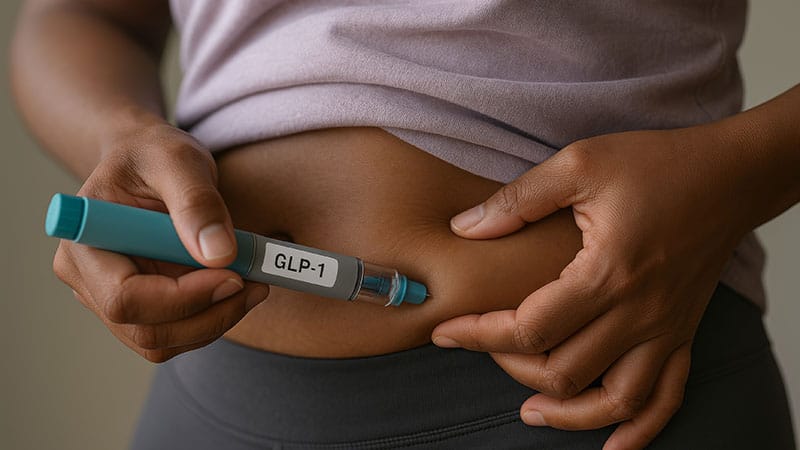
Despite the common perception that GLP-1 use is an easy way out for weight loss, the reality is much more complicated, according to current or recent users of these medications interviewed for a small new study.
Although the drugs have the major advantage of reducing food noise and appetite, they also have disadvantages, including challenging side effects, persistent stigma, cost barriers, and medication shortages, reported the 30 study participants, who came from 15 US states.
They did not see the drugs as a stand-alone treatment, but rather as a tool enabling them to make other lifestyle changes, said lead author Isabella de Vere Hunt, BM BCh, academic clinical fellow at the University of Oxford, Oxford, England.
 Isabella de Vere Hunt, BM BCh
That finding was a pleasant surprise, given the widespread view that GLP-1s are a “magic bullet” for weight loss, de Vere Hunt told Medscape Medical News.
Participants (57% White; mean age, 54 years) were recruited from the national health volunteer database ResearchMatch and took part in video interviews in the summer of 2025. Of the 30 participants, 10 were male, 19 were female, and 1 was nonbinary; 23 were currently taking the medications, and 7 had quit, some temporarily. Thirteen participants had BMIs ≥ 35, 11 had BMIs below that level, and 6 were unsure or didn’t know. Health conditions at the time of the interview included type 2 diabetes (27 patients), hypertension (17 patients), and obstructive sleep apnea (12 patients).
The study, aimed at providing insight into the lived experience of patients taking GLP-1s, was published online in JAMA Network Open.
The Hard Work of Weight Loss
The survey results demonstrate how hard people work to achieve weight loss while on a GLP-1, de Vere Hunt said. “Our findings suggest there is nothing easy about this journey,” she said. Nearly all participants said they had spent years trying to lose weight through other avenues and saw GLP-1s as a last resort.
Most described a reduction in food noise and appetite, with diminished psychological hunger, fewer intrusive food thoughts, and a reduced sense of compulsion around eating. Those changes enabled them to engage in diet and lifestyle changes.
As one participant put it: “Being clearheaded kind of made me be like, ‘Oh, I don’t need to feel sad and eat food. Actually, let’s just not eat food at night.’”
Patients also reported a spectrum of adverse side effects, such as nausea or diarrhea and stomach upset. It was striking to de Vere Hunt how many people were willing to tolerate severe side effects “because they felt the benefits were so meaningful to their lives.”
Participants reported variability in the care and support they received from healthcare clinicians. One user was vomiting and had no idea it was a drug side effect. Another praised the time her doctor took to answer questions.
Some said they were careful about who they told about their GLP-1 use because they worried about the drugs’ stigma as a “cop-out” or “cheating.” Some told people they were taking the medication for diabetes because they thought people would view that indication more favorably.
Participants often described access to GLP-1s as complex and expensive, and one participant had to stop the treatment because her tuition was due.
The study results underscore how important clinician communication is to the treatment experience, as well as the need to improve access, de Vere Hunt said.
An Accurate Depiction
Although the 30-patient sample size was small, the study captures the experience of taking a GLP-1, said Kevin R. Gendreau, MD, family and obesity medicine physician at Signature Healthcare in Brockton, Massachusetts, who reviewed the paper for Medscape Medical News.
 Kevin R. Gendreau, MD
Since Gendreau began in obesity medicine in 2020, he has seen more than 3000 patients. “This definitely matches what I see every day in clinic,” he said.
Gendreau often hears about how the medication reduces food noise. “Patients describe it almost the same way every time. Before the medication, food ran the show. After starting the medication, the patients gain more power to make decisions instead of negotiating with their own cravings all day,” he said.
In his practice, he sees patients tolerating side effects because they are happy to finally be successful at weight loss.
Gendreau agreed that patients need solid clinical support and education, not just a GLP-1 prescription and a wave goodbye. He tells patients that medications make the work of weight loss possible. As he says: “Medication opens the door, but you still have to walk through it.”
Participation in ResearchMatch was supported by a National Institutes of Health (NIH) award. The study research was funded by the Stanford Center for Digital Health. de Vere Hunt reported having no disclosures. A co-author reported receiving grants from the NIH and Doris Duke Foundation during the conduct of the study and receiving personal fees from pharmaceutical companies outside the submitted work. Gendreau reported having no disclosures.