
Paramedics who attended the scene immediately noticed Tūwharetoa was visibly emaciated, with his ribs showing.
But despite the troubling signs, Ryder refused to let two Plunket nurses into her Takanini home when they tried to visit the day before the boy’s death. Later that night, she left Tūwharetoa and two siblings, also toddlers, at home without an adult.
It is not known when she returned, but the agreed summary of facts states she realised Tūwharetoa was “floppy and unresponsive” around 5am the next day. She wouldn’t call 111 until nearly an hour and a half later.
Defence lawyer Conrad Wright argued today that the case had touches of infanticide, a legal definition that carries a maximum sentence of three years’ imprisonment. He conceded that his client pleaded guilty to manslaughter, which does not have a maximum term, but he asked for a significantly reduced sentence.
“The defendant was ground down by the circumstances,” he said, noting that she appeared to have post-traumatic stress disorder from the difficult birth and was ill-equipped to deal with the situation due to intergenerational trauma and disadvantage.
“She attempted to do her best … and ultimately failed at the crucial moment.”
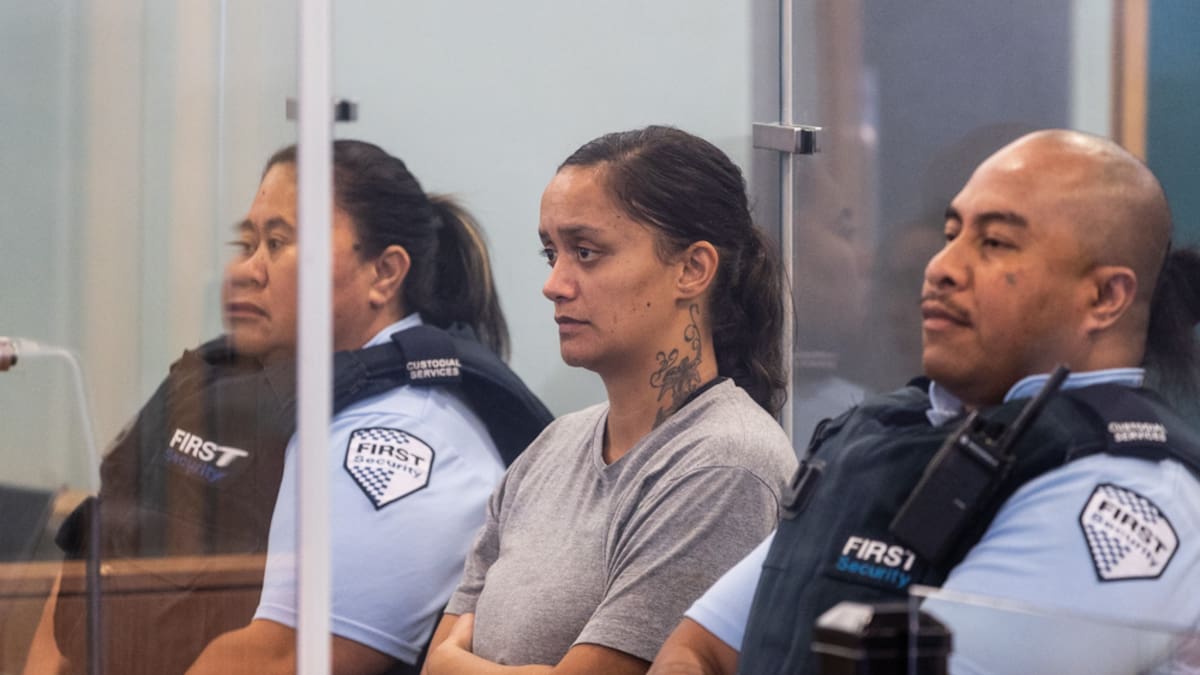
Ryder wept at times as details of her neglect were outlined in court.
‘A beautiful boy’
In a victim impact statement read aloud by prosecutors today, Ryder’s mother said she gives a karakia every day for Tūwharetoa, and she also cries daily.
She described her grandson as “a beautiful boy”.
“His eyes would light up and he’d follow you around the room,” she recalled.
“I’m normally a bubbly person, but now I’m walking around like a sad sack of spuds,” she added. “There is so much pain.
“Tūwharetoa’s passing has split our family.”
But she emphasised that she also loved her daughter, despite what happened.
“I know that Stormy loves her babies,” she said. “To Stormy and Tūwharetoa, I just want to say I love you very much.”
Surprise twin
Court documents outline how Tūwharetoa had a difficult start to life even before his birth.
Ryder did not seek antenatal care during her pregnancy, and Tūwharetoa and his twin sister were born significantly premature. The defendant had not been aware she was carrying twins.
Both infants suffered significant complications due to their early births and spent their first five months in a hospital newborn intensive care unit.
At two months old, Tūwharetoa suffered another significant setback in the form of a brain bleed and fluid build-up within his brain. If he was lucky enough to survive, the family was told, he’d need long-term care with frequent medical appointments.
“Ms Ryder had significant and extensive community support available to her following the twins’ discharge from hospital,” the agreed summary of facts state.
“She was aware of, and given training sessions for, Tūwharetoa’s significant feeding challenges [for instance using more energy to feed and requiring assistance].
“Upon discharge, the community services available included home care nurses (Kidz First), a community dietician, a speech and language therapist, a neurodevelopmental therapist, and appointments to see the neurosurgical clinic, the Neonatal clinic, and an ophthalmology appointment.”
Missed appointments
Tūwharetoa was diagnosed with cerebral palsy in August 2023, 10 months before his death. It severely affected his development, with reduced vision and limited control along the left side of his body.
Because of that, community health services remained engaged.
But getting Ryder to stay engaged was another matter altogether.
Between April 2023 and February 2024, Ryder took her son to four medical appointments outside their home but didn’t show up for another 13 appointments.
“Ms Ryder would often have medical appointments rescheduled and then still fail to attend,” the agreed summary of facts states.
Justice Grant Powell oversaw the sentencing of Stormy Lee Ryder in the High Court at Auckland for the manslaughter of her 19-month-old son. Photo / Jason Dorday
On 24 occasions during that same period, she let visiting healthcare or social workers into her home. However, appointments were either cancelled or visitors were turned away from her home 29 times, and on six other occasions, she would only speak with the visitors outside her home.
Despite all that, it appeared Tūwharetoa had been making slow but steady progress up until the last time he was weighed, court documents state.
OT not called in
Ryder appeared to become even more standoffish with those trying to help her after an incident in April 2024 in which a home care nurse asked police to force their way into the defendant’s home.
The nurse had seen children in the home but could not get any adults to come to the door. Ryder was later found asleep in the lounge. The house was messy, there was no power and one child had a heavily soiled nappy.
In the last four months of Tūwharetoa’s life, Ryder took him to one appointment and skipped five others. Of the 19 occasions workers came to her house, they were let inside only five times.
The situation was bad enough that a group of medical professionals held a meeting to discuss what they should do.
“Escalation to Oranga Tamariki was considered, recommended, and a referral was made,” court documents state. “However, it was argued against by other staff and placed on hold on the basis that they felt engagement would worsen following a referral.
“Ultimately, Oranga Tamariki were never engaged with family until after Tūwharetoa’s passing.”
‘An ugly feeling’
Court records also show that Ryder had become increasingly more isolated in the final month of her son’s life.
She had split with her partner, who was absent from the home and did not assist with childcare. And her mother, who had previously visited twice a week to help out, got fed up and stopped coming in early June.
“stop being mean to your kidz I feel sorry for the twins your house has an ugly feeling in it I’m not coming anymore,” Ryder’s mother told her in a text later recovered by police.
“You love the gear more than your kids,” the mother also texted – “gear” being a common slang term for drugs.
Around 10am on June 26, the day before the child’s death, two Plunket nurses showed up and asked to visit with the children.
Ryder, who was hanging clothes outside, said it wasn’t a good day for a visit.
Records obtained from rideshare app Uber show she left the home at 10.59pm that same day. Her children were left at home. She withdrew $120 and just after midnight messaged a private Facebook drug chat group named “Gotwhat ya Need” before deleting the message 10 minutes later.
She dialled 111 at 6.23am to report her son’s unresponsiveness, after first noticing him around 5am.
There was plenty of formula in the cupboard, police would later observe.
The child’s cause of death was later determined to have been complications from starvation and dehydration. Cerebral palsy was deemed a condition contributing to the death, but not related to the disease or condition causing it.
‘Ill-equipped’
When Ryder was in primary school, a teacher noted that she was bright enough that she could someday grow up to be Prime Minister, the court was told today.
But then she left school at 15, got into repeated abusive relationships and eventually became an addict, her lawyer said, describing her life as “a classic case of disadvantage”.
Had that background not been in play, she might have trusted nurses more and her son might have lived, Wright suggested.
Ryder had already accepted an earlier sentence indication in which Justice Grant said he would apply a starting point of six years and three months before applying reductions.
Citing a newly obtained psychological report, Wright suggested the judge should take the rare step of disregarding the already announced starting point and replace it with one of four years’ imprisonment.
Crown prosecutor Chris Howard. Photo / Michael Craig
But the judge concurred with Crown prosecutor Chris Howard that the starting point shouldn’t change. To be found guilty of infanticide, there’d have to be a finding that her mental state was significantly disturbed by giving birth, it was noted. But Ryder’s son had been doing well and was gaining weight until the final months of his life.
The judge did, however, allow a reduction of 25% to account for Ryder’s background, as well as discounts of 10% for her last-minute guilty plea, 5% for her efforts and rehabilitation and 5% for remorse.
It resulted in a final sentence of three years and five months’ imprisonment.
“It appears quite clear that these [background] matters ill-equipped you for the significant challenge of caring for Tūwharetoa”, the judge said.
Craig Kapitan is an Auckland-based journalist covering courts and justice. He joined the Herald in 2021 and has reported on courts since 2002 in three newsrooms in the US and New Zealand.
Sign up to The Daily H, a free newsletter curated by our editors and delivered straight to your inbox every weekday.