
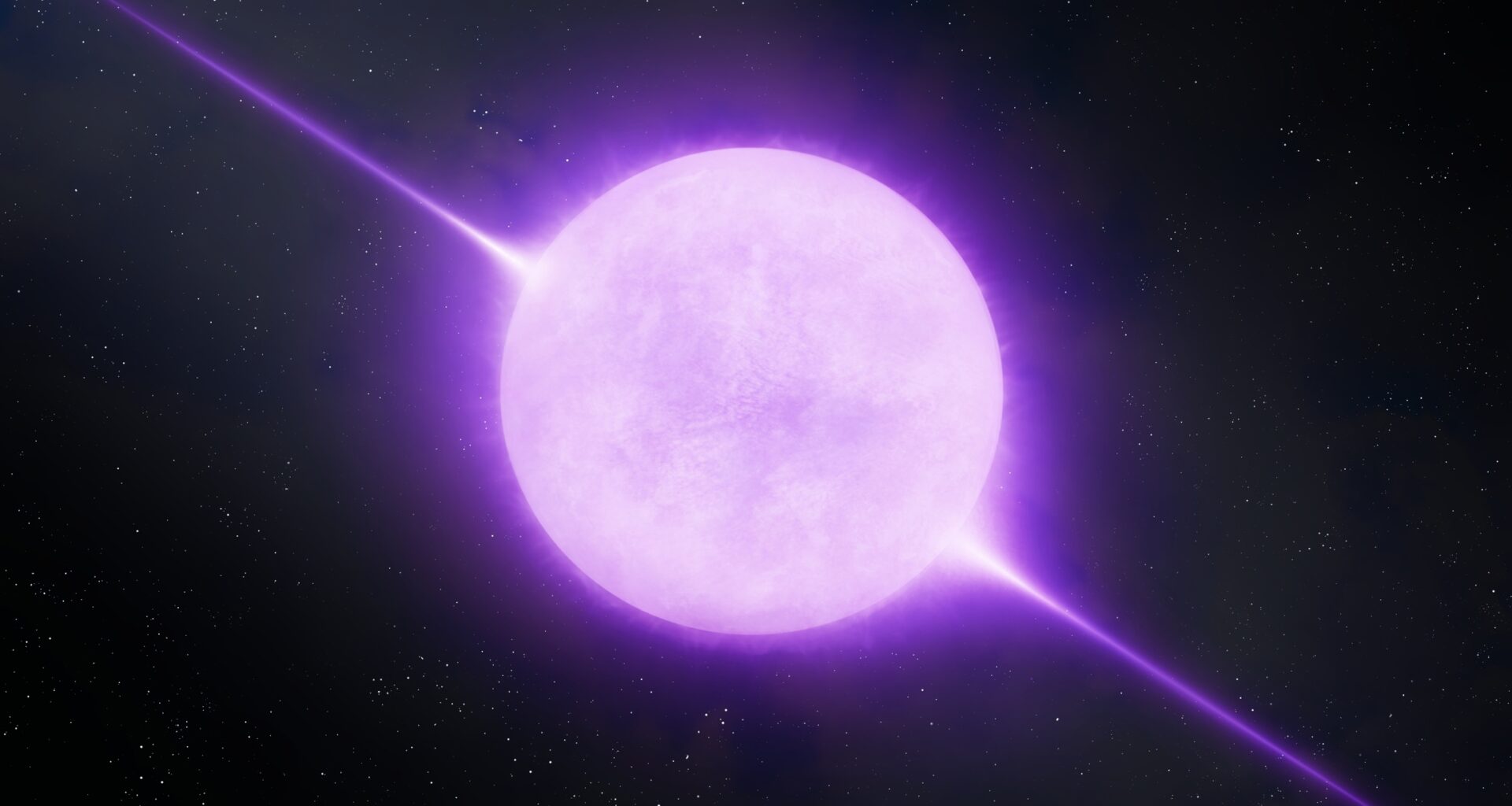
A giant star has one famous fate. Its core gives out, gravity takes over, and everything vanishes into a black hole. Now two physicists have shown how gravastars form instead.
That black hole ending has never sat easily with theorists, who cringe at the bottomless point inside. The gravastar offers a rival finish, where a hidden force fights gravity to a draw.
The black hole problem

Black holes work on paper and appear in real observations, yet they carry two stubborn problems.
One sits dead center: a point of infinite density called a singularity, where physics breaks down.
The other is the event horizon, the one-way boundary where anything that falls in is gone for good.
Imagine squeezing ten billion suns into a region smaller than an atom. It is no surprise that such an extreme picture has led physicists to wonder whether black holes might actually be something else.
A recent review catalogs a zoo of stand-ins. Most keep the horizon or singularity, and only a rare few drop both.
No singularity, no horizon
One rare stand-in is the gravastar, short for gravitational vacuum condensate star. It has no singularity and no horizon, yet from far away it looks almost identical to a black hole.
What holds it up is dark energy, the force speeding up our Universe’s expansion. A thin shell of ordinary matter caps that pressure and keeps it from bursting.
The idea was first sketched in a 2001 paper. Tidy as it looked, the gravastar carried one stubborn gap for about 25 years.
Nobody could explain how a real one would form. Stars collapse in a violent rush, not a polite folding into an exotic shell.
How gravastars form
The answer came from Daniel Jampolski and Professor Luciano Rezzolla, physicists at Goethe University Frankfurt. Jampolski worked it out in his master’s thesis, supervised by Rezzolla.
Their solution plants a tiny, growing universe inside the doomed star. Begin with the usual story of a star caving in under its own weight.
Deep at its center, the equations let a bubble of dark energy flick on and grow. The push mirrors the force that launched our own Universe, a Big Bang in miniature.
Crucially, none of this happens early. The bubble lies dormant while the star caves in almost completely. It wakes only as the collapse nears the black hole threshold, opening new physics.
When the collapse stops
As the bubble pushes out, the surrounding matter keeps raining in. The two meet right where a black hole’s boundary would form. There, the outward shove and inward pull cancel in a standoff.
The expansion needs no built-in brake. It slows on its own near that critical edge, easing to a stop instead of crashing through. What remains is a stable gravastar, with no singularity and no horizon.
Here is the part that eluded everyone. Earlier attempts to dodge the black hole leaned on exotic tweaks to gravity. Jampolski and Rezzolla managed it with nothing but Einstein’s original equations.
Three possible fates
In their model, a collapsing star can end three ways. One forms an ordinary black hole, another settles into the standstill of a gravastar. The third lands unbalanced, neither star nor black hole.
Black holes are the easy default. A gravastar instead needs the bubble’s starting conditions tuned just right, into a narrow window. Nature must land inside it for the trick to hold.
Inside that window, there is still room to move. Countless starting setups funnel to the same gravastar. Some let the bubble creep outward, others hold it still until a violent burst at the end.
A cosmic speed limit
The model carries a hard ceiling, traced back to the cosmic speed limit – nothing outruns light. To halt the collapse in time, the bubble must expand fast, and only so fast is allowed.
Compactness, a measure of how tightly a star’s mass is packed, has a cutoff. Cross a value of three-eighths, and the bubble can no longer keep up. Past that line, a black hole is unavoidable.
That figure sits just below a classic ceiling, set decades ago, for how compact a stable star can be. The near-match is no accident, a limit landing right where physics says it should.
What this changes
For a quarter century, gravastars sat in limbo, allowed by the math but with no origin story. That gap is now filled with a clear path from collapsing star to gravastar, built on Einstein’s untouched theory.
The payoff reaches past theory. If gravastars can form, some objects filed as black holes may be mimics. One study finds the two ring differently as gravitational waves pass, a way to tell them apart.
Plenty remains to study. Real stars are messier than smooth dust, bubbles might ignite off-center, and what flips the bubble on in the first place stays unsettled.
“It is essential to maintain an unbiased approach towards what we do not know,” said Rezzolla.
For the first time, a dying star has a believable second ending. A question physicists had nearly closed is open once more.
The study is published in the journal Physical Review D.
—–
Like what you read? Subscribe to our newsletter for engaging articles, exclusive content, and the latest updates.
Check us out on EarthSnap, a free app brought to you by Eric Ralls and Earth.com.
—–