
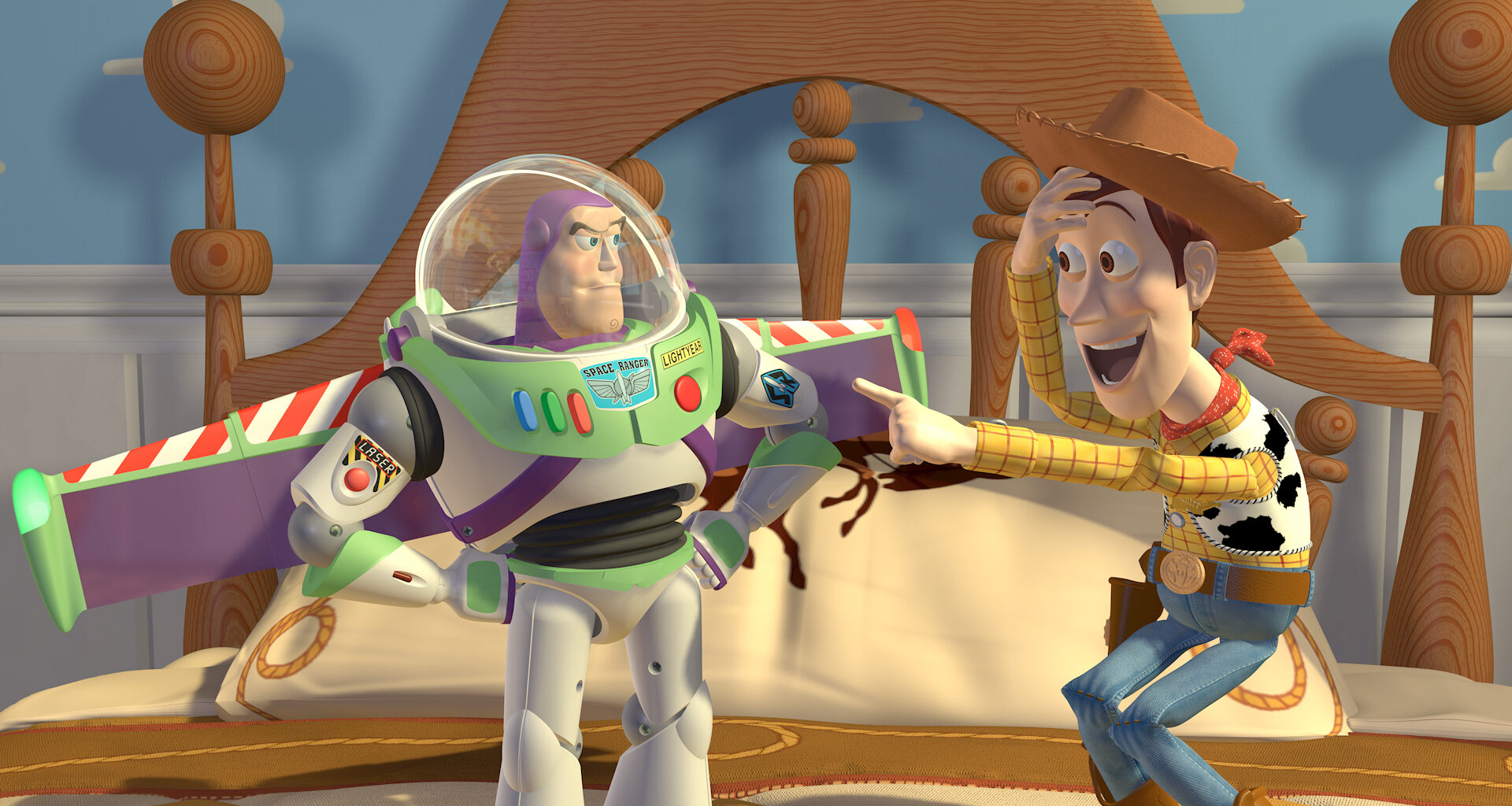
When Toy Story opened in theaters on Nov. 22, 1995, it not only introduced audiences to iconic characters Woody and Buzz Lightyear, it also reshaped the future of animation.
As the first fully computer-animated feature film, Toy Story marked a turning point in moviemaking –pairing emerging technologies with character-driven storytelling to push creative boundaries to infinity and beyond.
That breakthrough did not happen overnight.
Toy Story was the culmination of years of experimentation and creative trust between Pixar Animation Studios and Disney
Pixar’s Origins in Technology — and an Early Disney Connection
Pixar’s story begins in 1979, when Ed Catmull was recruited to lead Lucasfilm’s Computer Division — a group tasked with imagining a digital future for filmmaking. The group focused on tools that did not yet exist, including digital sound and computer graphics.
By the mid-1980s, the group’s animation team had begun producing original short films that showed how computer graphics could support character, humor, and emotion.
In 1984, animator John Lasseter is hired full-time and a partially completed version of The Adventures of André & Wally B. premieres at SIGGRAPH, an annual conference focused on computer graphics and interactive techniques that brings together researchers, artists, and technologists from around the world. The film featured flexible characters, hand-painted textures, and motion blur — early signals of a storytelling approach that placed character at the center of technical innovation.