

Track your investments for FREE with Simply Wall St, the portfolio command center trusted by over 7 million individual investors worldwide.
AMD (NasdaqGS:AMD) and Rackspace signed a multi year agreement to build dedicated AMD powered Enterprise AI Cloud infrastructure.
The partnership focuses on governed and accountable AI compute for regulated sectors, including healthcare.
The deal targets a phased rollout of 30 MW of AMD based data center capacity for AI workloads.
AMD becomes the silicon partner for Rackspace’s global governed AI infrastructure offering.
For investors watching AMD, this agreement relates to the company’s role in supplying chips for high performance computing and AI focused data centers. Instead of relying only on public cloud platforms, enterprises in areas such as healthcare and other regulated fields gain access to dedicated infrastructure built around AMD hardware.
This development is part of a broader shift in enterprise AI, with governance, compliance, and accountability treated as core priorities. As more companies look to run AI workloads under tighter controls, interest in tailored, private, or managed cloud setups like this may affect how demand for AMD based data center solutions changes over time.
Stay updated on the most important news stories for Advanced Micro Devices by adding it to your watchlist or portfolio. Alternatively, explore our Community to discover new perspectives on Advanced Micro Devices.
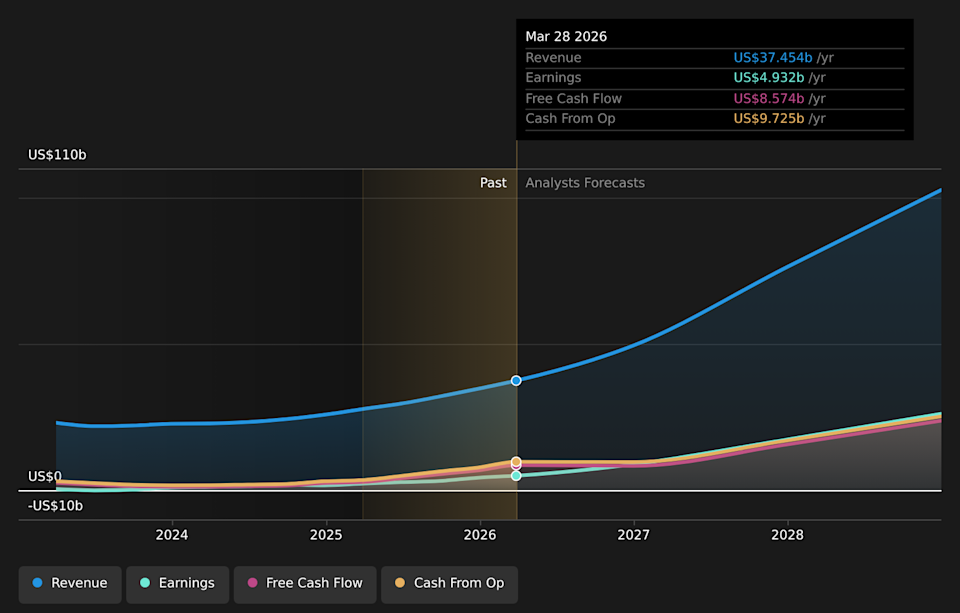 NasdaqGS:AMD Earnings & Revenue Growth as at Jun 2026
For AMD, the Rackspace agreement reinforces its push to supply the full stack of AI data-center hardware, combining Instinct accelerators and EPYC server CPUs in a governed, sector-specific cloud offering. The phased 30 MW rollout, tied to healthcare and other regulated users, gives AMD another route to enterprise AI workloads alongside hyperscale customers, and aligns with its focus on inference and agent-based systems that sit inside core business processes. Because both companies plan to commit sales and marketing resources, this is not just a chip supply contract but a go-to-market effort that could influence how CIOs compare AMD-based options with infrastructure centered on Nvidia or Intel hardware.
How This Fits Into The Advanced Micro Devices Narrative
The deal supports the narrative that AMD is deepening its role in AI and data-center compute by adding governed Enterprise AI Cloud offerings to existing hyperscaler and sovereign projects, consistent with expectations for broader AI-driven growth.
The focus on long-term, regulated workloads also highlights execution risk raised in the narrative, because meaningful revenue depends on successful multi-year deployments and competition with Nvidia, Intel and custom silicon from cloud providers.
The creation of a “new category” of managed, governed AI infrastructure aimed at healthcare and other regulated sectors is not fully captured in high-level growth assumptions that largely emphasize hyperscalers and government AI projects.
Knowing what a company is worth starts with understanding its story. Check out one of the top narratives in the Simply Wall St Community for Advanced Micro Devices to help decide what it’s worth to you.
The Risks and Rewards Investors Should Consider
⚠️ Concentration in AI infrastructure leaves AMD exposed if enterprise AI adoption in regulated sectors is slower than expected or if governance requirements change and favor alternative architectures.
⚠️ Analysts already flag rich expectations and at least one risk tied to recent insider selling, so any delay in the 2026 to 2028 rollout or weaker-than-hoped capacity utilization at Rackspace could weigh on sentiment.
🎁 The agreement adds another channel for AMD hardware into data centers, alongside large hyperscaler and research deals, which may broaden demand for its Instinct and EPYC products across inference and AI-agent workloads.
🎁 Positioning at the “silicon layer” of Rackspace’s governed AI stack may help AMD deepen software and ecosystem integration, an area that is important in competing with established GPU suppliers such as Nvidia.
What To Watch Going Forward
Following this news, investors in AMD may want to track how quickly Rackspace signs healthcare and other regulated customers onto the Enterprise AI Cloud, what mix of Instinct GPUs and EPYC CPUs is used, and how that compares with offerings built around Nvidia and Intel hardware. The timing and scale of actual deployments between 2026 and 2028, as well as any disclosures on utilization or expansion beyond the initial 30 MW, will be important signals for how much this partnership contributes alongside AMD’s existing AI data-center agreements.
To ensure you’re always in the loop on how the latest news impacts the investment narrative for Advanced Micro Devices, head to the community page for Advanced Micro Devices to never miss an update on the top community narratives.
This article by Simply Wall St is general in nature. We provide commentary based on historical data and analyst forecasts only using an unbiased methodology and our articles are not intended to be financial advice. It does not constitute a recommendation to buy or sell any stock, and does not take account of your objectives, or your financial situation. We aim to bring you long-term focused analysis driven by fundamental data. Note that our analysis may not factor in the latest price-sensitive company announcements or qualitative material. Simply Wall St has no position in any stocks mentioned.
Companies discussed in this article include AMD.
Have feedback on this article? Concerned about the content? Get in touch with us directly. Alternatively, email editorial-team@simplywallst.com