
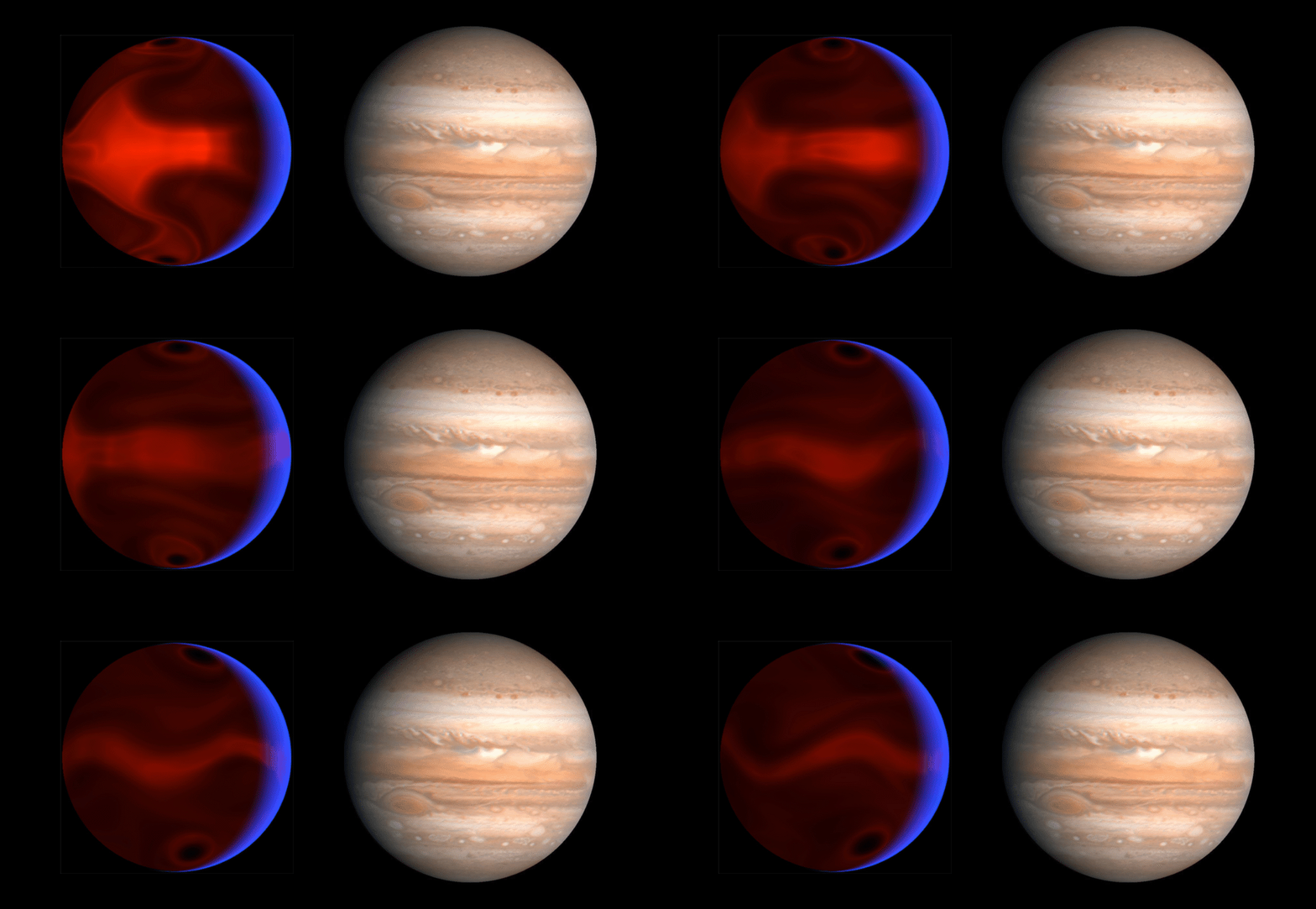
 Comparison of best-fit size of the exoplanet HD 80606 b with Jupiter. Credit: Wikimedia Commons
Jupiter’s cloud tops hover around –145°C. So what do astronomers mean when they call something a “hot Jupiter”?
In the case of HD 80606 b, they mean a gas giant that gets blasted by its star so intensely that NASA’s James Webb Space Telescope watched its temperature jump by about 600° C. The planet, four times Jupiter’s mass and 217 light-years from Earth, follows a stretched-out orbit that turns it into a rare test case for watching alien weather and chemistry change in real time.
Hot Jupiter?
Hot Jupiters are giant planets that orbit very close to their stars. Many finish an Earth-year in just days, or even hours. Their tight orbits bake their atmospheres and make them easier for telescopes to study because they block or emit more starlight than smaller planets.
HD 80606 b belongs to this special family of gas giants, but it breaks the usual mold. It does not stay close to its star. Its 111-day orbit is extremely elliptical, meaning it swings from far out to perilously near, then back again.
“Hot Jupiters are already considered some of the most extreme exoplanets we know of, but even among that population, HD 80606 b is one of the most extreme,” Tiffany Kataria of NASA’s Jet Propulsion Laboratory said in a NASA statement. “We typically think of hot Jupiters as hot gas giants sitting right next to their stars, but this planet’s highly eccentric orbit creates a completely different beast.”
How Webb Caught the Roasting
The team had to time the observation like a celestial ambush. HD 80606 b reaches its closest approach to its star only once every 111 days, and Webb can point at a given target only during certain windows in its own orbit around the Sun.
Researchers used Webb’s Mid-Infrared Instrument (MIRI) to watch the planet before, during and after periastron—the point when an orbiting body comes closest to its star. At that same moment, HD 80606 b passed behind the star from Webb’s view, creating a secondary eclipse.
That eclipse gave astronomers a clean comparison. Before the planet disappeared, Webb saw light from both the star and the planet. During the eclipse, it saw mostly the star. The difference revealed the planet’s own infrared glow, which carries information about heat.
×
Thank you! One more thing…
Please check your inbox and confirm your subscription.
To read that glow, the team used spectroscopy, a technique that spreads light into its component wavelengths. Different molecules absorb and emit light at particular wavelengths, so the spectrum can reveal both temperature and chemistry.
The clearest result so far was the heat spike. As HD 80606 b swept close to its star, Webb measured its atmosphere warming by about 611° C (1,100° F) over a short part of the orbit.
“Webb has shown that the planet’s increase in temperature was even more extreme than we anticipated based on Spitzer data,” Kataria explained.
The spectra may also show how the planet’s chemistry responds to that sudden roasting. The team is looking for signatures of gases such as methane and carbon dioxide, which can change as heat rises and falls. Those chemical results are still under analysis, but the dataset gives researchers a rare chance to track how a giant planet’s atmosphere changes across a single close pass of its star.
What Comes Next?
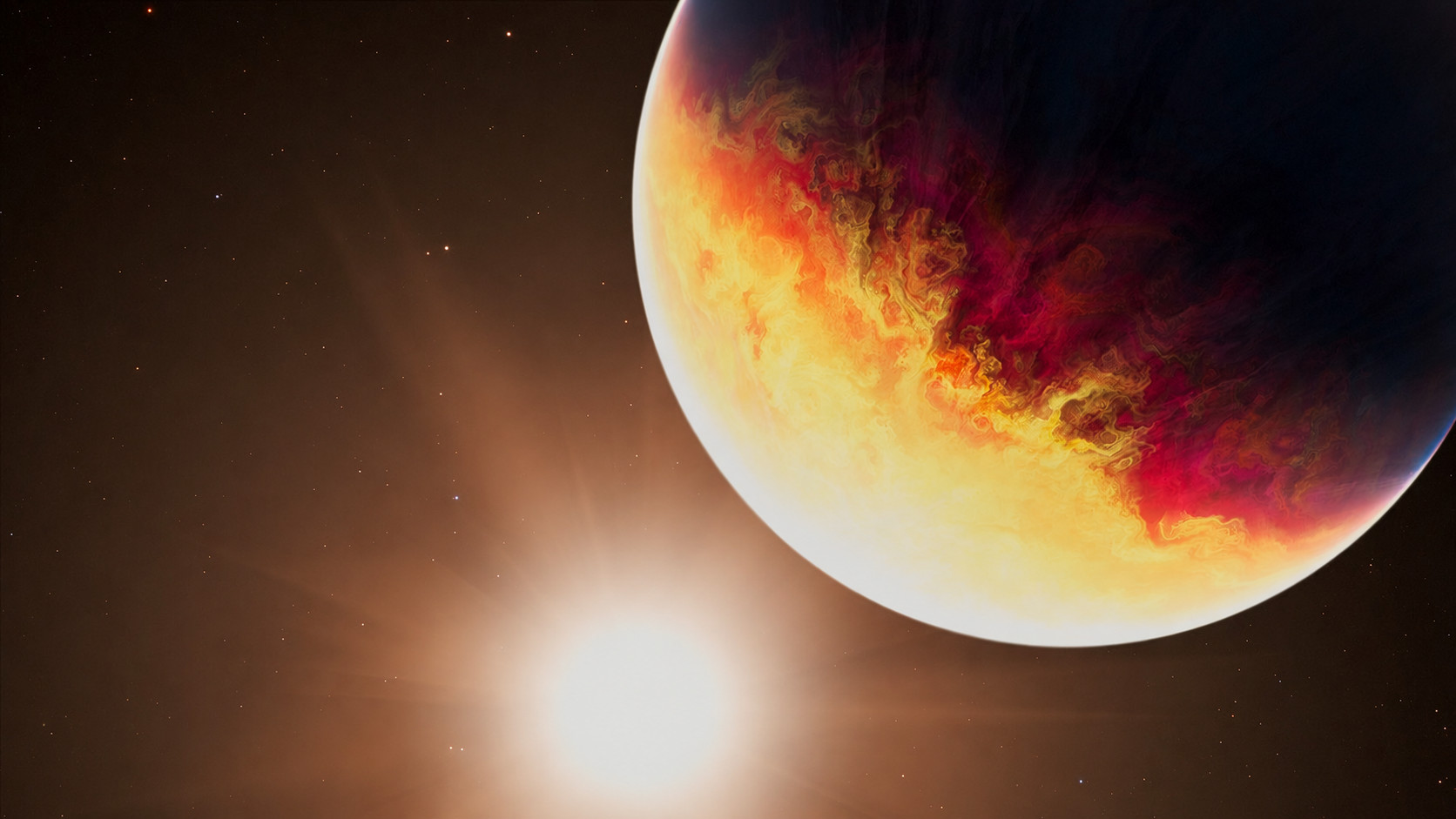
 Artist’s reconstruction of the roasted planet. Credit: NASA, ESA, CSA, Joseph Olmsted (STScI)
The findings remain preliminary, presented at the 248th meeting of the American Astronomical Society in Pasadena.
The observations do not yet give a finished weather report for HD 80606 b. But they may show how a giant planet’s atmosphere reacts when sunlight suddenly intensifies—how molecules form or break apart, and how clouds may appear, vanish, or shift.
NASA’s retired Spitzer telescope first made HD 80606 b famous as a “roasted exoplanet.” Webb is now adding the chemical detail Spitzer could not.
“Spitzer did amazing work on this exoplanet, and now Webb is building on that legacy by enabling us to drill down to distinguish specific chemical signatures like methane and carbon dioxide, which is just amazing progress,” Ryan Challener, co-author and research associate at the Cornell Center for Astrophysics and Planetary Science, said in the NASA statement. “There’s so much to learn from this one dataset here—we really are just getting started deciphering what Webb has to tell us.”