
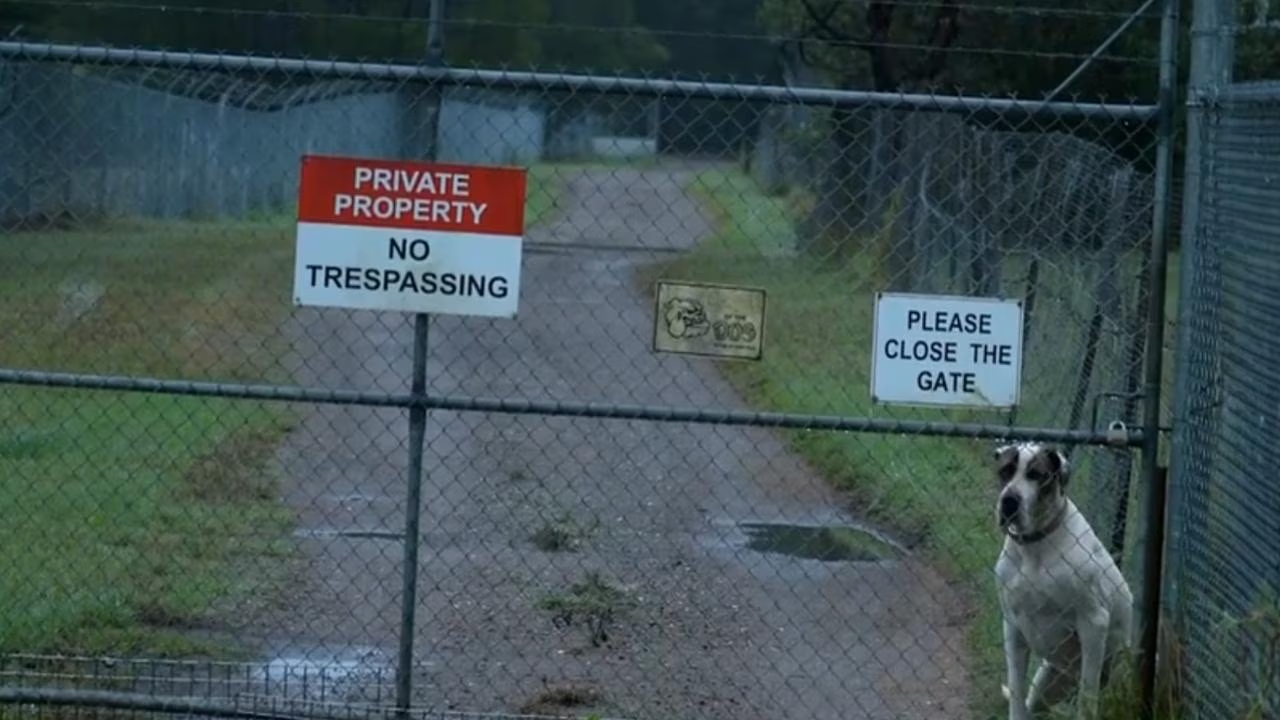
For decades, a government-funded colony of more than 160 baboons has lived, bred and died on Sydney’s outskirts, hidden in plain sight from the taxpayers who fund every single day of their captivity.
The Australian National Baboon Colony at Wallacia, in Sydney’s west, houses more than 160 baboons bred and used for medical research under the oversight of Sydney Local Health District.
The existence of the heavily secured facility is largely unknown to the public, despite decades of operation and ongoing taxpayer funding.
Now, whistleblower testimony, internal medical records obtained through parliament and renewed criticism from animal welfare advocates have reignited debate over whether Australia should continue using primates in medical experimentation.
Animal Justice Party MP Emma Hurst said documents obtained through parliamentary orders – and seen by news.com.au – detailed at least 24 baboon deaths between 2021 and 2025, including animals euthanised due to lymphoma, weight loss, breeding suitability and participation in medical studies.
“These documents give us the first ever inside look into the miserable lives of these primates being held captive for cruel experimentation purposes,” Ms Hurst said.
“We know that 24 baboons were killed, because they weren’t suitable for research or because they were sick or unsuitable for breeding.”
The records include references to lymphoma, seizures, paralysis, skin conditions, stillbirths, hypertension studies during pregnancy and animals euthanised as part of diabetes and transplant research programs.
One baboon, “Ted”, was euthanised in 2024 as part of a diabetic study, the documents revealed. Another, “Summer”, was euthanised for “management” reasons and noted as “not suitable for breeding”.
Medical notes also reference stillborn infants, progressive weight loss, animals described as “withdrawn” and “isolating”, and multiple euthanasia decisions linked to suspected lymphoma.
A former animal technician who worked at the facility for more than four years described the colony as physically and emotionally difficult to work in.
The former employee, who asked for their name to be withheld, said staff formed close bonds with the baboons while carrying out daily care, medical assistance and behavioural monitoring.

“You loved them, but it became harder and harder to justify what they were going through,” the former worker said.
The whistleblower alleged in the documents that some studies intentionally induced diseases, including diabetes and hypertension, in the animals.
“The difficult part is that they weren’t born diabetic; they were given diabetes,” the former worker said.
The former employee also described the facility as “very grey, concrete and metal”, saying the baboons were housed in concrete buildings with mesh cages and limited enrichment.
The worker also said there was a strong culture of secrecy surrounding the colony, claiming staff were discouraged from discussing the facility publicly or taking photographs inside.
“It was all very hushed and swept under the carpet,” the former employee said.
Ms Hurst said the lack of transparency surrounding the colony was concerning, given that it operates with public funding.
“There is no other industry that receives taxpayer money with zero transparency,” she said.
“Most people have no idea this baboon facility exists.”
However, Sydney Local Health District defended the colony and said the research conducted there had contributed to major medical advances.
In a statement to news.com.au, the district said the facility played “an essential role in advancing lifesaving medical research” and that animal welfare was its “highest priority”.
“The colony has contributed to critical advances, including improving understanding of pre-eclampsia and toxaemia in pregnancy — leading causes of maternal and newborn mortality,” the statement said.
“The ANBC has also supported research into novel insulin delivery for diabetes and the neurological impacts of the disease.”
NSW Health said all animal research conducted at the colony was subject to strict ethical and regulatory oversight under national guidelines governing the use of animals in scientific research.
“All research meets rigorous ethical and regulatory requirements, ensuring high standards of care and accountability,” the statement said.
The department also pointed to growing investment in alternatives to animal research, including a $4.5 million NSW Government funding package announced in 2023-24 to support the development of non-animal technologies.
That funding helped establish the Non-Animal Technologies Network (NAT-Net), a collaboration involving eight research institutions developing alternatives such as organoids and laboratory-grown tissue models.
But experts say those technologies cannot yet fully replace the use of animal models in all areas of medical research.
Genetics PhD student Emily Morice, from the University of Otago, said alternative technologies such as organoids and cell cultures were valuable for studying isolated biological systems, but could not yet replicate interactions across an entire living organism.
“This is very relevant for investigating pre-eclampsia, pregnancy complications, diabetes and transplantation biology,” Ms Morice said.
“Current available alternatives exist to model pieces of this biology but not simultaneously.”
Ms Morice said the induction of diseases in animal studies was “understandably distressing”, but noted induced disease models were widely used in medical research involving conditions including cancer, Parkinson’s disease, hypertension and diabetes.
“For animal studies, ethical justification is always required,” she said.
“Questions are always asked such as ‘can animals be replaced?’, ‘can fewer animals be used?’ and ‘how can suffering be reduced?’.”
Addressing criticism over euthanasia records, Ms Morice said many of the documented cases appeared linked to attempts to prevent unnecessary suffering.
“It appears to me that the euthanasia decisions … seem like they were made to prevent unnecessary suffering,” she said.
“The details suggest ongoing monitoring, veterinary assessments and well documented decision making.”
However, she also said greater transparency and increased funding for replacement technologies were reasonable reforms alongside stronger public reporting and oversight.
The use of primates in medical research has increasingly come under scrutiny globally, with some countries reducing reliance on non-human primate testing as alternative technologies improve.
Animal welfare advocates argue Australia is lagging behind international trends, while researchers maintain some areas of medicine still require animal models before treatments can proceed to human trials.
Ms Hurst said she believed the Wallacia facility should ultimately be phased out.
“This secret facility must be shut down, and the funding should be diverted into non-animal research,” she said.
Sydney Local Health District said maintaining the colony in Australia ensured any primate research occurred under Australian welfare laws and oversight frameworks, rather than offshore jurisdictions with potentially weaker protections.
“We recognise that animal research can raise concerns and are committed to transparency and ethical responsibility in pursuing medical advances that benefit millions of Australians,” the district said.
Read related topics:Sydney