
It’s another Friday and it’s been a very busy week from us on the advocacy front. We hope you enjoy our roundup today!
This Week in Greater Auckland
Greater Auckland’s research and advocacy is powered by hundreds of hours of volunteer labour each month, and your support helps keep us going! We warmly welcome your donations, and are always open to offers of guest posts, practical help, and pro-bono expertise.
PS Another great way to back the kaupapa: Greater Auckland tees, totes, and (new!) caps! Remember, these are print-on-demand (no returns possible), so be sure to double-check sizing before ordering.
New to our merch shopfront this week – not a fare cap, just a regular cap, but totally a public transport cap! Check ’em out along with the rest of the range here.
Greater Auckland in the media
We have been everywhere this week talking about our call for the government to work together with opposition parties to rescope and review Warkworth to Te Hana, which would be New Zealand’s most expensive road.
Connor did an interview yesterday morning on the Ryan Bridge Today show, with Nadine Higgins.
Business Desk has an excellent bit of insight from Thomas Manch on the numbers for the Warkworth to Te Hana Crown Loan, which also quotes Connor:
Plea for transparencyConnor Sharp, campaign director for transport advocacy group Greater Auckland, said the loan was “an extraordinary amount of money to allocate without being transparent about it”, and that it would lock in future governments.
“I just don’t think people understand how much this actually costs through a PPP, right?” he said.
“My understanding is that, based on other PPPs, the overall public cost is about three times [higher than] if you do it through traditional procurement.”
By this logic, Sharp said the Government could be signing the public up for $12b in payments for a road that could be $3.5b to $4b.
“This has been in planning for 17 years, and it’s come at the expense of all the other smaller things that we could have done.”
He said the Government should instead reduce the scope of W2TH and spend the same money across the entire Northland Corridor project.
And Connor also joined Bernard Hickey and Peter Bale on the Weekly Hoon, from The Kaka:
Millions vs billions
Between the unaffordable Roads of National Signficance programme (55 billions, nominally), and the debate about the potential cost of Labour’s public transport fare-cap policy (65-110 millions, nominally), it’s clear there’s a crucial communications gap when it comes to talking with the public about numbers with lots of zeroes in them.
As someone observed on social media:
What’s the difference between $65m & $55b?
About $55b.
$65m is ~0.12% of $55b. Almost nothing when compared against each other.
They also pointed to this video, that literally paces out the difference between millions and billions, fun viewing if you have an hour up your sleeve.
Another way to make the scale of things clear is to just present every major infrastructure cost in terms of millions.
If (like me) you find millions vs billions hard, try scaling down the numbers.Say Labour’s PT fare cap costs $65. Or even a hundred bucks.Then one (1) expressway = $6000And the full set? $55,000💰By all means count the pennies – but keep your eye on that fat suitcase of cash labelled “RONS”👀
— Jolisa Gracewood (@nzdodo.bsky.social) 2026-06-17T00:24:04.212Z
For example:
65 to 110 million dollars per year is the estimated range of Labour’s public transport fare-cap policy.
4,000 million dollars was the 2019 estimate of the sticker price for Warkworth to Te Hana, based on which…
12,000 million dollars is what WW2TH may cost us overall, if delivered by a Public-Private Partnership, and…
55,000 million dollars is the current sticker price for ALL the Roads of National Significance, so…
165,000 million dollars is what it would cost New Zealand, minimum, to deliver all the RoNS via PPPs – going by today’s prices, but not factoring in things like increases in the costs of labour and materials, the cost of maintenance on existing and future roads, and the cost of repairs to the transport network due to climate-charged weather events.
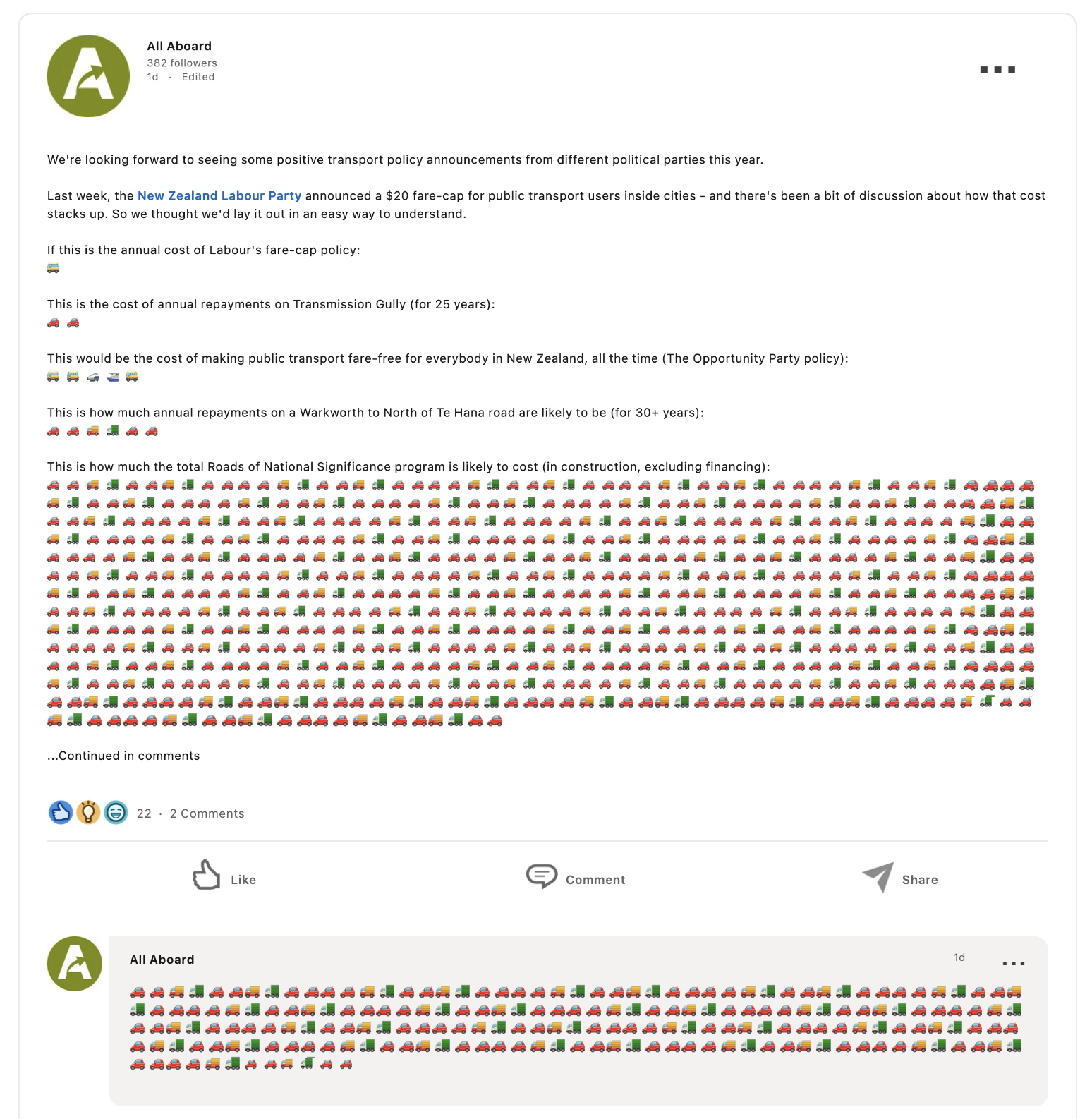
We also liked this visual take that All Aboard Aotearoa posted over on LinkedIn. You may need to squint to read the text, so here’s the gist:
We’re looking forward to seeing some positive transport policy announcements from different political parties this year.
Last week, the New Zealand Labour Party announced a $20 fare-cap for public transport users inside cities – and there’s been a bit of discussion about how that cost stacks up.
So we thought we’d lay it out in an easy way to understand.
If this is the annual cost of Labour’s fare-cap policy: 🚌
This is the cost of annual repayments on Transmission Gully (for 25 years): 🚗 🚗This would be the cost of making public transport fare-free for everybody in New Zealand, all the time (The Opportunity Party policy): 🚌 🚌 🚅 ⛴️ 🚌This is how much annual repayments on a Warkworth to North of Te Hana road are likely to be (for 30+ years): 🚗 🚗 🚚 🚛 🚗 🚗This is how much the total Roads of National Significance program is likely to cost (in construction, excluding financing):
Out of consideration for blind or low-vision readers using screen-readers, we haven”t copy-pasted the approximately 900 vehicle emojis that follow (and which are “continued in comments”!), but you can see them below…
And then there’s always the “per capita” calculus.
A similar idea is to divide by 5 million instead of by 1 million. Then you have roughly the average cost per person in NZ.$13 per person for Labour’s public transport fare cap.Versus $1,200 per person for one expressway, or $11,000 per person for all their RONS.
— (@tuffrings.bsky.social) 2026-06-17T03:04:05.764Z
Simeon Brown’s blanket speed limit reversals likely costing lives
A brilliant article by Hayden Donnell from the Spinoff, about a new bit of research from Timothy Welch on how many lives Auckland’s Safe Speed programme likely saved.
Doing that work spurred Welch on to a much wider effort. He has now carried out a similar assessment on the entirety of Auckland.
After accounting for traffic flows, weather and contributing factors such as driver impairment, he has concluded that the lower speed limits put in place by Auckland Council between 2022 and 2025 likely averted 138 crashes. Though the numbers come with a statistical range, Welch’s best estimate is the changes were responsible for preventing 29 serious injuries and four deaths.
“There’s a lot of cases where you really have to talk carefully about the data, because it’s so confusing. In this case, it’s very clear: more people died, and more people were seriously injured because we had higher speeds,” he says. [emphasis added]
Of course, in 2024, then-Minister of Transport Simeon Brown’s blanket speed limit reversals increased speeds across Auckland (and elsewhere) to dangerous levels.
As Professor Welch explains though:
The picture gets more complicated when you look at the period after speed limits were raised. Though there’s some evidence crash frequency is trending up following the reversals, particularly on roads like Te Irirangi Drive, the dataset is still relatively small and Welch doesn’t feel comfortable drawing firm conclusions yet.
“I think these numbers are very conservative,” he says. “They would be the lowest attributable change that we’d find, and the numbers that we’ll likely see publicly available from our agencies will probably be higher in the near future.”
What a legacy Simeon Brown is leaving. across the motu.
A subscription model for Public Transport?
Also on Labour’s fare cap policy, we quite liked this take from Brendon Harre. Comment of the week? (Also, subscription, or …membership?)
I think it would be helpful to examine this policy from the angle that it is a change in pricing strategy.
It is a move from usage to subscription based pricing.
The private sector has subscription based pricing for a lot sectors. Gym membership, some internet and telecommunication services, video or music streaming products, etc.
Why is subscription based pricing used is some circumstances? I think it is because these services seem to have high fixed costs and low operating costs and the subscription model gives a steady predictable stream of revenue to repay the fixed costs.
In some ways this does describe public transport networks.
From a customer perspective subscription charges incentives them to use up spare capacity in the service because its reduces their marginal cost for further useage to zero.
This does raise the question of what to do if the gym, telecom network, bus or train becomes overcrowded. If it can the service provider should use the revenue from more customers paying the regular full subscription price to expand the capacity of the service so these congestion issues are a infrequent or minor inconvenience. Public transport with enough upfront investment because of its spatial nature has a high capacity to avoid congestion issues. So this doesn’t seem to be an unreasonable assumption.
In conclusion, this Labour party policy could be seen as entrepreneurial use of spare capacity to address cost of living issues rather than the more typical cross subsidy situation that many are viewing it as.
Good energy abounding!
Looks like despite no government support, solar power is becoming so attractive to businesses that they’re going all in. RNZ reports on how the country’s largest industrial landlord is investing in solar on its rooftops:
New Zealand’s largest industrial landlord, Calder Stewart, plans to spend $110 million turning the rooftops of its buildings into solar power stations, in a move aimed at lowering electricity costs for tenants and creating a new energy revenue stream.
The company intends to install up to 170,000 solar panels across its national portfolio over the next decade.
At full rollout, the system is expected to generate enough electricity each year to power between 15,000 and 20,000 homes.
Meanwhile, Fonterra has signed a large deal to purchase 80% of the generation from a Solar Farm project in Canterbury.
Private equity-backed ANZA Power has signed a “virtual” power purchase agreement with Fonterra for the dairy giant to take 80% of the generation output from its Somerton Solar Farm project, near Rakaia in Canterbury.
ANZA, an Australian and New Zealand energy developer and operator that is part of global infrastructure investor I Squared Capital, said the deal with Fonterra was a significant milestone.
It’s time we get some subsidies for distributed solar and battery going for the rest of us!
Podcast breaking down what went wrong with HS2 in the UK
This is a good listen, with some relevant lessons for New Zealand about mega-infrastructure projects.
Ultra-Low-Emission Zones reduce hospital admissions in London
London’s scheme to drastically improve air quality through restricting polluting vehicles, is seeing dividends via a healthier population, suggests a new study.
Low emission and clean air zones attract controversy whenever they are proposed, but there is growing evidence that they work in improving air quality. The Bradford zone was followed by a reduction of about 25% in GP visits for heart and breathing problems and survey data shows that the central London zone was followed by a reduction in the likelihood of a person taking sick leave.
Now analysis of health records has found emergency admissions to hospital reduced after the introduction of the T-charge and ultra-low emissions zone (Ulez) in central London.
Both schemes were designed to reduce air pollution inhaled by Londoners. Starting in 2017, the T-charge was an additional congestion charge for older, more polluting vehicles. During T-charge, many of the vehicles that drove in central London were upgraded in preparation for the introduction of the more comprehensive central London Ulez in 2019.
With benefits like this, surely Auckland will be progressing its zero-emission zones in the City Centre soon, right?
News from Auckland Transport
We’ve spotted some great social media comms from AT on the level crossing programme, highlighting the various options and the trade-offs involved in delivering them.
And also, nice to see good records being broken – but of those 483km of refreshed roads, how many included quick and easy improvements for active modes? AT has promised to do this, and it fits right in with the expectations from Council to deliver more efficiently – such a massive opportunity to dig once, and do it right!
Auckland Transport (AT) is in the final stages of delivering its largest ever annual road maintenance programme with over 480 kilometres (km) of Auckland’s roads having been repaired and resurfaced this financial year, helping Aucklanders and freight get to where they want to go safely and efficiently.
To date AT has completed 483km of resurfacing (comprising 104km of asphalt, 370km of chip seal and 9km of pavement rehabilitation) which is equivalent to driving from Auckland to Bulls (6 hours driving time).
GM Road Asset Maintenance & Renewals, Alan Wallace, says this is the biggest road renovation programme AT has ever delivered.
“Last year we achieved about 440km and this new record has been made possible due to the increased funding that Auckland Council and NZTA have provided for road maintenance in Auckland.
Speaking of active modes: AT has now started on revamping Carrington Road, with bus upgrades, new traffic lights, continuous dedicated cycleways, and several new crossings. This is a government-funded project to bring the road up to scratch for the people who will be living in new housing on what was the Unitec site, and work will run till the end of 2027.
Also, the city’s busiest commuter bike route runs right across the work site – the Northwestern path, essentially our “cycle superhighway”. Bike Auckland’s Carol Green has put together a handy guide on how to navigate Carrington Road on a bike during the road works, with some suggested optional detours.
Looks like now would be an excellent time for whoever is in charge to open up the (already built) bike paths through the former Unitec site, to enable much safer journeys through here.
Detour options to the west of Carrington Road. Image via Bike Auckland. (The paths in red are essentially complete, but haven’t yet been opened to the public for access.)
Optional detours to the east of Carrington Road. Image via BIke Auckland.
That’s it from us this week, a very big week at our end – hope yours was good, and hope you have a good weekend! And as always, feel free to add stories in the comments that caught your eye, we know there’s lots going on all over the place.
Share this