
“[I’d be] checking my emails … constantly, even though there’s nothing that I’m expecting.”
Even with things he considered “more productive”, he fell into the same addiction pattern.
“I could read the Guardian website or the BBC website for half an hour, and then if I ask myself 15 minutes later, what the key takeaways of any of those stories were, I wouldn’t be able to.”
He was replicating the same activity, scrolling and consuming content without engaging with it, he said.
“It was just as unproductive as me spending half an hour on Facebook.”
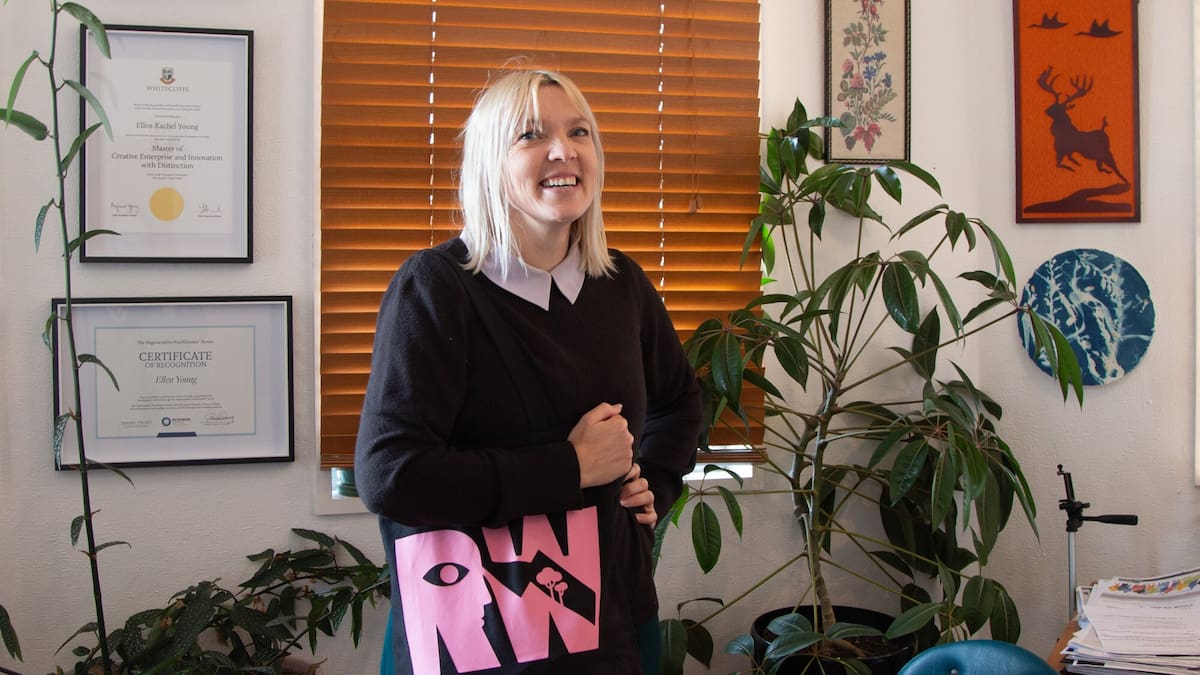
Redford turned to Real Worlders, a start-up founded by Whanganui’s Ellen Young that is developing “real-world” solutions to digital distraction.
It’s not anti-tech.
It promotes intentional use of technology where people pick their own boundaries and Real Worlders helps them stick to it.
“I got frustrated with the problem being talked about all the time and no one ever giving anyone a holistic solution,” Young said.
New Zealand behavioural neuroscientist and speaker Kathryn Berkett said digital distraction was “definitley changing the brain”.
Young began Real Worlders last year after noticing the toll digital distraction was taking on herself and her family.
“I noticed [I was] zoning out from my kids and that being normalised for them,” she said.
The long-term impact it would have on society concerned her and she became determined to find a “realistic” solution.
New Zealand behavioural neuroscientist and speaker Kathryn Berkett said two major things happen during screen use.
“One is that most activity on a screen activates us into the stress response,” she said.
“So when we talk about being slightly frustrated or slightly nervous or slightly anxious, we’ve got a bit of a tension in our body.”
Berkett said this activated a fight-or-flight response.
“When we stay in that state for a long period of time, it can be … detrimental to our mental health and our physical health.”
The second thing is spikes in the body’s dopamine levels.
Dopamine is the reward chemical in the brain responsible for feelings of pleasure, motivation, mood, attention, memory and important body functions like immune system regulation and sleep.
“Most device use is made to bring on unpredictable, instant dopamine hits,” she said.
“Our brain becomes used to having instant, powerful dopamine hits.”
Activities that create “more subtle dopamine”, like going for a walk or spending time with friends, then become “dull”.
“It’s definitely changing the brain,” Berkett said.
“We have to talk about it. We have to be honest about it.”
Global studies have increasingly linked the effects of screen addiction to the stark increases in mental health problems globally in the past decade, especially among younger generations.
Adolescents who spent more than four hours daily on screens were almost three times as likely to have depression symptoms, and more than twice as likely to show anxiety symptoms than those who spent fewer than four hours on screens, over a two-week period, according to a study published by the United States’ Centres for Disease Control and Prevention.
New Zealanders reporting high or very high psychological distress – including anxiety, depression, or emotional fatigue – rose by 316.7% for males and 313.2% for females between 2011 and 2025, according to the Ministry of Health New Zealand.
Ages 15 to 24 had the highest rate, more than double that of the groups aged 34 and older.
Young wanted to develop a solution that didn’t rely on self-control.
She said social media bans or blocking apps, easily overridden, weren’t enough on their own and non-smart phones weren’t realistic, lacking the necessary tools for modern life.
“Every solution is trying to get you to just use your pure self-control to just stop the behaviour.
“We need to offer holistic solutions that actually help people escape.”
Young has a background in philosophy and entrepreneurship and has overseen community projects for Whanganui District Council.
Community became her solution.
Real Worlders aims to give people space to share their experiences, rebuild human connection and hold accountability without giving up the benefits of technology.
Her first cohort of 14 people met in person weekly for seven weeks, learning her three-step approach – education, blocking tools and “life design”.
People learned about the problem and studied how they used their phones during a typical day.
They talked about what they would prefer to do in the physical world with the time they spent online, and installed blocking tools to limit certain app use based on their own goals.
Redford, who was part of that cohort, has now lowered his phone use from eight hours a day to three and a half.
Whanganui’s Carla Standen took part in the first cohort of Real Worlders in 2025 to help her focus more on family time. Photo / Erin Smith
Carla Standen was also in the first cohort and joined the programme so she could learn techniques to pass on to her children.
She didn’t consider herself someone addicted to her phone and was already conscious of digital distraction, she said.
“It was quite eye-opening.”
Standen was surprised by how much she unconsciously used her phone for distractive activities.
“I have my children for a short amount of time at home and I want to know that I’ve made the most of our relationship,” she said.
Young said she planned to continue developing Real Worlders. She offers courses for businesses and hopes to create one for schools.
Young is offering a workshop on Sunday, June 28, from 9.30am to 2pm at Article, 20 Drews Ave.
People can also join the community on the Real Worlders website.
“Building the world is a collective act and it requires everyone. And right now we’ve got so many people not present in that,” Young said.
Erin Smith is a multimedia journalist based in Whanganui.